


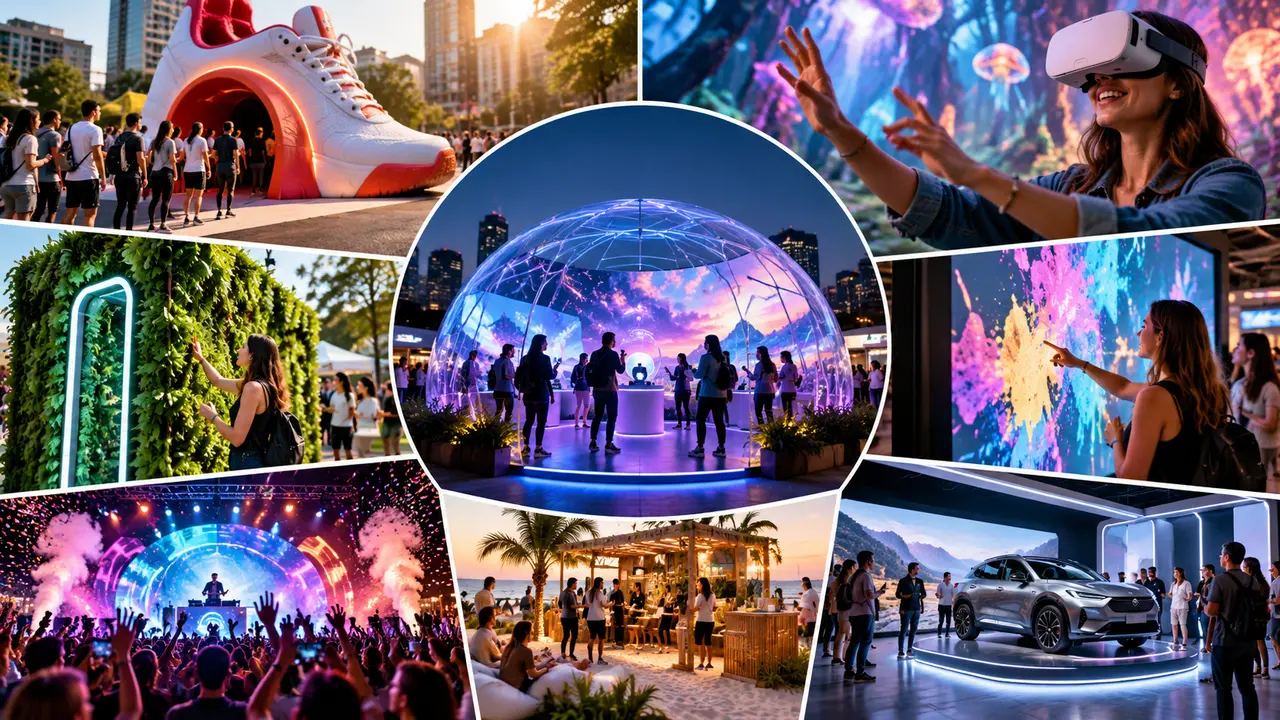
Experiential marketing is a marketing strategy that invites people to actively participate in a brand experience instead of passively receiving an advertisement. The experience might involve testing a product, entering an interactive installation, visiting a pop-up store, playing a branded game, attending an event, or participating in a digital or virtual experience.
The defining idea is participation. Instead of only telling customers what a brand represents, experiential marketing gives them an opportunity to experience some part of that promise themselves.
That makes experiential marketing broader than simply hosting events. A successful campaign connects an experience to a specific marketing objective, such as product trial, brand awareness, lead generation, customer engagement, social sharing, or sales.
How Does Experiential Marketing Work?
Experiential marketing changes the customer’s role from audience member to participant.
Consider a company launching a new running shoe. A conventional advertising campaign might show the shoe in videos, social ads, or billboards. An experiential campaign could build a temporary running course where visitors try the shoes, receive performance information, compete in challenges, and share their results online.
Both approaches promote the same product, but the second gives customers direct interaction with it.
| Traditional Advertising | Experiential Marketing |
|---|---|
| Audience receives a message | Audience participates |
| Often explains product benefits | Can demonstrate benefits directly |
| Usually relies on media exposure | Relies on interaction and experience |
| Brand controls most of the communication | Customers influence how they participate |
| Success may focus on impressions, clicks, or conversions | Success can include participation, trials, leads, engagement, sharing, and conversions |
An experience does not necessarily need to happen in person. Experiential campaigns can incorporate virtual events, augmented reality, interactive websites, and other digital components. What matters is whether the audience meaningfully participates rather than simply watches an advertisement.
What Are the Main Types of Experiential Marketing?
Experiential marketing can take many forms because the experience should fit the audience, product, objective, and environment. Common formats include pop-ups, product demonstrations, interactive installations, live events, immersive environments, and digital experiences.
Pop-Up Experiences
A pop-up is a temporary physical space where customers can interact with a brand. It might resemble a store, exhibition, themed environment, café, demonstration area, or entertainment venue.
Pop-ups work particularly well when the physical environment can communicate something that would be difficult to demonstrate through conventional media.
Product Sampling and Demonstrations
Sampling is one of the simplest forms of experiential marketing. A food company might let shoppers taste a new product, while a technology company could allow conference visitors to test a new device.
The experience becomes more useful when it does more than distribute free products. Staff demonstrations, customization, challenges, education, or immediate feedback can turn an ordinary sample into a memorable product interaction.
Interactive Installations
Interactive installations require visitors to perform an action that changes or completes the experience. Examples could include touchscreens, motion-sensitive displays, projection environments, interactive art, games, or personalized content.
The interaction should have a reason to exist. Adding technology without connecting it to the brand or campaign objective can create an impressive installation that produces little marketing value.
Events and Live Experiences
Brands can create their own events or build interactive experiences within existing festivals, conferences, sporting events, exhibitions, and trade shows.
However, an event is not automatically experiential marketing. An audience sitting through a conventional presentation remains largely passive. Giving attendees meaningful opportunities to interact, create, test, compete, customize, or contribute makes the experience more participatory.
Immersive Brand Experiences
Immersive campaigns place participants inside an environment designed around a product, story, entertainment property, or brand identity.
These campaigns can also extend beyond the physical environment. Participants might create photographs, videos, personalized content, or other material that continues circulating through social media and digital channels after the experience ends.
Digital, AR, and VR Experiences
Experiential marketing does not have to be entirely physical. Augmented reality, virtual reality, interactive digital tools, virtual events, and personalized online experiences can also create participation.
A furniture retailer, for example, could let customers use augmented reality to visualize products inside their homes. The interaction simultaneously creates an experience and helps solve a purchasing problem.
Experiential Marketing vs. Event Marketing vs. Brand Activation
These terms frequently overlap, but they are not always interchangeable.
Event marketing uses events to promote a company, product, or message. An event might contain experiential elements, but participation is not necessarily its defining feature.
Brand activation generally refers to campaigns designed to prompt direct consumer interaction with a brand. Activations can include experiential campaigns, sampling, digital interactions, promotions, and other approaches.
Experiential marketing specifically emphasizes creating an experience in which consumers participate.
The easiest test is to ask: What does the customer actually get to do?
If the answer is primarily “watch,” “read,” or “listen,” the campaign may be advertising or event marketing without being strongly experiential. If customers can try, explore, create, play, personalize, compete, contribute, or otherwise interact, the campaign has a clearer experiential component.
Why Do Brands Use Experiential Marketing?
One of experiential marketing’s biggest advantages is its ability to make an abstract marketing claim tangible.
Suppose a luggage company says its suitcase is exceptionally durable. Advertising can communicate that claim, but an interactive demonstration where customers test the suitcase against realistic handling conditions allows them to evaluate the feature themselves.
Experiences can also produce several outcomes simultaneously. A single activation may generate product trials, email sign-ups, social content, conversations between customers, media attention, customer feedback, and direct sales.
Participation can also make the customer part of the content. A personalized photograph, competition result, customized product, or video gives participants something they may voluntarily share afterward. In that situation, the experience extends beyond the people physically present.
Still, memorable does not automatically mean effective. A spectacular installation that attracts thousands of visitors but fails to communicate the product or influence a meaningful business objective may be successful entertainment but weak marketing.
What Does a Good Experiential Marketing Campaign Look Like?
Strong experiential marketing starts with an objective rather than a stunt.
The first question should not be, “What exciting event can we create?” It should be, “What should customers think, feel, learn, try, or do differently after participating?”
From there, marketers can build the experience around five practical components:
- A defined audience: Identify exactly who the experience needs to reach.
- A specific objective: Decide whether the campaign should drive awareness, trials, leads, purchases, education, loyalty, or another measurable outcome.
- A relevant interaction: Give participants something meaningful to do that connects naturally with the brand.
- A continuation mechanism: Determine what happens after participation, such as a follow-up email, offer, shareable asset, product purchase, or membership sign-up.
- Measurement: Establish success metrics before launching the activation.
This prevents the common mistake of creating an impressive experience first and trying to justify its marketing value afterward.
How Do You Measure Experiential Marketing?
Experiential marketing should be measured according to the campaign’s objective rather than relying on attendance alone.
For an awareness campaign, marketers might track attendance, reach, social mentions, branded searches, content views, or media coverage. A product-launch campaign could measure samples distributed, demonstrations completed, trial-to-purchase conversions, or sales. A B2B activation may prioritize qualified leads, meetings booked, demonstrations, and pipeline generated.
Digital tools can add another measurement layer. QR codes, registrations, unique promotional codes, surveys, CRM records, landing pages, and tracked follow-up communications can connect participation with later customer actions.
For example, imagine a skincare brand attracts 4,000 people to an activation and collects 1,000 consented registrations. If 200 of those registered participants subsequently make a tracked purchase, the company has a 25% registration rate among participants and a 20% tracked conversion rate among registered participants.
Those figures alone would not prove that the experience caused every purchase. They would, however, give marketers a much stronger basis for evaluating the campaign than attendance alone.
A Practical Experiential Marketing Example
Imagine a coffee company launching a new cold-brew range.
Instead of simply distributing cans at a shopping center, the company creates a temporary “cold brew lab.” Visitors choose flavor characteristics, learn how different ingredients affect the drink, taste several combinations, and receive a personalized recommendation.
Participants can then scan a QR code to save their preferred drink, claim a product offer, or find a nearby retailer. With appropriate consent, the company can also collect feedback about flavors and purchasing preferences.
This campaign performs several jobs simultaneously. Consumers taste the product, learn what makes it different, participate in personalization, and receive a reason to continue interacting with the brand.
The experience therefore supports the product rather than distracting from it.
Common Experiential Marketing Mistakes
A frequent mistake is prioritizing spectacle over relevance. A giant installation may attract photographs, but attention has limited value when participants cannot understand why the experience belongs to that particular brand.
Another problem is excessive friction. Long registration forms, confusing instructions, queues, complicated technology, or forced social posting can undermine an otherwise appealing activation.
Measurement can also become an afterthought. Teams sometimes count attendees and photographs because those numbers are readily available, even when the campaign was supposed to generate trials or sales.
Marketers should also account for accessibility, privacy, staffing, safety, venue restrictions, weather, technology failures, and crowd management when appropriate. Experiential campaigns exist in real environments, so execution can affect the brand experience just as much as the creative concept.
When Is Experiential Marketing a Good Choice?
Experiential marketing is particularly useful when experiencing something firsthand makes the brand proposition easier to understand.
Products involving taste, touch, performance, entertainment, personalization, technology, travel, hospitality, fitness, beauty, automobiles, and consumer electronics can naturally lend themselves to demonstrations and immersive experiences.
B2B organizations can also use experiential approaches at conferences and trade shows by replacing passive booths with demonstrations, simulations, workshops, or personalized assessments.
Experiential marketing may be less suitable when the experience has no meaningful connection with the offering or when the cost of reaching each participant is difficult to justify against the campaign objective.
It also does not have to replace digital advertising, content, email, or social media. Those channels can expand an experience’s impact before and after the physical interaction. The activation becomes the central experience, while other channels recruit participants, document the event, distribute content, and continue the customer relationship.
FAQs About Experiential Marketing
Is experiential marketing the same as event marketing?
No. Events can be used for experiential marketing, but hosting an event does not automatically make it experiential. Experiential marketing emphasizes active audience participation, while event marketing can also include presentations, sponsorships, exhibitions, and other less interactive formats.
What is a simple example of experiential marketing?
A supermarket tasting station can be a simple example when customers interact directly with a product. Adding demonstrations, comparisons, feedback, games, or personalization can turn basic sampling into a richer experience.
Can experiential marketing happen online?
Yes. Virtual events, augmented reality, virtual reality, interactive websites, digital games, and personalized online tools can all incorporate experiential marketing principles when users actively participate.
Is experiential marketing expensive?
Not necessarily. Large immersive installations can require substantial production budgets, but sampling programs, workshops, demonstrations, community activities, and small pop-ups can operate at much smaller scales. The appropriate budget depends on the audience, objective, location, production requirements, and expected return.
What makes experiential marketing successful?
Successful campaigns connect a meaningful participant action with a clear brand and business objective. The experience should be easy to understand, relevant to the audience, operationally sound, and measurable.
What should marketers measure after an experiential campaign?
The right metrics depend on the objective. Useful measures can include participation, product trials, registrations, qualified leads, purchases, promotional-code redemptions, social engagement, customer feedback, and post-event conversions.
Conclusion
Experiential marketing turns marketing from something people receive into something they participate in. Instead of relying exclusively on messages about what a product or brand offers, it creates opportunities for customers to try, explore, play, learn, personalize, or interact directly.
The strongest experiential campaigns are not necessarily the biggest or most elaborate. They connect the experience to the product, give the audience a meaningful role, define the desired outcome in advance, and measure what happens afterward. When those elements align, an experience can support awareness, product understanding, customer engagement, lead generation, and sales while giving participants something conventional advertising often cannot provide: a direct memory of interacting with the brand.
For more helpful guides please visit RoyalSprinter.
