


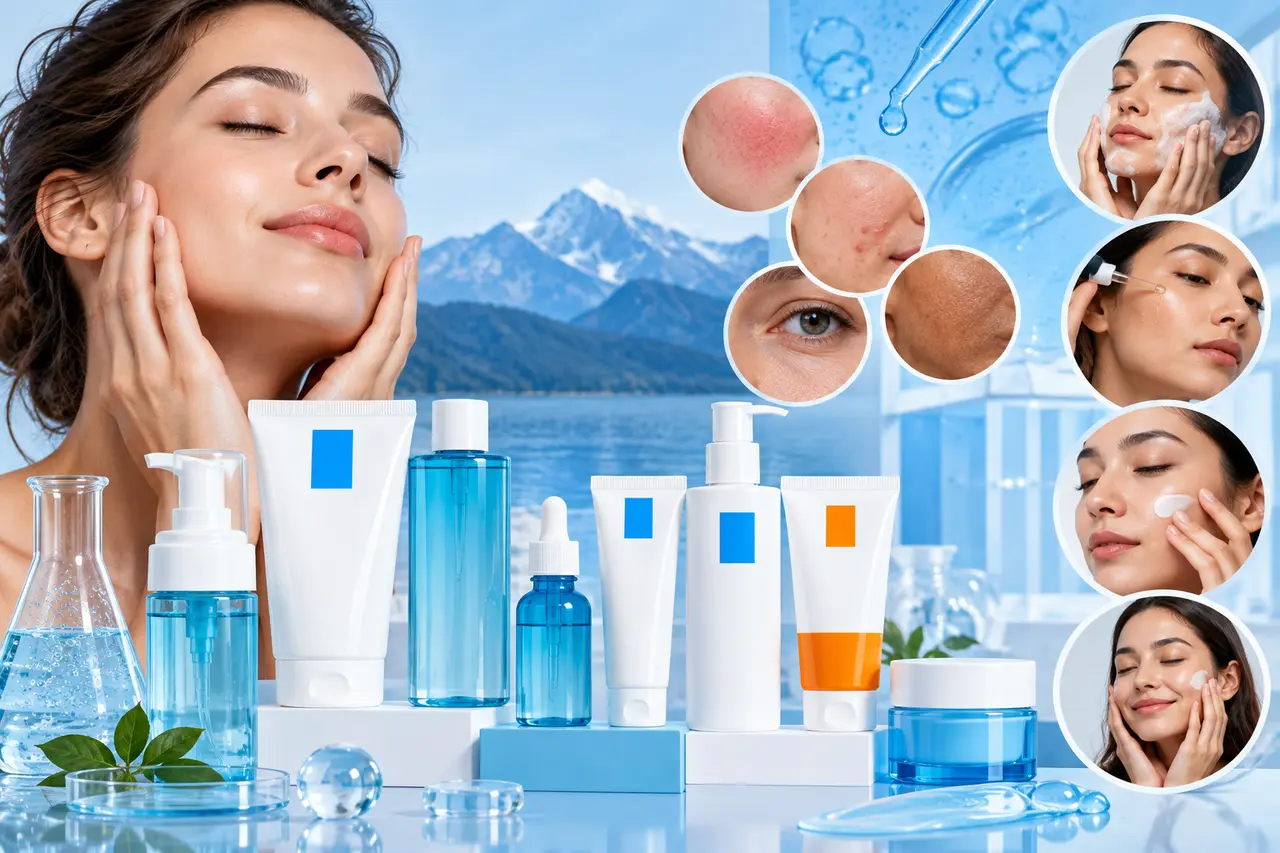
La Roche-Posay is a French skincare brand best known for products developed around sensitive skin, acne, dryness, sun protection, uneven skin tone, and skin-barrier care. Its catalog includes cleansers, moisturizers, sunscreens, acne treatments, serums, body products, and targeted formulas under ranges such as Toleriane, Anthelios, Effaclar, Cicaplast, Lipikar, Hyalu B5, and Mela B3.
The useful way to shop La Roche-Posay is not to ask which product is “best” overall. Instead, identify your skin type and main concern, then choose the appropriate cleanser, treatment, moisturizer, and sunscreen without unnecessarily combining multiple active ingredients.
What Is La Roche-Posay?
La Roche-Posay is a dermatological skincare brand originating in France. Roche-Posay Laboratories Pharmaceutiques was founded in 1975, according to the brand’s published history. Its skincare identity is closely associated with thermal spring water sourced from La Roche-Posay, France.
The brand sells products for several common skincare needs rather than focusing on a single category. Its current U.S. portfolio includes products for sensitive skin, acne-prone skin, dry and eczema-prone skin, dark spots, signs of aging, and sun protection.
One reason La Roche-Posay can feel confusing to first-time buyers is that the brand name appears on dozens of very different products. An Effaclar acne treatment, for example, should not be treated as interchangeable with a Toleriane moisturizer or Cicaplast barrier cream simply because all three come from La Roche-Posay.
La Roche-Posay Product Ranges Explained
The easiest way to understand the brand is to start with its major product families.
| La Roche-Posay range | Main focus | Often suited to |
|---|---|---|
| Toleriane | Gentle cleansing and moisturizing | Sensitive, normal, dry, combination, or oily skin depending on formula |
| Effaclar | Acne and excess oil | Oily and acne-prone skin |
| Anthelios | Sunscreen | Daily face and body sun protection |
| Cicaplast | Barrier protection and dry-skin care | Dry, rough, irritated, or compromised-feeling skin |
| Lipikar | Face and body moisturization | Very dry and eczema-prone skin |
| Hyalu B5 | Hydration and signs of aging | Dehydration, fine lines, loss of plumpness |
| Mela B3 | Uneven tone and dark spots | Hyperpigmentation and visible discoloration |
These categories describe the ranges broadly. Individual formulas within the same range can have different ingredients, textures, and intended skin types, so the exact product label matters.
Toleriane: A Starting Point for Sensitive-Skin Routines
Toleriane is one of La Roche-Posay’s core ranges for gentle cleansing and moisturizing. It can be particularly useful when someone wants to build a simple routine before adding targeted treatments.
For normal-to-dry skin, the brand currently lists Toleriane Hydrating Gentle Facial Cleanser as a cleanser designed for normal to dry skin. For normal-to-oily skin, Toleriane Purifying Foaming Face Wash provides a different cleansing option.
Toleriane Double Repair Face Moisturizer is another prominent product in the range. The official product information describes a formula containing ceramide-3, niacinamide, glycerin, and the brand’s thermal water.
This distinction matters because “sensitive skin” does not automatically mean “dry skin.” Someone with sensitive but oily skin may prefer a different cleanser or moisturizer texture from someone whose skin is sensitive, dry, and tight.
A simple Toleriane-based routine
A basic routine might look like this:
- Gentle cleanser appropriate for your skin type
- Moisturizer
- Broad-spectrum sunscreen in the morning
A treatment serum can then be added if you have a specific concern such as acne, discoloration, or fine lines.
Starting with fewer products also makes it easier to identify the cause if a new formula causes burning, itching, dryness, or breakouts.
Effaclar: La Roche-Posay Products for Acne and Oily Skin
Effaclar is the range most closely associated with acne-prone and oily skin. La Roche-Posay’s current acne category includes formulas using ingredients such as salicylic acid and benzoyl peroxide, alongside cleansers, moisturizers, and other acne-focused products.
That does not mean every person with acne should use every Effaclar product simultaneously.
Acne routines can become unnecessarily irritating when people combine an exfoliating cleanser, leave-on salicylic acid, benzoyl peroxide, retinoid, and other strong treatments at the same time. Irritation can make a routine harder to tolerate even when individual ingredients are appropriate.
A more practical approach is to identify the active treatment first, then keep the rest of the routine relatively simple.
Example acne routine
Morning
- Gentle cleanser
- Lightweight moisturizer
- Broad-spectrum sunscreen
Evening
- Cleanser
- One appropriate acne treatment
- Moisturizer
Depending on the severity and type of acne, an over-the-counter routine may not be enough. Persistent, painful, cystic, or scarring acne warrants evaluation by a dermatologist rather than repeatedly adding stronger cosmetic products.
Cicaplast: What Is It Actually For?
Cicaplast is La Roche-Posay’s barrier-focused range. Its best-known product is Cicaplast Balm B5+, a multi-purpose cream positioned for dry and irritated skin. The U.S. formula includes ingredients such as panthenol, madecassoside, dimethicone, glycerin, and shea butter.
Cicaplast is often most useful as a supportive product rather than the centerpiece of every skincare routine.
Someone might reach for a barrier-focused balm when skin feels unusually dry, rough, chapped, or irritated after environmental exposure or an overly aggressive skincare routine. However, a richer balm may feel too occlusive for some people, particularly if they prefer lightweight textures.
Cicaplast also should not be treated as a substitute for treating the underlying cause of a persistent rash, infection, severe acne, or another medical skin condition.
Anthelios: La Roche-Posay Sunscreens
Anthelios is La Roche-Posay’s sun-protection range, covering face and body sunscreens in different textures and formats. The brand currently categorizes Anthelios as its broad-spectrum sunscreen family.
Sunscreen is also the product that can have the greatest impact on how successfully many other skincare goals are managed. Consistent sun protection is particularly relevant when a routine targets visible sun damage or hyperpigmentation.
When choosing an Anthelios sunscreen, look beyond the SPF number. Consider:
- broad-spectrum protection
- whether the product is intended for face or body
- mineral versus other sunscreen-filter systems
- tint
- finish
- water resistance when needed
- compatibility with your moisturizer and makeup
A sunscreen that feels comfortable enough to use consistently is generally more practical than one with a texture you dislike and therefore rarely apply.
Sunscreen formulas and approved UV filters can differ between countries, so a product with an Anthelios name in one market may not have an identical ingredient list to the version sold elsewhere.
Lipikar: For Very Dry and Eczema-Prone Skin
Lipikar focuses primarily on dry to very dry skin and body care. La Roche-Posay currently describes the family as face and body care for extra-dry and eczema-prone skin.
This makes Lipikar different from a facial acne range such as Effaclar. Someone dealing with extensive body dryness, frequent roughness, or an easily disrupted moisture barrier may find a richer face-and-body moisturizer more useful than a lightweight facial lotion.
For people with eczema, skincare can support moisture retention, but skincare products are not necessarily substitutes for prescribed treatment during active or severe flares. Persistent eczema should be discussed with an appropriate healthcare professional.
Hyalu B5: Hydration and Fine Lines
The Hyalu B5 family focuses on hydration and signs of aging, particularly using hyaluronic-acid-based formulas. The brand currently sells Hyalu B5 Pure Hyaluronic Acid Serum and additional Hyalu B5 products, including moisturizers.
Hyaluronic acid is primarily useful as a humectant, meaning it helps support hydration rather than functioning like an exfoliating acid despite having the word “acid” in its name.
This makes it fundamentally different from ingredients such as salicylic acid or glycolic acid.
For dehydrated skin, a hydrating serum can be layered beneath moisturizer. It is optional, however. Someone whose moisturizer already provides sufficient hydration does not need a separate hyaluronic acid serum simply because it is popular.
Mela B3: La Roche-Posay for Dark Spots
Mela B3 is aimed at visible dark spots and uneven skin tone. The current Mela B3 Dark Spot Serum contains the brand’s Melasyl ingredient alongside niacinamide. La Roche-Posay states that Melasyl resulted from 18 years of research and is designed to reduce the appearance of persistent discoloration.
A dark-spot serum works best as one part of a wider routine rather than an isolated solution.
Daily sun protection remains especially important because UV exposure can contribute to pigmentation becoming darker or more persistent. People with stubborn pigmentation should also distinguish among possible causes, such as post-acne marks, melasma, and other forms of discoloration, because they do not always respond identically.
If pigmentation changes rapidly, appears unusual, or cannot be readily explained, medical evaluation is more appropriate than simply adding another brightening serum.
What Is Special About La Roche-Posay Thermal Spring Water?
La Roche-Posay Thermal Spring Water comes from the town of La Roche-Posay in France and is used across many of the brand’s formulas. According to the company, the water contains minerals and trace elements, including selenium, and has soothing and antioxidant properties.
The brand also sells the thermal water on its own as a mist.
It is useful to keep this feature in perspective. Thermal spring water helps distinguish the brand’s formulation story, but it does not determine whether every La Roche-Posay product will suit every person.
For example, an individual response to a moisturizer depends on the complete formulation, including humectants, emollients, occlusives, active ingredients, preservatives, and other components, not simply the presence of thermal water.
How to Choose the Right La Roche-Posay Products
The most reliable starting point is your skin concern, not the product that happens to be most popular online.
| If your main concern is… | Range to investigate first | What to prioritize |
|---|---|---|
| Sensitive skin | Toleriane | Gentle cleanser and simple moisturizer |
| Acne or excess oil | Effaclar | Appropriate acne active without over-treating |
| Dry or damaged-feeling barrier | Cicaplast | Barrier-supportive, richer textures |
| Very dry body skin | Lipikar | Moisturizing face/body care |
| Daily sun exposure | Anthelios | Broad-spectrum SPF and wearable texture |
| Dehydration or fine lines | Hyalu B5 | Hydrating formulas |
| Dark spots | Mela B3 | Targeted pigmentation care plus sunscreen |
Step 1: Identify your skin type
Ask whether your skin is primarily oily, dry, combination, normal, or highly reactive.
Skin type and skin concern are not the same thing. You can have dry skin with acne, oily skin that is dehydrated, or sensitive skin with hyperpigmentation.
Step 2: Identify one priority concern
Choose the problem that matters most right now.
For example:
- breakouts
- dryness
- irritation
- dark spots
- sun protection
- fine lines
Trying to address five concerns at once often produces an unnecessarily complicated routine.
Step 3: Build the foundation first
For most people, the foundation is straightforward:
Morning: cleanser if needed, moisturizer, sunscreen.
Evening: cleanser, targeted treatment if needed, moisturizer.
Additional toners, mists, masks, exfoliants, and serums are optional rather than automatic requirements.
Step 4: Introduce active products gradually
When trying a new treatment product, introducing it separately makes reactions easier to identify.
Patch testing can also be sensible for people who are particularly reactive, although a patch test cannot guarantee that a product will never cause irritation or breakouts when applied regularly across the face.
A La Roche-Posay Routine by Skin Concern
For dry and sensitive skin
Morning
- Toleriane gentle cleanser or rinse as appropriate
- Toleriane moisturizer
- Anthelios sunscreen
Evening
- Toleriane gentle cleanser
- Moisturizer
- Cicaplast on particularly dry areas if appropriate
The goal is to minimize unnecessary exfoliation and maintain comfortable hydration.
For oily and acne-prone skin
Morning
- Suitable cleanser
- Lightweight moisturizer
- Anthelios sunscreen
Evening
- Cleanser
- Appropriate acne treatment
- Moisturizer
Avoid assuming oily skin does not need moisturizer. Overly aggressive cleansing and excessive active ingredients can create additional irritation.
For dark spots after acne
Morning
- Gentle cleanser
- Suitable pigmentation treatment if directed for daytime use
- Moisturizer if needed
- Broad-spectrum sunscreen
Evening
- Cleanser
- Targeted serum such as a dark-spot formula
- Moisturizer
This type of routine addresses both the visible marks and an important external factor that can worsen pigmentation: UV exposure.
For dehydrated, mature-looking skin
Morning
- Gentle cleanser
- Hyaluronic-acid-based hydrating product if desired
- Moisturizer
- Sunscreen
Evening
- Cleanser
- Selected treatment
- Moisturizer
Hydration can make skin appear smoother and more comfortable, but hydration alone should not be confused with completely reversing structural skin aging.
Are La Roche-Posay Products Good for Sensitive Skin?
Many La Roche-Posay products are specifically positioned for sensitive skin, and Toleriane is particularly centered on gentle skincare. Several products are also marketed as dermatologist-tested and suitable for sensitive skin.
Still, “suitable for sensitive skin” does not mean that no user will ever react to the product.
Sensitivity varies considerably. One person may tolerate niacinamide or a foaming cleanser easily, while another may experience stinging or dryness. Allergies and individual ingredient sensitivities are also possible.
Read the ingredient list of the specific product rather than assuming the entire brand will behave the same way on your skin.
Is La Roche-Posay Worth the Price?
Whether La Roche-Posay represents good value depends on the product and what you expect from it.
Products such as cleansers, moisturizers, sunscreen, and acne treatments solve different problems, so it makes little sense to judge the entire brand on a single price-to-volume comparison.
A useful decision framework is:
- Does the formula address a problem you actually have?
- Are the ingredients appropriate for your skin?
- Do you tolerate the texture?
- Will you use it consistently?
- Is there a less expensive product with a comparable function that works equally well for you?
The most expensive or popular option is not automatically the better skincare choice.
A simple three-product routine that you use every day may provide more practical value than an elaborate routine containing several expensive serums that irritate your skin or remain unused.
La Roche-Posay Ingredients Worth Understanding
Different products use different ingredient combinations, but several ingredients appear prominently across the current range.
Niacinamide
Niacinamide, a form of vitamin B3, appears in products including Toleriane Double Repair and Mela B3. It is commonly incorporated into skincare aimed at barrier support and improving the appearance of uneven tone.
Hyaluronic acid
Hyaluronic acid is central to the Hyalu B5 family and is used primarily for hydration and a plumper skin appearance.
Panthenol
Panthenol, or provitamin B5, is prominent in Cicaplast Balm B5+. It is included to support moisturization and soothing.
Salicylic acid and benzoyl peroxide
These acne-focused active ingredients appear within La Roche-Posay’s acne collection. Because both can cause irritation or dryness, more treatment is not always better.
Ceramides and glycerin
Toleriane Double Repair includes ceramide-3 and glycerin among its highlighted ingredients. These support the product’s moisturizing and barrier-focused purpose.
Common Mistakes When Using La Roche-Posay
One common mistake is buying products based on popularity without checking the intended skin type. A cleanser made for oily skin may feel unnecessarily drying on very dry skin, while a heavy balm may be more occlusive than someone with oily skin prefers.
Another mistake is building an entire routine from one product family simply because the range targets a particular concern. Your ideal routine can mix ranges. Someone could reasonably use a Toleriane cleanser, an Effaclar treatment, a different moisturizer, and an Anthelios sunscreen.
Using too many treatment products at once is another problem. Introducing multiple acids, acne medications, retinoids, or brightening ingredients simultaneously makes irritation more likely and makes it difficult to identify which product caused a reaction.
Finally, do not assume the same La Roche-Posay product has an identical formula in every country. Sunscreen regulations and product portfolios differ by market, and manufacturers can reformulate products. Check the ingredient list on the packaging or official site for the version you are actually buying.
Who Should Consider La Roche-Posay?
La Roche-Posay is particularly worth considering if you want a skincare range that lets you build a routine around a specific concern while retaining relatively straightforward product categories.
It may be a useful option for people looking for:
- gentle facial cleansers
- moisturizers for sensitive skin
- acne-focused treatments
- barrier-supportive creams
- body moisturizers for very dry skin
- daily sunscreen
- hydration serums
- products targeting visible dark spots
That does not mean you need to use La Roche-Posay exclusively. Skincare products from different brands can generally be combined when their formulations and active ingredients are compatible.
When Skincare Products Are Not Enough
Cosmetic and over-the-counter skincare can help with many common concerns, but some situations need professional assessment.
Consider speaking with a dermatologist or another qualified healthcare professional for persistent or severe acne, acne scarring, recurring dermatitis, a rash that does not resolve, severe irritation, unusual pigmentation changes, signs of infection, or a skin lesion that changes in size, color, shape, or behavior.
This is particularly important when symptoms are painful, spreading, bleeding, or otherwise unusual.
Frequently Asked Questions About La Roche-Posay
Is La Roche-Posay a French brand?
Yes. The company traces its origins to France, and its thermal spring water is sourced from La Roche-Posay, France. Its published history dates Roche-Posay Laboratories Pharmaceutiques to 1975.
Which La Roche-Posay range is best for acne?
Effaclar is the brand’s primary acne and oily-skin range. The best individual product depends on your type of acne, skin sensitivity, and other treatments you already use.
Which La Roche-Posay products are best for dry skin?
Toleriane can be suitable for facial dryness and sensitive skin, while Lipikar focuses more strongly on very dry face and body skin. Cicaplast may also be useful when the skin barrier feels particularly dry or irritated.
Can I use La Roche-Posay Cicaplast every day?
Cicaplast Balm B5+ is designed as a barrier-supportive multi-purpose cream, and some people use it regularly. Whether daily use makes sense depends on your skin type, the areas where you apply it, and how you respond to its richer texture.
Can I combine La Roche-Posay products from different ranges?
Yes. You do not need to keep your entire routine within Toleriane, Effaclar, Cicaplast, or another single range. Choose products according to their individual function and make sure your active ingredients do not create unnecessary irritation when combined.
Is La Roche-Posay suitable for all skin types?
The brand sells products for many different skin types, but no individual product is automatically suitable for everyone. Select the specific formula according to your skin type, concern, ingredient tolerance, and preferred texture.
Conclusion
La Roche-Posay is best understood as a collection of targeted skincare ranges rather than a single type of skincare. Toleriane focuses on gentle cleansing and moisturizing, Effaclar targets acne and oil, Anthelios covers sun protection, Cicaplast supports dry and irritated skin, Lipikar addresses very dry face and body skin, Hyalu B5 focuses on hydration, and Mela B3 targets visible discoloration.
For most people, the smartest approach is to start with a simple cleanser, moisturizer, and daily sunscreen, then add one targeted product based on a clearly defined concern. Choosing products this way is more useful than buying an entire La Roche-Posay range simply because it is popular.
For more helpful guides please visit RoyalSprinter.
