


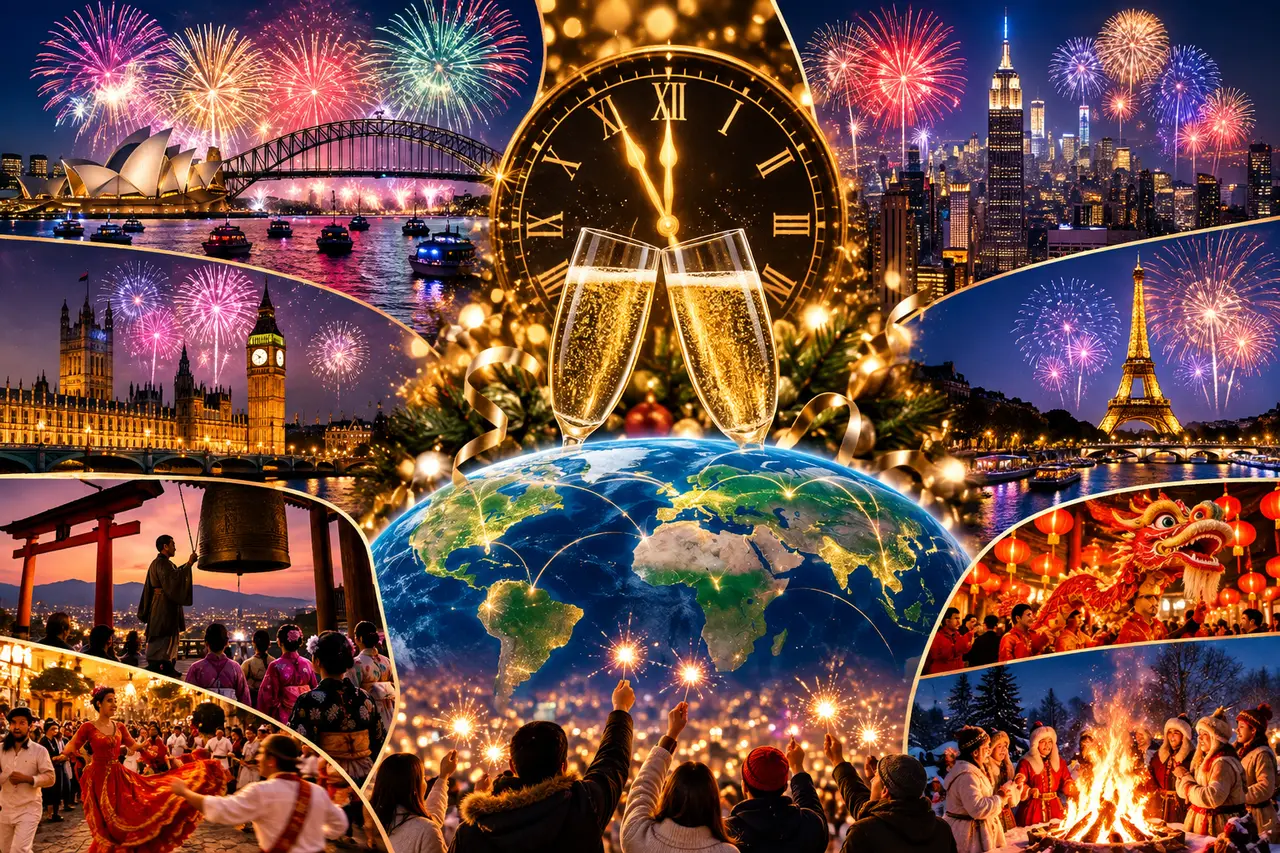
New Year’s Eve is celebrated on December 31, the final day of the year in the Gregorian calendar. For millions of people, the evening means countdowns, fireworks, parties, special meals, music, and gathering with family or friends. For others, it is a quieter opportunity to reflect on the year that is ending and prepare for the one ahead.
Although midnight on December 31 has become a globally recognizable moment, there is no single way to celebrate it. Traditions differ significantly between countries, cultures, families, and religious communities. Some people eat symbolic foods for luck, some attend public celebrations, and others spend the evening at home.
Understanding these traditions reveals something important about New Year’s Eve: the celebration is as much about looking backward as looking forward.
When Is New Year’s Eve?
New Year’s Eve falls on December 31 every year. It is immediately followed by New Year’s Day on January 1.
The date comes from the Gregorian calendar, which is widely used internationally for civil purposes. When the clock reaches midnight locally, December 31 ends and January 1 begins.
That does not mean the entire world enters the new year simultaneously. Time zones cause midnight to arrive progressively around the planet. The International Date Line also plays an important role in determining where each calendar day begins and ends.
New Year celebrations are not limited to January 1, either. Different cultures and religious traditions use different calendars, so Lunar New Year, Nowruz, and other new-year observances occur at different times.
| Celebration | Typical timing | Calendar or basis |
|---|---|---|
| Gregorian New Year | January 1 | Gregorian calendar |
| Lunar New Year | January or February | Lunisolar calendars |
| Nowruz | Around March 20 | Iranian solar calendar and spring equinox |
| Songkran | April | Traditional Thai New Year |
| Rosh Hashanah | Usually September or October | Hebrew calendar |
These celebrations should not be treated as different versions of exactly the same holiday. Each has its own cultural, historical, and sometimes religious significance.
Why Is New Year’s Eve Celebrated on December 31?
December 31 is New Year’s Eve because January 1 is the first day of the new year under the Gregorian calendar.
The connection between January and the beginning of a year goes back further than the Gregorian calendar itself. Ancient Roman calendar reforms helped establish January as the opening month. The month is associated with Janus, the Roman god traditionally connected with beginnings, transitions, and doorways.
Calendar systems subsequently changed over centuries. The Gregorian calendar was introduced in 1582 under Pope Gregory XIII as a reform of the Julian calendar. It gradually became widely adopted around the world.
Today, December 31 therefore functions as the final calendar day before the Gregorian year changes.
Its significance, however, extends beyond the mechanics of a calendar. The transition creates a natural psychological and social dividing line. People can associate the old year with completed experiences and January 1 with a fresh period in which to establish plans, goals, or resolutions.
The History of New Year’s Eve Celebrations
Humans were marking the beginning of new years long before modern December 31 parties existed.
Ancient societies developed calendars around agricultural cycles, astronomical observations, seasons, and religious practices. As a result, the beginning of a year has not always fallen in January.
Modern New Year’s Eve combines much older ideas about renewal with comparatively recent traditions such as enormous public countdowns, televised celebrations, elaborate fireworks, and citywide entertainment.
One of the best-known examples developed in New York City.
People began gathering for New Year’s Eve celebrations in Times Square in 1904. The famous ball-lowering tradition followed in 1907, when an illuminated iron-and-wood ball descended from the flagpole at One Times Square to mark the transition into 1908.
The idea of dropping a ball to mark time was older still. Time balls had previously been used to help ships set their chronometers accurately.
Over the following century, broadcasting transformed local celebrations into international spectacles. People no longer had to stand in a city square to participate. Radio, television, satellite broadcasts, and eventually online streaming allowed audiences around the world to watch major countdowns in real time.
Popular New Year’s Eve Traditions
The most familiar New Year’s Eve customs often involve a shared countdown, but many traditions carry meanings related to prosperity, health, friendship, remembrance, or good fortune.
Counting Down to Midnight
The final seconds before midnight provide a clear focal point for a celebration.
People often count backward together from ten before cheering when the clock reaches 12:00. Fireworks, bells, music, confetti, and other festivities may begin at the same moment.
The countdown works especially well at large events because thousands of people can participate in one simple shared ritual.
Watching Fireworks
Fireworks have become one of the most recognizable visual symbols of New Year’s Eve.
Major cities often stage displays around prominent landmarks, waterfronts, or public spaces. Sydney Harbour, for example, has become internationally associated with large New Year celebrations.
Fireworks are not appropriate everywhere, however. Local laws may restrict private fireworks, and they present risks involving burns, fires, noise, pets, and crowds. Attending a professionally managed public display is often a more practical alternative to using fireworks at home.
Making New Year’s Resolutions
A resolution is a personal commitment to change or accomplish something during the coming year.
Typical resolutions involve exercise, finances, education, relationships, travel, career goals, or changing a habit. The underlying idea fits naturally with the symbolic reset associated with January 1.
A specific plan is usually more actionable than a vague resolution. Instead of resolving to “save more money,” for example, someone could decide to transfer a fixed amount into savings after every payday.
Singing “Auld Lang Syne”
“Auld Lang Syne” is strongly associated with New Year celebrations in many English-speaking communities.
The song is connected with Scottish poet Robert Burns and older Scottish tradition. Its themes concern remembering longstanding relationships and times past, which makes it particularly suitable for a night that simultaneously closes one year and welcomes another.
Its international New Year association expanded as Scottish communities carried the tradition abroad. Radio and television broadcasts later helped establish it as a familiar midnight song in the United States and elsewhere.
Sharing a Midnight Kiss
A kiss at midnight is another familiar custom, particularly among couples.
Its precise historical development is less straightforward than some popular explanations suggest. Rather than needing a single origin story, it can be understood as part of the broader tradition of beginning the new year with affection and connection.
As with any physical affection, participation depends on mutual consent. Nobody needs to take part simply because it is a holiday tradition.
New Year’s Eve Traditions Around the World
One of the most interesting features of New Year’s Eve is how communities have adapted the occasion to their own cultures.
Spain: Eating 12 Grapes
A famous Spanish tradition involves eating 12 grapes at midnight, timed with the clock chimes.
Each grape represents one month of the coming year. The custom has also spread to other Spanish-speaking communities.
The challenge of eating the grapes quickly has become part of the fun, although people should naturally eat at a safe pace.
Japan: Ringing Temple Bells
In Japan, Buddhist temples traditionally ring bells 108 times around the transition into the new year.
The practice is known as Joya no Kane. Its religious significance distinguishes it from a typical entertainment-focused countdown.
Brazil: Wearing White
White clothing is a prominent feature of New Year celebrations in Brazil, particularly at large coastal gatherings.
The color is associated with peace. Celebrations may also include music, fireworks, food, and traditions influenced by Afro-Brazilian culture.
Scotland: Hogmanay
Scotland has especially strong traditions surrounding Hogmanay, the Scottish celebration of New Year’s Eve and the arrival of the new year.
Customs can include gatherings, music, singing “Auld Lang Syne,” and first-footing, in which the first person entering a home after midnight traditionally carries symbolic significance.
Symbolic New Year Foods
Food traditions are especially diverse.
Different communities associate particular dishes with prosperity or good fortune. Examples include lentils, black-eyed peas, greens, long noodles, grapes, and ring-shaped foods.
The meanings vary by culture. Rather than treating any particular food as universally “lucky,” it is more accurate to understand these dishes as cultural symbols expressing hopes for the coming year.
The Times Square New Year’s Eve Ball Drop
Few New Year’s Eve events are as internationally recognizable as the Times Square ball drop in New York City.
The celebration in Times Square dates to 1904, while the first ball descent took place in 1907. At 11:59 p.m. Eastern Time, the ball begins its final 60-second descent at One Times Square, reaching the bottom as the new year begins.
The ball itself has changed dramatically over the decades.
The original was made from iron and wood, measured five feet in diameter, weighed about 700 pounds, and contained 100 light bulbs. Later versions incorporated wrought iron, aluminum, computer controls, crystal, and LED technology.
The tradition was interrupted during the wartime dimouts of 1942 and 1943. Crowds nevertheless gathered in Times Square, observing a moment of silence followed by chimes rather than the illuminated ball descent.
That history shows how a relatively simple mechanism for signaling midnight developed into a globally recognized New Year symbol.
How to Celebrate New Year’s Eve
A memorable New Year’s Eve does not require an enormous party. The right celebration depends on the people involved, budget, location, transportation, and preferred atmosphere.
| Celebration style | Good choice for | Planning priority |
|---|---|---|
| House party | Friends and families | Food, music, space |
| Restaurant dinner | Couples or small groups | Early reservations |
| Public countdown | People seeking atmosphere | Transport and crowds |
| Fireworks display | Families and groups | Viewing location |
| Game or movie night | Relaxed gatherings | Activities and snacks |
| Reflective evening | Individuals or couples | Quiet setting |
| Video celebration | Long-distance friends | Time zones and connectivity |
Host a Dinner or House Party
Home celebrations provide flexibility over food, music, guest numbers, and timing.
A practical party plan includes a clear start time, enough seating, drinks and food for the expected number of guests, music, simple activities, and a plan for midnight.
Hosts should also consider how guests will get home. If alcohol is served, designated drivers, taxis, rideshare services, or overnight accommodation can reduce unnecessary risk.
Attend a Public Celebration
Large public events provide an atmosphere that is difficult to reproduce at home.
The tradeoff is convenience. Popular celebrations can involve road closures, security checks, restricted entry, long periods of standing, cold or hot weather, and limited access to bathrooms.
Check official event information before leaving home rather than relying on an old social-media post or information from a previous year.
Plan a Quiet New Year’s Eve
Not everyone enjoys crowds.
A quiet evening might include cooking a favorite meal, watching a film, calling distant relatives, playing games, looking through photographs from the past year, or writing down goals for the next one.
This approach can be especially useful for families with young children, people with pets disturbed by fireworks, or anyone who simply prefers a relaxed celebration.
How to Plan a New Year’s Eve Party
Start with the guest list and budget rather than decorations.
Those two decisions affect almost everything else, including venue size, food, drinks, seating, entertainment, and transportation.
A simple planning sequence is:
- Set the approximate budget.
- Create the guest list.
- Choose the venue.
- Decide whether the event is casual, formal, or themed.
- Plan food and drinks.
- Arrange music or entertainment.
- Create a midnight countdown plan.
- Confirm transportation or sleeping arrangements where necessary.
- Check local rules if fireworks or outdoor activities are involved.
Food does not need to be complicated. Small dishes that can be prepared ahead of time often work better than a meal requiring the host to spend the entire evening cooking.
A visible clock or television countdown also prevents the surprisingly common party problem of people realizing too late that midnight is only seconds away.
New Year’s Eve Ideas for Families
Families can adapt the celebration so children do not need to stay awake until midnight.
A mock countdown earlier in the evening is one solution. Choose 8 p.m. or 9 p.m., count down together, and treat it like midnight for younger children.
Other ideas include making a family time capsule, decorating cookies, playing board games, creating a photo booth, writing wishes for the coming year, watching a family movie, or preparing a special dinner together.
A “best of the year” activity can also give the evening more meaning. Each person chooses a favorite memory, achievement, book, film, trip, or funny moment from the previous 12 months.
New Year’s Eve Ideas for Couples
Couples do not need an expensive restaurant reservation to make the evening distinctive.
Cooking dinner together, revisiting a meaningful location, taking an evening walk, creating a shared playlist, exchanging handwritten notes, or reviewing photographs from the year can create a more personal celebration.
Couples can also use the evening for practical planning. Discussing one or two shared goals for the next year, such as saving for a trip or completing a home project, turns the symbolic fresh start into something concrete.
The aim does not have to be creating the “perfect” New Year’s Eve. Expectations around the holiday can become disproportionately high. A celebration that matches both people’s preferences is generally more enjoyable than copying what everyone else appears to be doing.
Staying Safe on New Year’s Eve
New Year’s Eve can combine several risk factors at once: late-night travel, crowded venues, alcohol, winter weather in some regions, and fireworks.
Planning transportation before the celebration starts removes one major uncertainty. Anyone drinking alcohol should avoid driving and use a designated driver or appropriate transport alternative.
At crowded public events, agree on a meeting point in case members of the group become separated. Keep phones charged and pay attention to official instructions concerning entrances, exits, road closures, or emergencies.
Private fireworks require particular caution. Laws vary substantially by location, so check local rules first. Children should not handle fireworks intended for adult use, and spectators should remain at a safe distance.
Pets may also react strongly to loud fireworks. Keeping them securely indoors in a familiar environment can help prevent frightened animals from escaping.
New Year’s Eve vs. New Year’s Day
Although closely connected, the terms describe different dates.
New Year’s Eve is December 31. The word “eve” refers to the evening or period before a particular day.
New Year’s Day is January 1.
Many celebrations begin during the evening of December 31 and continue beyond midnight, so one event can technically take place across both dates.
This distinction matters for bookings and travel. A hotel reservation, restaurant event, train schedule, or ticket advertised for “New Year’s Eve” normally refers to December 31, even when the event ends during the early hours of January 1.
Making the New Year More Meaningful
The countdown lasts seconds, but the transition can provide a useful opportunity for reflection.
Instead of creating a long list of resolutions, consider three questions:
What should continue? Identify something from the previous year that worked well.
What should change? Choose one habit, commitment, or situation that deserves attention.
What is the next concrete action? Turn the answer into something measurable.
For example, “I want to read more” is an intention. “I will read for 20 minutes before bed four nights per week” describes an action.
The same method works for financial, professional, educational, relationship, or health-related goals. A calendar change cannot create change by itself, but it can provide a convenient moment to decide what happens next.
Frequently Asked Questions About New Year’s Eve
Is New Year’s Eve December 31 or January 1?
New Year’s Eve is December 31. New Year’s Day is January 1. Celebrations often cross midnight, which is why a New Year’s Eve event may continue into January 1.
Why do people celebrate at midnight?
Midnight marks the transition from December 31 to January 1 in the local time zone. Counting down the final seconds gives groups a shared way to mark the exact change of date.
Why do people kiss on New Year’s Eve?
The midnight kiss is a social tradition associated with beginning the new year with affection and connection. Customs and explanations vary, and participation is entirely optional.
Why are fireworks used on New Year’s Eve?
Fireworks create a highly visible and audible way of marking midnight and are incorporated into celebrations in many countries. Historical beliefs about noise and warding off misfortune also appear in some traditions, although modern displays are often primarily celebratory.
Does everyone celebrate New Year on January 1?
No. January 1 is New Year’s Day under the Gregorian calendar, but many cultures and religions observe additional new-year festivals according to lunar, lunisolar, solar, or religious calendars.
What can you do on New Year’s Eve without going to a party?
You can prepare a special meal, watch films, play games, video-call friends or relatives, review the past year, create goals, attend an early fireworks display, or simply enjoy a quiet evening. A large party is only one way to mark the occasion.
Conclusion
New Year’s Eve is the final day of the Gregorian year, but its importance comes from more than the date itself. December 31 creates a shared moment to recognize what has passed and anticipate what comes next.
The details differ around the world. One person may eat 12 grapes in Spain, another may hear temple bells in Japan, while crowds in New York watch the Times Square ball descend. Others celebrate at a family dinner table or spend the evening quietly at home.
There is no single correct way to spend New Year’s Eve. The most meaningful celebration is one that fits the people involved, respects the traditions being observed, and allows the old year to end safely before the new one begins.
For more helpful guides please visit RoyalSprinter.
