


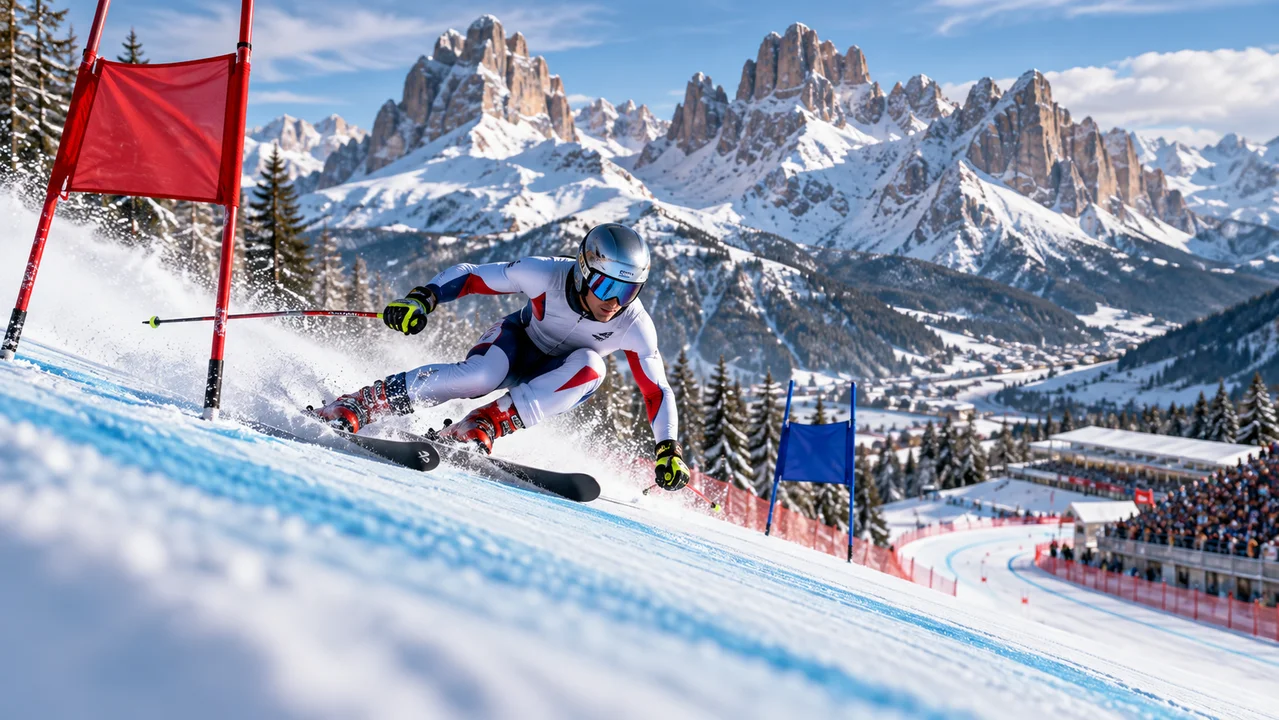
Alpine skiing at the 2026 Winter Olympics delivered 10 medal events across the men’s and women’s programs at Milano Cortina 2026. The races included downhill, super-G, giant slalom, slalom, and the new team combined format. The men’s competition took place at the Stelvio Ski Centre in Bormio, while the women’s Olympic races were staged in Cortina d’Ampezzo.
The Games produced victories for established Olympic stars and newer champions. Franjo von Allmen won the men’s downhill, Federica Brignone captured two women’s individual gold medals, Mikaela Shiffrin won the women’s slalom, and Lucas Pinheiro Braathen earned Brazil’s gold in the men’s giant slalom. Official FIS results also show extremely close margins in several races, including Breezy Johnson’s four-hundredths-of-a-second victory in the women’s downhill.
This guide covers the 2026 Winter Olympics alpine skiing results, medalists, disciplines, competition format, venues, and some of the performances that defined the Olympic program.
2026 Winter Olympics Alpine Skiing Results at a Glance
The alpine skiing program awarded medals across five men’s and five women’s events. Individual speed events consisted of downhill and super-G, while giant slalom and slalom formed the technical side of the program. Team combined paired a speed skier with a slalom skier from the same nation.
Here are the medalists from the 10 events:
| Event | Gold | Silver | Bronze |
|---|---|---|---|
| Men’s downhill | Franjo von Allmen, Switzerland | Giovanni Franzoni, Italy | Dominik Paris, Italy |
| Men’s super-G | Franjo von Allmen, Switzerland | Ryan Cochran-Siegle, United States | Marco Odermatt, Switzerland |
| Men’s giant slalom | Lucas Pinheiro Braathen, Brazil | Marco Odermatt, Switzerland | Loïc Meillard, Switzerland |
| Men’s slalom | Loïc Meillard, Switzerland | Fabio Gstrein, Austria | Henrik Kristoffersen, Norway |
| Men’s team combined | Switzerland 2 | Austria 1 | Switzerland 1* |
| Women’s downhill | Breezy Johnson, United States | Emma Aicher, Germany | Sofia Goggia, Italy |
| Women’s super-G | Federica Brignone, Italy | Romane Miradoli, France | Cornelia Hütter, Austria |
| Women’s giant slalom | Federica Brignone, Italy | Sara Hector, Sweden | Thea Stjernesund, Norway* |
| Women’s slalom | Mikaela Shiffrin, United States | Camille Rast, Switzerland | Anna Swenn-Larsson, Sweden |
| Women’s team combined | Austria 1 | Germany | United States 2 |
*The published medal records contain ties in the men’s team combined silver position and women’s giant slalom silver position, so no separate bronze medal was awarded in those events.
The medal table shows how widely success was distributed. Switzerland was particularly prominent in the men’s program, while the women’s individual titles went to the United States and Italy.
Men’s Alpine Skiing Results
Men’s Downhill
Switzerland’s Franjo von Allmen became Olympic downhill champion with a time of 1:51.61. Italy’s Giovanni Franzoni finished just 0.20 seconds behind him, while Italian veteran Dominik Paris took bronze at 0.50 seconds back.
Marco Odermatt narrowly missed the podium, finishing fourth, 0.70 seconds behind von Allmen. Alexis Monney gave Switzerland another top-five result.
The downhill was particularly significant because it immediately established von Allmen as one of the central figures of the alpine skiing competition.
Men’s Super-G
Von Allmen followed his downhill success by winning the men’s super-G, giving him two individual Olympic gold medals in the speed disciplines. American Ryan Cochran-Siegle took silver, while Switzerland’s Marco Odermatt earned bronze.
Winning both men’s speed races made von Allmen one of the defining alpine skiers of Milano Cortina 2026.
Men’s Giant Slalom
The men’s giant slalom produced a historic result for Brazil. Lucas Pinheiro Braathen won gold, with Marco Odermatt taking silver and Switzerland’s Loïc Meillard earning bronze.
Braathen, who previously competed for Norway before representing Brazil, delivered a result that extended Olympic alpine skiing success beyond the nations traditionally associated with the sport.
Men’s Slalom
Loïc Meillard won the men’s slalom in a combined time of 1:53.61. Austria’s Fabio Gstrein finished 0.35 seconds behind for silver, and Norway’s Henrik Kristoffersen earned bronze at 1.13 seconds back.
Timon Haugan of Norway finished fourth, while Belgium’s Armand Marchant completed the top five.
Meillard’s victory added another gold to Switzerland’s highly successful men’s alpine skiing campaign.
Men’s Team Combined
The men’s team combined paired one downhill skier and one slalom skier, with their times determining the final team result.
Switzerland 2, consisting of Franjo von Allmen and Tanguy Nef, won gold with a combined time of 2:44.04. Austria 1 and Switzerland 1 tied at 0.99 seconds behind the winners. The official FIS results therefore list both teams in second place.
The result also meant another Olympic title for von Allmen after his victories in downhill and super-G.
Women’s Alpine Skiing Results
Women’s Downhill
The women’s downhill produced one of the narrowest finishes of the alpine program.
American Breezy Johnson won in 1:36.10, defeating Germany’s Emma Aicher by only 0.04 seconds. Sofia Goggia of Italy earned bronze, finishing 0.59 seconds behind Johnson.
Jacqueline Wiles and Cornelia Hütter tied for fourth at 0.86 seconds behind the winner.
A four-hundredths margin means the difference between Olympic gold and silver was less than the blink of an eye, illustrating how small timing differences can decide downhill medals.
Women’s Super-G
Italy’s Federica Brignone won the women’s super-G in 1:23.41.
Romane Miradoli of France took silver, 0.41 seconds behind Brignone, while Austria’s Cornelia Hütter earned bronze at 0.52 seconds back. Ariane Rädler missed the podium by just one-hundredth of a second, finishing 0.53 seconds behind the winner.
That tiny gap between third and fourth demonstrated another characteristic of Olympic alpine racing: a medal can depend on a fraction of a second accumulated over an entire course.
Women’s Giant Slalom
Brignone also won the women’s giant slalom, giving the Italian skier a second individual Olympic gold medal.
Sweden’s Sara Hector and Norway’s Thea Stjernesund shared the silver-medal position in the published medal records. Because of the tie, the medal listing does not show a separate bronze medalist.
Brignone’s victories in two different disciplines demonstrated her ability to succeed in both speed-oriented and technical racing.
Women’s Slalom
American Mikaela Shiffrin won the women’s slalom gold medal. Switzerland’s Camille Rast earned silver, and Sweden’s Anna Swenn-Larsson took bronze.
Slalom demands rapid direction changes through closely spaced gates, making it fundamentally different from the long, high-speed lines of downhill. Shiffrin’s victory came in the most technical alpine discipline on the Olympic program.
Women’s Team Combined
Austria won the women’s team combined, with Germany taking silver and the United States earning bronze.
Team combined created a different competitive challenge from a normal individual race. Instead of asking one skier to excel at both speed and slalom, countries could pair specialists whose performances contributed to one combined result.
How Alpine Skiing Worked at the 2026 Winter Olympics
The Olympic alpine skiing program brought together two broad categories of racing: speed events and technical events.
Downhill is the fastest discipline and features long courses, large turns, jumps, and substantial vertical drops. Super-G also emphasizes speed, but competitors must negotiate more direction changes.
Giant slalom moves further toward technical skiing. Athletes complete two runs, and their times are added together. Slalom uses even tighter gate spacing and requires extremely rapid turns. A mistake that costs only a few tenths of a second can substantially change the standings.
Team combined added another dimension to Milano Cortina 2026 by linking the speed and technical disciplines through two-athlete teams.
| Discipline | Main characteristic | Competition emphasis |
|---|---|---|
| Downhill | Long, high-speed course | Speed, line selection and stability |
| Super-G | Speed with more turning | Speed plus technical precision |
| Giant slalom | Wider technical turns | Two-run consistency |
| Slalom | Closely spaced gates | Quick turns and precision |
| Team combined | Downhill plus slalom | Performance of two specialists |
This range explains why the Olympic alpine program rarely revolves around one type of skier. An athlete who excels in downhill does not automatically have the technical profile needed to win slalom.
Where the 2026 Olympic Alpine Skiing Events Took Place
Milano Cortina 2026 distributed events across northern Italy rather than concentrating every sport around a single Olympic city.
The official competition schedule placed the men’s alpine skiing events at the Stelvio Ski Centre in Bormio. The schedule included men’s downhill, team combined, super-G, giant slalom, and slalom.
Women’s alpine skiing was centered on Cortina d’Ampezzo, one of Italy’s best-known winter-sports destinations.
This split gave the men’s and women’s competitions distinct settings while using established Alpine racing locations.
The New Team Combined Format Explained
Team combined was one of the most important changes to the 2026 Olympic alpine program.
Traditional alpine combined required an individual athlete to race both a speed discipline and slalom. Team combined instead allowed countries to pair two specialists. One athlete completed the downhill portion and another completed the slalom.
The two times were added to produce the team’s final result.
For example, Switzerland 2 won the men’s event with Franjo von Allmen recording 1:52.22 in the downhill portion and Tanguy Nef adding a 51.82 slalom run. Their combined time was 2:44.04.
That structure changes team strategy. Nations with depth across both speed and technical skiing can build combinations around athletes’ strongest disciplines rather than relying on one all-round skier.
Standout Alpine Skiers at Milano Cortina 2026
Several performances stand out when the entire alpine program is viewed together.
Franjo von Allmen won men’s downhill and super-G and was also part of the gold-medal-winning Switzerland 2 team combined pairing. His results made him a central figure in the men’s competition.
Federica Brignone delivered Italy two individual women’s gold medals by winning super-G and giant slalom. Her super-G victory came by 0.41 seconds over Romane Miradoli.
Breezy Johnson captured the women’s downhill for the United States in an exceptionally close race, while Mikaela Shiffrin added another American alpine title in women’s slalom.
Lucas Pinheiro Braathen’s giant slalom gold also gave the men’s technical program one of its most notable results, with the Brazilian finishing ahead of Swiss stars Marco Odermatt and Loïc Meillard.
What Made the 2026 Olympic Alpine Skiing Competition Different?
Milano Cortina 2026 combined familiar Olympic disciplines with a meaningful format change.
The downhill, super-G, giant slalom, and slalom retained the recognizable structure of elite alpine competition. Team combined, however, shifted the combined concept toward specialization. Countries could connect the performance of a downhill racer with that of a slalom specialist.
The results also showed how competitive margins varied by discipline. Johnson won the women’s downhill by 0.04 seconds, while Hütter took women’s super-G bronze by only 0.01 seconds over Rädler. In men’s downhill, the first four competitors were separated by just 0.70 seconds.
Those numbers provide useful context that a medal table alone cannot show. Olympic alpine skiing is not simply about who finished first, second, and third. In several Milano Cortina races, tiny differences separated a medal from fourth place.
Frequently Asked Questions
How many alpine skiing events were at the 2026 Winter Olympics?
There were 10 alpine skiing medal events at Milano Cortina 2026: downhill, super-G, giant slalom, slalom, and team combined for both men and women.
Who won the men’s downhill at the 2026 Winter Olympics?
Switzerland’s Franjo von Allmen won the men’s downhill in 1:51.61. Giovanni Franzoni of Italy took silver, while Italy’s Dominik Paris earned bronze.
Who won the women’s downhill at Milano Cortina 2026?
American Breezy Johnson won the women’s downhill in 1:36.10, finishing only 0.04 seconds ahead of Germany’s Emma Aicher. Sofia Goggia of Italy took bronze.
Who won the women’s slalom at the 2026 Winter Olympics?
Mikaela Shiffrin of the United States won women’s slalom gold. Switzerland’s Camille Rast took silver, while Sweden’s Anna Swenn-Larsson earned bronze.
What was team combined in Olympic alpine skiing?
Team combined paired two skiers from the same country. One raced downhill and the other raced slalom, with their times combined to determine the team’s final result.
Where was men’s Olympic alpine skiing held in 2026?
The men’s alpine skiing competition was held at the Stelvio Ski Centre in Bormio, Italy. The venue hosted downhill, super-G, giant slalom, slalom, and men’s team combined.
Conclusion
The 2026 Winter Olympics alpine skiing program combined traditional speed and technical racing with the Olympic introduction of team combined. Switzerland produced a particularly strong men’s campaign, led by Franjo von Allmen, while Federica Brignone won two individual titles for host nation Italy.
Breezy Johnson’s 0.04-second downhill victory, Mikaela Shiffrin’s slalom gold, and Lucas Pinheiro Braathen’s giant slalom title added further variety to the medal picture. More importantly, the results showed how little separated many of the world’s leading skiers. Across several events, hundredths of a second determined who reached the podium and who left without a medal.
For readers following Milano Cortina 2026 retrospectively, the official race results provide the clearest picture: alpine skiing was defined by close margins, specialist performances, and a team format that changed how Olympic combined racing worked.
For more helpful guides please visit RoyalSprinter.
