


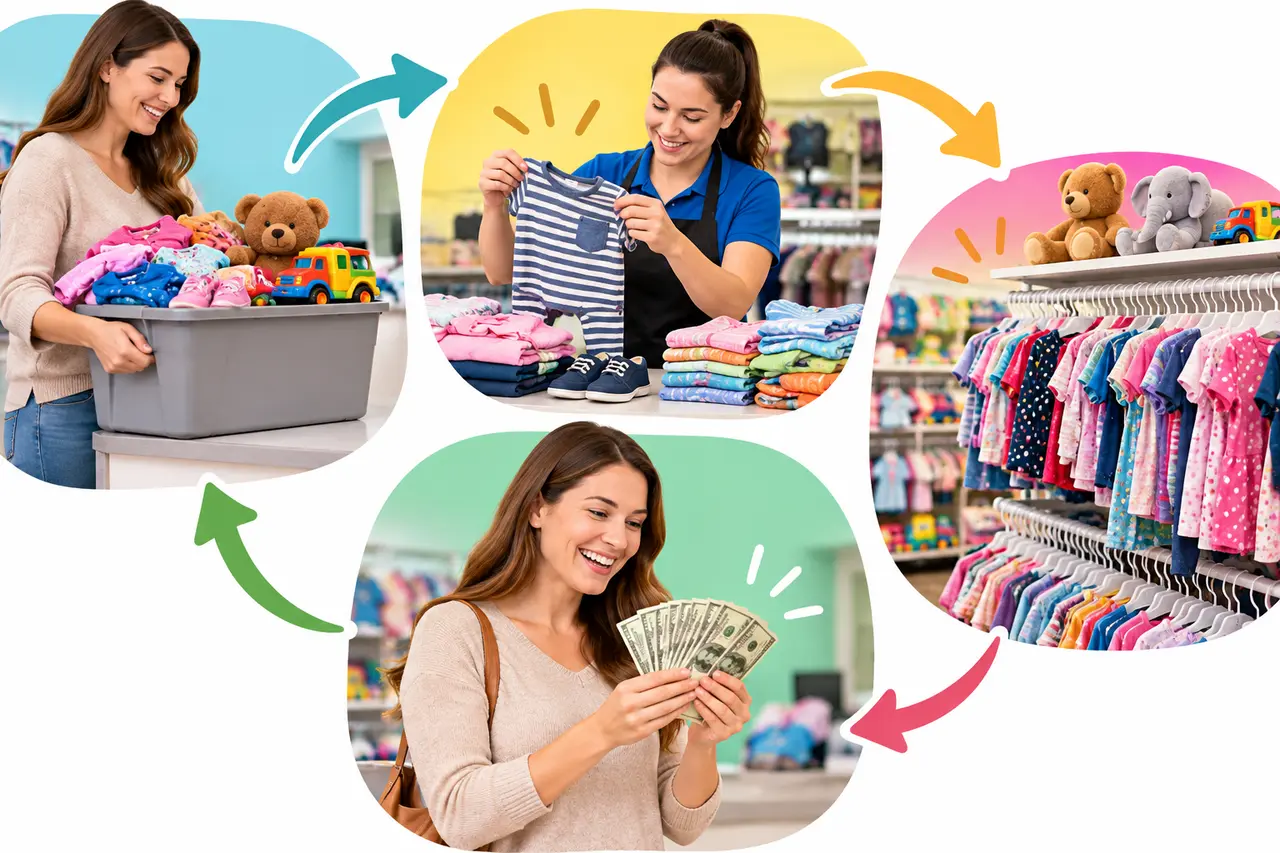
Once Upon a Child is a children’s resale store where families can buy gently used clothing, shoes, toys, and baby gear or sell eligible items for cash. The chain has more than 400 independently owned and operated locations, so inventory, buying priorities, and some selling policies can vary from one store to another.
For parents, the concept is straightforward: children quickly outgrow clothes, toys, and equipment that may still have plenty of useful life left. Instead of storing those items or arranging individual online sales, sellers can bring eligible products to a local store for evaluation. If the store wants the items and the seller accepts the offer, payment is generally made on the spot. Shoppers, meanwhile, can find secondhand children’s products for up to 70% less than regular retail prices, according to the company.
What Is Once Upon a Child?
Once Upon a Child is a resale business specializing in products for babies, children, and families. Stores buy gently used children’s merchandise from customers and resell accepted products locally.
The company primarily deals in children’s clothing, shoes, toys, and baby gear. Its official selling information states that stores buy clothing ranging from preemie sizes through Youth 20, although the merchandise a particular location needs can change.
Unlike traditional consignment, where a seller may have to wait until an item sells before receiving money, the standard Once Upon a Child process allows customers to receive cash after the store evaluates and agrees to purchase their items. No appointment is generally required.
Each location is independently owned and operated. This distinction matters because one store may urgently need winter coats, larger children’s sizes, strollers, or outdoor toys while another has enough of those products already. Local policies concerning containers, quantities, processing times, and specific merchandise may also differ.
How Selling to Once Upon a Child Works
The basic selling process involves bringing your children’s unwanted items to a store, allowing staff to inspect them, reviewing the offer, and receiving payment if you accept it.
The official process can be summarized like this:
| Step | What Happens | What You Should Do |
|---|---|---|
| 1. Gather items | You select children’s items you no longer need | Choose clean, gently used products in good condition |
| 2. Bring them to a store | Staff receive the items for evaluation | Check your local store’s buying preferences first |
| 3. Store review | Staff determine which items they can purchase | Allow time for the store to inspect condition and safety |
| 4. Receive an offer | The store calculates an offer for accepted merchandise | Review the total before accepting |
| 5. Get paid | Payment is provided after you accept the offer | Collect your cash and any items the store did not purchase |
Once Upon a Child states that stores buy throughout the year and that sellers generally do not need appointments. The company also recommends contacting your local location to learn which products are currently most wanted because a store may not purchase every eligible item presented to it.
What Does Once Upon a Child Buy?
The main categories are children’s clothing, shoes, toys, and baby gear. Merchandise must generally be in suitable condition and, where relevant, meet current safety requirements.
Clothing can include infant, toddler, preschool, and youth sizes. Shoes may include sneakers, boots, sandals, slides, rain boots, and other children’s footwear. Stores may also purchase toys and various types of baby equipment.
Brand can influence demand. The company’s current list of popular brands includes names such as Carter’s, Cat & Jack, Nike, adidas, Baby Gap, Children’s Place, Columbia, Crocs, Disney, Fisher-Price, Gap, H&M, Old Navy, OshKosh B’gosh, Polo Ralph Lauren, Puma, Under Armour, Vans, Zara, and others.
A recognizable brand does not automatically guarantee acceptance. Condition, style, safety, local inventory, and current customer demand can all influence whether a particular store wants an item.
What Items Will Once Upon a Child Not Accept?
Not everything made for children can be resold. The company specifically states that it does not buy car seats, recalled merchandise, or products that fail to meet current government safety standards.
Stores also evaluate products against safety information and recalls. According to the company’s safety policy, products on store shelves are reviewed with current safety standards and recall information in mind, and recalled products are removed.
Beyond safety restrictions, individual stores can reject merchandise because of its condition or local demand. Common condition problems may include stains, excessive fading, pilling, tears, missing components, broken fasteners, or damaged toys.
Equipment and toys should generally be functional and complete. An otherwise desirable toy can be difficult for a resale store to purchase if an essential piece, battery cover, accessory, or component is missing.
Because local buying rules can be more restrictive than the chain-wide guidelines, checking your specific store before transporting bulky equipment can save a wasted trip.
How Much Does Once Upon a Child Pay?
There is no single payment amount that applies to every item. Offers depend on factors such as the product’s brand, condition, style, demand, and the price at which the store expects to resell it.
Individual store guidance provides useful insight into the pricing model. For example, one location explains that its computer system considers demand, style, condition, and brand. That location says many products are priced for resale at approximately 30% to 50% of their original new selling price, with sellers typically receiving approximately 30% to 50% of that resale price. These percentages should be treated as a location-specific example rather than a guaranteed chain-wide payout.
Consider a hypothetical item that originally sold new for $40. If a store decided its used selling price should be $16 and offered the seller 40% of that resale price, the seller would receive $6.40.
That calculation is only an illustration. It does not mean Once Upon a Child will pay $6.40 for a $40 item. Actual offers depend on the merchandise and the buying policies and inventory needs of the individual location.
This distinction also explains why comparing a resale-store offer directly with the item’s original retail price can be misleading. The store must purchase the product below its eventual resale price to cover operating expenses and leave room for resale margin.
How to Improve Your Chances of Getting Items Accepted
Good preparation cannot guarantee that a store will buy an item, but it can prevent avoidable condition-related rejections.
Start with clothing that is freshly cleaned and easy for employees to inspect. Look closely under bright lighting for stains, discoloration, excessive wear, holes, damaged zippers, missing buttons, and pilling. Turn clothing right-side out and keep matching pieces together.
For toys and equipment, clean surfaces and check functionality before leaving home. Make sure required pieces and accessories are included. Battery-operated toys should work, and equipment should not contain damaged or unsafe components.
You can use this quick pre-selling checklist:
- Wash and neatly organize clothing.
- Inspect garments for stains, holes, fading, and excessive wear.
- Keep matching outfit pieces together.
- Clean shoes, toys, and equipment.
- Test electronic or battery-operated toys.
- Find missing pieces and accessories.
- Check baby equipment for obvious damage.
- Review current product recalls when appropriate.
- Check your local store’s current “most wanted” products.
- Confirm local restrictions before transporting large equipment.
Timing can also matter. One location notes that its buying counter tends to be busier on weekends and that weekdays may have shorter waits. Because stores are independently operated, this should not be assumed for every location, but calling ahead can help you choose a convenient time.
Why Some Good Items May Still Be Rejected
A rejection does not necessarily mean an item is poor quality.
Resale stores have to consider their existing inventory and what local shoppers are currently purchasing. A store with dozens of similar shirts in one size may decline another shirt even if it is clean and barely worn. Another location experiencing strong demand for that same size could make a different decision.
Seasonality can affect local demand as well, even though Once Upon a Child says it buys all seasons throughout the year. A store’s immediate needs can still influence its willingness to purchase particular products.
Style is another factor. Children’s clothing can remain physically usable long after local demand for a particular design has fallen.
For sellers, the practical lesson is to separate eligibility from demand. An item may qualify as the type of merchandise the company buys without necessarily being something your particular store wants that day.
Shopping at Once Upon a Child
Once Upon a Child is not only a place to sell unwanted children’s products. Its resale model also gives families an alternative to purchasing everything new.
The company says merchandise can be priced at up to 70% below regular retail, although actual savings depend on the individual product. Inventory changes continuously because stores acquire merchandise from local sellers and add new items to the sales floor.
That constantly changing inventory creates a different shopping experience from a conventional children’s retailer. You may find a specific brand, size, toy, or piece of equipment during one visit and find completely different merchandise the next time.
Secondhand shopping can be particularly practical for products children use for relatively short periods, such as rapidly changing clothing sizes or age-specific toys.
However, shoppers should still inspect used merchandise carefully. Check clothing condition, verify that toys contain necessary pieces, and make sure equipment is suitable for your child’s age and needs.
Once Upon a Child vs. Selling Items Yourself
Selling directly through a local marketplace may sometimes produce a higher selling price, but it requires more involvement. A resale store exchanges some potential selling value for speed and convenience.
| Selling to Once Upon a Child | Selling Directly to Another Buyer |
|---|---|
| Store evaluates the merchandise | You evaluate and price the merchandise |
| No individual product listings required | Photos and listings usually need to be created |
| No need to negotiate with multiple buyers | Buyers may negotiate |
| Eligible purchases can result in immediate payment | Payment depends on finding a buyer |
| Store determines its offer | Seller determines the asking price |
| Not every item will be accepted | You can attempt to list almost anything permitted by the platform |
| Usually less ongoing effort | Potentially more time and communication |
The better method depends on your priority.
If maximizing the amount received for a valuable item matters more than convenience, direct selling may be worth considering. If the main goal is clearing several children’s items without photographing, listing, messaging buyers, arranging pickups, and waiting for sales, a resale store can be considerably simpler.
A mixed approach can also work. Higher-value specialty items can be sold individually, while everyday clothing, toys, and gear can be taken to a resale store.
Buying and Selling Used Kids’ Items Can Reduce Waste
Children often stop using products because they have grown out of them rather than because those products have reached the end of their useful life.
Resale extends that useful life. Instead of one household buying a product, using it briefly, and discarding it, another family can use the same item.
Once Upon a Child reports that it has kept 800 million children’s items out of landfills since 1993 and says its stores recycle more than 100 million items annually. These figures are company-reported sustainability statistics.
The practical benefit for families is simpler: sellers can recover some value from products their children no longer need, while buyers gain access to lower-priced used merchandise.
Frequently Asked Questions About Once Upon a Child
Does Once Upon a Child pay cash?
Yes. The company’s standard process states that sellers receive cash on the spot when the store purchases their merchandise and the seller accepts the offer.
Do I need an appointment to sell to Once Upon a Child?
Generally, no. Once Upon a Child says sellers can bring merchandise in without an appointment and that stores buy throughout the day. Check your local store before visiting because locations are independently operated.
What sizes does Once Upon a Child buy?
The company’s current general guidance says it purchases children’s clothing from Preemie through Youth 20. A particular location’s current needs can still affect what it accepts.
Does Once Upon a Child buy car seats?
No. The company’s official selling policy states that stores are unable to purchase car seats. Recalled products and items that fail to meet current government safety standards are also excluded.
Why did Once Upon a Child reject my clothes?
Possible reasons include stains, fading, wear, outdated or low-demand styles, excess inventory in a particular category, or insufficient local demand. Because stores are independently operated, an item rejected by one location is not necessarily representative of what every location currently needs.
Can I find out exactly how much an item is worth before visiting?
For many products, an accurate offer requires an in-person inspection because condition affects value. At least some individual locations specifically state that they cannot quote large items without physically assessing them and checking their condition and safety. Contact your local store for its specific policy.
Is Once Upon a Child Worth Using?
Once Upon a Child can be a practical option for families who want to turn outgrown children’s clothing, shoes, toys, and baby gear into cash without managing individual online listings. The tradeoff is that the store determines what it needs and what it is willing to pay, so sellers should not expect every item to be accepted or to receive an amount close to its original retail price.
Preparation can make the process smoother. Bring clean, complete, working items, check your local store’s current buying needs, and remember that brand, style, condition, safety, and demand can affect an offer.
For shoppers, the model provides access to frequently changing secondhand children’s merchandise at potentially substantial discounts from regular retail prices. For sellers, it offers convenience and immediate payment for items the store chooses to purchase. The key is to treat each location’s current inventory needs as part of the equation rather than assuming every eligible children’s product will automatically receive an offer.
For more helpful guides please visit RoyalSprinter.
