


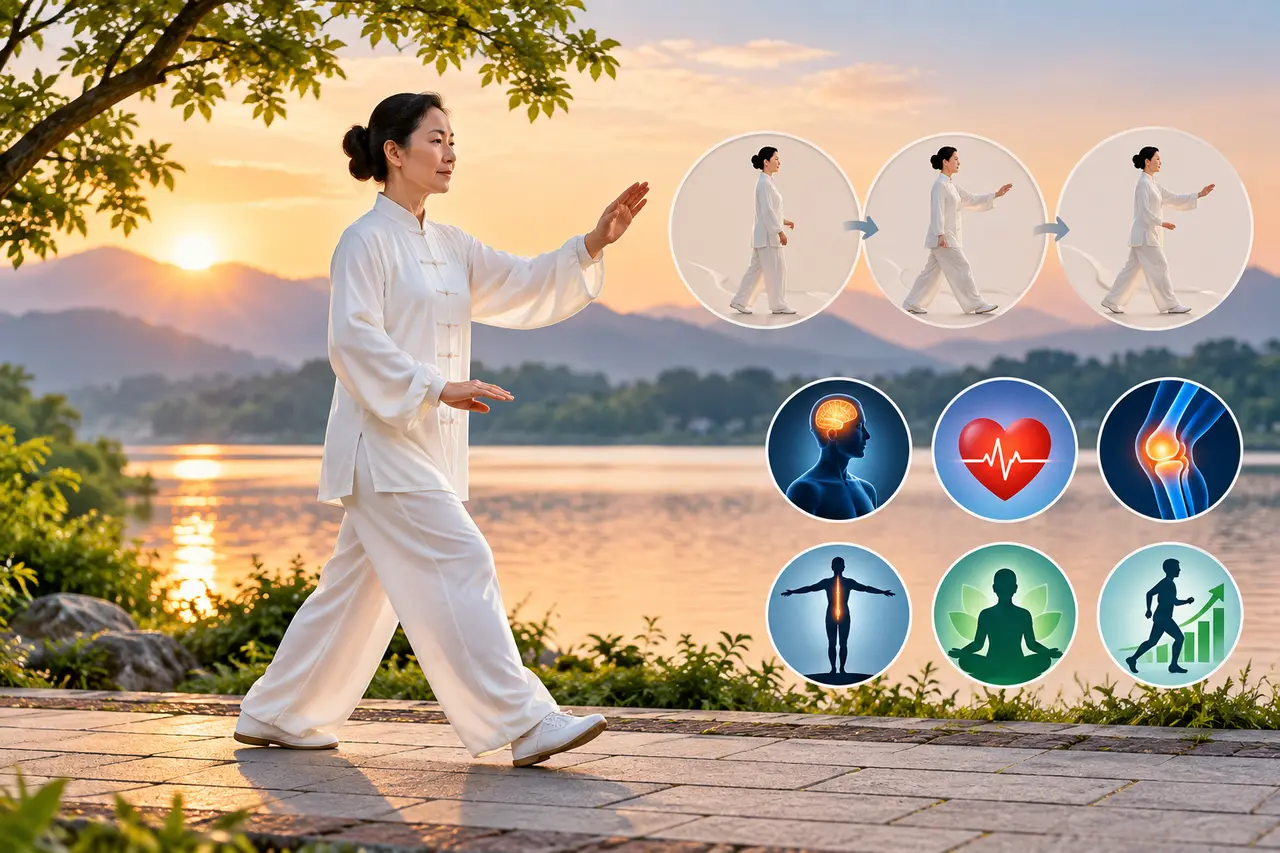
Tai chi walking is a slow, controlled way of walking that emphasizes deliberate weight shifting, upright posture, balance, relaxed breathing, and awareness of each step. Rather than trying to cover distance or increase speed, you move carefully from one leg to the other while maintaining control of your center of gravity.
It can be a useful way for beginners to explore principles found in tai chi without immediately learning a long sequence of forms. The movements can also be adapted to a person’s mobility and balance. Research on tai chi more broadly suggests potential benefits for balance and fall prevention, particularly in older adults, although studies specifically examining tai chi walking as a standalone exercise are more limited.
This guide explains how tai chi walking works, how to practice it step by step, what research suggests about its benefits, and the mistakes that can make the movement less comfortable or stable.
What Is Tai Chi Walking?
Tai chi walking applies basic tai chi movement principles to stepping. You move slowly enough to notice how your weight transfers through your feet and legs instead of automatically shifting forward as you might during ordinary walking.
A typical step involves establishing your balance on one leg, moving the other foot without rushing, placing it gently, and then gradually transferring your weight onto it. Your body remains upright and relaxed while your breathing continues naturally.
The main elements include:
- Slow, deliberate steps
- Gradual transfer of body weight
- Upright but relaxed posture
- Controlled foot placement
- Soft, comfortable knees
- Awareness of balance
- Calm, natural breathing
- Continuous rather than abrupt movement
Tai chi itself combines gentle movements and postures with controlled breathing and mental focus. The National Center for Complementary and Integrative Health (NCCIH) also notes that tai chi movements can be adapted and practiced while walking, standing, or sitting.
Tai chi walking should not be confused with simply walking very slowly. The distinguishing feature is the attention given to balance and weight transfer throughout each step.
How Tai Chi Walking Differs From Normal Walking
Ordinary walking is designed to move you efficiently from one place to another. Your weight transfers rapidly, and much of the movement happens automatically.
Tai chi walking deliberately slows this process down.
| Feature | Tai Chi Walking | Normal Walking |
|---|---|---|
| Primary emphasis | Control, awareness and weight transfer | Efficient forward movement |
| Speed | Usually very slow | Natural or brisk |
| Weight transfer | Deliberate and gradual | Rapid and largely automatic |
| Step length | Usually short and controlled | Varies naturally |
| Attention | Focused on posture, feet and balance | Often directed elsewhere |
| Breathing | Relaxed and consciously observed | Usually automatic |
| Training goal | Movement control and tai chi practice | Transportation, fitness or recreation |
Neither method is inherently a replacement for the other. Brisk walking, for example, may provide a more substantial aerobic challenge. Tai chi walking places greater emphasis on controlled movement.
A randomized trial involving older women found that both tai chi and brisk walking improved measures of balance over a 16-week training period, although improvements appeared at different stages of training. That study investigated full tai chi training rather than tai chi walking specifically, so its findings should not be interpreted as proof that slow tai chi steps produce identical results.
How to Do Tai Chi Walking Step by Step
Beginners should first learn the movement somewhere flat, uncluttered, and stable. A wall, sturdy counter, or secure railing can provide support when appropriate.
1. Establish a Comfortable Starting Position
Stand with your feet roughly hip-width apart.
Keep your spine comfortably upright rather than rigid. Let your shoulders relax and look forward instead of continuously looking at your feet.
Your knees can remain slightly soft rather than locked.
Take a few normal breaths before moving. There is no need to force unusually deep breathing.
2. Settle Your Weight Onto One Leg
Before lifting a foot, gradually transfer more of your weight onto the opposite leg.
For example, if you want to step forward with your left foot, first become stable over your right leg.
This distinction matters. Instead of lifting one foot while your body weight is still divided unpredictably between both legs, you establish a stable supporting side first.
Avoid leaning your upper body dramatically to achieve the shift. The movement should feel controlled rather than like you are falling sideways onto the supporting leg.
3. Lift the Other Foot Gently
Once you feel stable, allow the unweighted foot to become light.
Lift it only as much as necessary to move it forward. Large or exaggerated steps are unnecessary.
Your supporting knee should remain comfortably aligned with the direction of your foot.
4. Place the Foot Forward
Move the free foot forward slowly and place it down gently.
Keep the step relatively short while learning.
Depending on the tai chi method being taught, details of heel and foot placement may vary. Beginners do not need to force a particular foot position if it causes discomfort.
At this point, placing the foot down does not mean you must immediately put all your weight onto it.
5. Transfer Your Weight Gradually
Begin transferring your body weight onto the forward leg.
Think of the movement as a gradual transition rather than a sudden push.
Your torso should travel with the weight shift without excessive forward bending. Keep the movement smooth enough that you could stop safely if necessary.
This controlled transfer is one of the most useful skills to practice.
6. Stabilize Before Taking the Next Step
Once your weight has moved onto the forward leg, notice whether you actually feel stable.
Then allow the rear foot to become lighter.
Bring it forward for the next step and repeat the sequence.
A useful beginner rhythm is:
Stabilize → unweight → step → place → transfer → stabilize.
That sequence matters more than walking quickly or covering a long distance.
A Simple 10-Minute Tai Chi Walking Routine for Beginners
You do not need a lengthy routine for your first practice. Technique usually deteriorates when beginners continue after their legs become tired, so starting conservatively can make learning easier.
Try this structure:
| Time | Practice |
|---|---|
| 1 minute | Stand comfortably and notice your posture and breathing |
| 2 minutes | Practice shifting weight from side to side without stepping |
| 2 minutes | Practice slow forward steps with support nearby |
| 2 minutes | Continue walking slowly while focusing on smooth weight transfer |
| 2 minutes | Turn carefully and repeat in the opposite direction |
| 1 minute | Finish with comfortable standing and normal breathing |
A hallway or another clear, level area can work well because tai chi walking does not require much distance.
During early sessions, concentrate on one skill at a time. For example, focus first on weight shifting. During another practice, pay attention to posture or foot placement.
Trying to control your feet, knees, hips, hands, breathing, posture, and attention simultaneously can make a simple exercise unnecessarily complicated.
What Are the Benefits of Tai Chi Walking?
Claims about tai chi walking need some qualification. There is substantial research examining tai chi as a broader mind-body exercise, but much less research isolates the walking component and tests it independently.
That means benefits demonstrated for complete tai chi programs cannot automatically be attributed to tai chi walking alone.
It Trains Deliberate Weight Shifting
Every tai chi step asks you to distinguish between the supporting leg and the leg that is moving.
That provides repeated practice transferring your center of mass while maintaining control.
Instead of rushing through the transition between feet, you spend time consciously managing it. This is one reason tai chi principles are relevant to research on balance and gait.
Tai Chi May Improve Balance
Balance is one of the better-studied areas of tai chi research.
According to NCCIH, evidence suggests tai chi may improve balance and stability in older adults and reduce their risk of falling. A review summarized by NCCIH found that tai chi may reduce the rate of falls and the number of older adults experiencing falls, although the certainty of evidence differed between outcomes.
This evidence applies to tai chi programs overall. It should not be converted into a claim that a few minutes of tai chi walking will prevent falls.
It May Support Aspects of Walking Control
Researchers have also examined connections between tai chi and gait.
An NCCIH-funded preliminary trial reported that six months of tai chi training might improve aspects of gait dynamics in older adults. Other research has investigated changes in walking behavior among experienced tai chi practitioners.
A systematic review of five randomized controlled trials involving 346 stroke survivors found evidence of short-term improvements in certain measures of gait ability following tai chi. However, the studies were small and considered at high risk of bias, so the researchers called for larger, longer trials.
Again, these studies concern tai chi interventions, not necessarily standalone tai chi walking.
It Encourages Movement Awareness
Tai chi requires attention to posture, movement, breathing, and physical sensations.
Tai chi walking makes this especially apparent because slowing each step gives you time to notice when your weight changes, where your foot lands, and whether your upper body remains controlled.
This can turn an otherwise automatic action into deliberate movement practice.
It Is Relatively Adaptable
Tai chi does not always require deep stances or complex sequences. NCCIH notes that its movements can be adapted for walking, standing, or sitting.
The appropriate adaptation depends on the person. Someone with significant mobility problems, a neurological condition, recent surgery, dizziness, or a high risk of falling may require professional supervision rather than simply modifying the exercise independently.
Common Tai Chi Walking Mistakes
Small technique problems become more noticeable when movement is deliberately slowed.
Taking steps that are too long. Long steps can make transferring weight more difficult. Shorten the step until you can control the transition comfortably.
Moving the foot before establishing balance. Make sure the supporting leg feels stable before deliberately unweighting the other foot.
Leaning the torso forward. Move your body through the step rather than reaching ahead with your head and shoulders.
Locking the knees. Keep your legs comfortable and avoid forcing the knees into rigid positions.
Squatting too deeply. Tai chi walking does not require an extremely low stance. A higher stance is often more practical for beginners.
Forcing slow movement. Slower is useful only while you remain controlled. Shaking, excessive muscular tension, or struggling to maintain a position is not the goal.
Holding your breath. Continue breathing comfortably. There is no benefit in creating tension by trying to synchronize every breath perfectly during your first sessions.
Watching your feet constantly. Beginners may occasionally check foot placement, but constantly dropping your head can alter posture and reduce awareness of the environment.
How Slow Should Tai Chi Walking Be?
There is no universal number of seconds that every tai chi step must take.
Move slowly enough to distinguish the phases of the step but quickly enough to remain comfortable and stable. You should be able to feel when one foot becomes relatively unweighted and when the new foot begins accepting your weight.
Speed can change as your control improves.
Extremely slow walking is not automatically better. If slowing down causes excessive wobbling, discomfort, or fatigue, use a more manageable pace or practice basic standing weight shifts first.
How Often Should Beginners Practice?
Consistency is generally more useful for learning a movement skill than occasionally attempting a long, exhausting session.
A beginner might start with several minutes of controlled practice and gradually increase the duration if the movement remains comfortable. There is no well-established research-based prescription showing that a specific number of minutes of standalone tai chi walking produces a particular health outcome.
Research involving full tai chi programs often uses much longer sessions over several weeks or months. For example, studies cited by NCCIH have used varying frequencies and durations, which is one reason a universal therapeutic dose cannot be assumed.
If your primary goal is general fitness rather than learning tai chi, tai chi walking can also complement other appropriate forms of aerobic, strength, flexibility, and balance exercise rather than replacing them.
Tai Chi Walking for Older Adults
Tai chi is frequently studied in older populations because balance, mobility, and fall prevention become increasingly important with age.
Evidence summarized by NCCIH indicates that tai chi may reduce falls among community-dwelling older adults. Research has also examined its effects on gait and balance.
Tai chi walking may therefore be an accessible way to practice some of the movement principles found in tai chi, but safety should determine how it is performed.
Older adults who are unsteady should not assume that moving slowly automatically makes an exercise safe. A person can still lose balance during a slow weight transfer, particularly when one foot becomes lightly loaded or leaves the floor.
A stable support, appropriately trained instructor, physical therapist, or other qualified healthcare professional may be appropriate when balance is impaired.
Is Tai Chi Walking Good for the Knees?
Tai chi uses relatively gentle, controlled movements, but that does not mean every stance or technique is suitable for every knee.
Research summarized by NCCIH indicates that tai chi may help with pain and stiffness associated with osteoarthritis. Clinical guidelines have also recommended tai chi as an exercise option for knee and hip osteoarthritis.
Those findings relate to appropriately performed tai chi programs, however. They do not mean knee pain should be ignored during tai chi walking.
Keep the stance comfortable, avoid unnecessarily deep knee bending, and make sure the knee follows a comfortable line with the foot rather than forcing it into an awkward position.
Anyone with significant or worsening knee pain, recent injury, joint replacement, or another musculoskeletal condition should obtain individualized guidance before treating tai chi walking as rehabilitation.
Tai Chi Walking vs. Brisk Walking
These exercises overlap, but they generally emphasize different physical qualities.
Tai chi walking prioritizes control, balance, posture, and awareness. Brisk walking emphasizes continuous locomotion and usually provides a greater cardiovascular stimulus because of its higher pace.
They do not need to compete.
A person who can safely perform both might use ordinary or brisk walking for aerobic activity while using tai chi practice to work on slower, more deliberate movement.
Research comparing tai chi and brisk walking in older women found improvements in balance measures with both forms of exercise after sustained training.
The practical takeaway is not that one form of walking is universally superior. Your health, mobility, goals, exercise intensity, and ability to perform each activity safely determine what role each can play.
When Tai Chi Walking May Not Be Appropriate Without Supervision
Tai chi is generally regarded as a safe practice, and reported problems tend to be relatively minor, such as musculoskeletal discomfort.
Still, walking exercises involve balance and weight transfer.
Consider getting medical or rehabilitation guidance before beginning if you have significant balance problems, unexplained dizziness, frequent or recent falls, a recent operation or serious injury, substantial joint pain, or a medical or neurological condition affecting your ability to walk safely.
Stop the exercise if you experience severe or unusual pain, chest pain, faintness, or other concerning symptoms.
Tai chi walking can complement appropriate healthcare, but it should not be used as a substitute for diagnosis, physical therapy, fall-risk assessment, or treatment when those are needed.
Frequently Asked Questions About Tai Chi Walking
Can beginners do tai chi walking?
Yes. The basic weight-shifting and stepping movements can be simplified considerably. Beginners should use short steps, a comfortable stance, and a safe environment. Anyone with significant balance limitations may need support or professional instruction.
Can you lose weight with tai chi walking?
Any physical activity contributes to energy expenditure, but tai chi walking is generally performed slowly and should not be assumed to burn the same amount of energy as brisk or prolonged conventional walking. Weight management also depends on overall physical activity, food intake, health, and other individual factors.
Is tai chi walking the same as walking meditation?
They overlap in their emphasis on awareness, but they are not necessarily the same practice. Tai chi walking specifically applies movement principles associated with tai chi, including controlled weight transfer and deliberate stepping. Walking meditation may use different techniques depending on the contemplative tradition.
Do you need special shoes for tai chi walking?
Specialized shoes are not required for basic practice. What matters more is having stable, comfortable footwear appropriate for the surface and your individual needs. Avoid practicing on a slippery or unstable surface.
Can tai chi walking help prevent falls?
Research indicates that tai chi programs may improve balance and reduce fall risk in some older adults. However, evidence for tai chi as a complete practice should not be treated as proof that tai chi walking alone prevents falls. People already at high risk of falling should seek appropriate professional assessment.
How long does it take to notice improvements?
There is no established timeline specifically for tai chi walking. Studies of complete tai chi programs have used interventions lasting weeks or months. For example, one randomized trial comparing tai chi with brisk walking observed balance improvements during a 16-week intervention, while other studies have used different schedules and populations.
Conclusion
Tai chi walking turns an ordinary step into a controlled practice of balance, posture, weight transfer, and movement awareness. The basic method is simple: establish your balance, unweight one foot, place it carefully, gradually transfer your weight, stabilize, and repeat.
Research provides reasonable support for tai chi more broadly as a balance-focused exercise, particularly for older adults, but claims about tai chi walking specifically should remain measured because much of the evidence evaluates complete tai chi programs rather than isolated walking drills.
For a beginner, the most useful starting point is not an extremely deep stance or complicated sequence. Practice short, controlled steps in a safe environment, prioritize stability over speed, and gradually develop smoother weight transfers. If balance problems, pain, falls, or medical conditions affect your walking, individualized guidance from an appropriate healthcare or rehabilitation professional is a safer starting point.
For more helpful guides please visit RoyalSprinter.
