


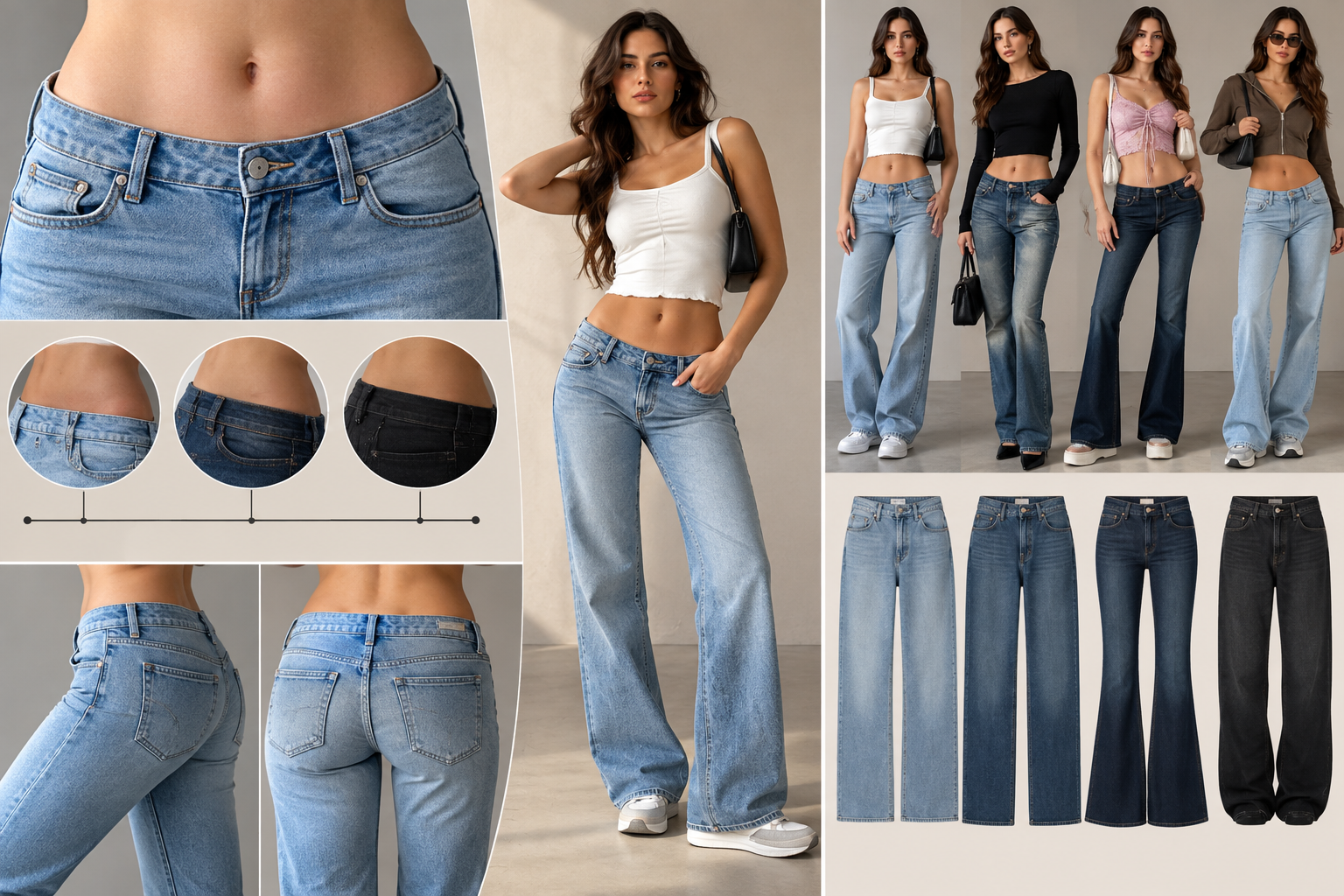
Low rise jeans sit lower on the torso than mid-rise or high-rise jeans, with the waistband resting closer to the hips than the natural waist. The defining feature is the rise, not whether the jeans are skinny, baggy, straight, or flared. Rise is generally measured from the crotch seam to the top of the waistband.
Today’s low rise jeans come in far more shapes than the ultra-tight denim commonly associated with early-2000s fashion. Loose, wide-leg, bootcut, straight, slim, and other low-slung silhouettes give shoppers plenty of options.
The key to finding a pair that works is to look beyond the “low rise” label. Front rise, hip fit, denim stretch, leg shape, and inseam collectively determine how the jeans actually look and feel.
What Are Low Rise Jeans?
Low rise jeans are denim pants with a waistband designed to sit below the natural waist, typically closer to the hips.
“Low rise” describes the vertical position of the waistband. It does not describe the shape of the leg.
Low rise jeans can be:
- Straight-leg
- Baggy or loose
- Wide-leg
- Bootcut
- Flared
- Slim
- Skinny
- Barrel or tapered
That variety makes modern low-rise denim considerably more versatile than its Y2K stereotype. You can choose a low waistband while still selecting the leg shape that suits your preferred style.
How Low Is a Low Rise?
There is no single front-rise measurement that every denim brand uses to define low rise. One brand may describe a certain measurement as low rise while another may categorize a similar pair differently.
A better approach is to check the actual garment measurements instead of relying entirely on the product name.
| Measurement | What It Tells You |
|---|---|
| Front rise | Distance from the crotch seam to the top of the front waistband |
| Back rise | Amount of coverage through the seat and back |
| Waist | Size of the waistband |
| Hip or seat | Space around the fullest part of the hips |
| Inseam | Length from the crotch to the hem |
| Leg opening | Width of the jeans near the hem |
Two pairs can both be advertised as low rise but sit noticeably differently when worn.
Body proportions also affect the result. The same front-rise measurement can look relatively higher on a shorter torso and lower on a longer torso. This makes actual garment measurements more useful than relying on labels alone.
How to Measure the Rise of Jeans
You can reduce much of the uncertainty of buying low rise jeans online by measuring a pair you already own.
Choose jeans with a waistband that sits at a height you like. Button them, lay them flat, and smooth the fabric without excessively stretching it.
Measure the front rise from the crotch seam intersection to the top of the front waistband.
Next, record the waistband, hip width, thigh width, inseam, and leg opening when possible.
When shopping online, compare the measurements of the new jeans with your reference pair. This approach can be more reliable than assuming your usual tagged size will create the same fit.
It is particularly useful when buying vintage or secondhand denim because sizing conventions can vary significantly between brands, periods, and individual garments.
Low Rise vs. Mid Rise vs. High Rise Jeans
The main difference between these styles is where the waistband sits on the torso.
| Jean Rise | General Position | Typical Visual Effect |
|---|---|---|
| Low rise | Around or closer to the hips | Shows more torso and creates a lower waistline |
| Mid rise | Between the hips and natural waist | Creates a more centered waistband position |
| High rise | Around or near the natural waist | Raises the visual waistline and provides more torso coverage |
These descriptions are more useful than assigning universal measurements because brands do not always categorize rises in exactly the same way.
Low rise jeans generally expose more of the torso because the waistband begins lower. High rise jeans move the apparent waistline upward, while mid-rise jeans provide a middle ground.
None of these rises is inherently more flattering than another. The result depends on body proportions, the cut of the jeans, styling, and personal preference.
Choosing the Right Low Rise Jeans for Your Body
Rather than looking for a supposedly ideal rise for a particular “body type,” concentrate on where you want the waistband to sit and how you want the jeans to fit through your hips and legs.
Start with the waistband. It should remain reasonably secure during normal movement without creating uncomfortable pressure. Because low rise jeans rest closer to the hips, the fit around this area is particularly important.
Next, consider both the front and back rise. Jeans can appear to fit well while standing but become uncomfortable when sitting if there is insufficient room through the rise and seat.
Hip and thigh measurements also matter. Sizing up can create an intentionally relaxed or slouchy look, but buying larger jeans is not necessarily the same as buying denim specifically designed with a low rise.
Finally, choose the leg shape independently. The fact that you want a lower waistband does not mean you have to choose skinny, baggy, or flared jeans.
Which Low Rise Leg Shape Should You Choose?
Low rise straight jeans offer a balanced silhouette. The relatively consistent leg width makes them easy to combine with different tops and footwear.
Low rise baggy jeans create a relaxed, casual appearance. Extra room through the hips and legs can produce a deliberately loose, low-slung silhouette.
Low rise wide-leg jeans provide even more volume through the leg. They can make the lowered waistband a stronger part of the overall outfit.
Low rise bootcut jeans fit closer through the upper leg before becoming wider toward the hem. They work particularly well when you want some shape through the thigh without choosing a narrow ankle.
Low rise flare jeans create a more dramatic widening toward the bottom and can emphasize a retro-inspired silhouette.
Low rise slim or skinny jeans provide a closer fit through the legs. They create a very different effect from baggy low-rise denim despite sharing the same general waistband position.
The easiest way to choose is to make two separate decisions: How low do you want the waistband, and how much volume do you want through the legs?
Rigid vs. Stretch Low Rise Denim
Fabric composition can substantially change how low rise jeans feel.
Rigid denim, usually made primarily or entirely from cotton, tends to hold its shape and create a structured silhouette. Because the fabric has limited give, accurate hip, seat, and thigh measurements become particularly important.
Stretch denim contains fibers that allow the material to expand during movement. This can make fitted low rise jeans feel more forgiving while sitting, walking, or bending.
Neither construction is automatically better.
Choose rigid denim if you prefer structure and a traditional denim feel. Consider stretch denim if flexibility, movement, and a close fit are higher priorities.
Always check the garment’s care instructions as well. Washing and drying methods can affect denim’s fit, appearance, and longevity.
How to Style Low Rise Jeans
Modern low rise jeans can be styled without recreating an entire early-2000s outfit.
For a simple casual outfit, pair straight or loose low rise jeans with a fitted T-shirt, tank top, knit, or casual shirt. A cropped top emphasizes the lowered waistband, while a longer top makes the rise less noticeable.
Proportion becomes particularly important with baggy or wide-leg jeans. A fitted or compact top can contrast with the volume of the lower half.
Alternatively, an oversized shirt or jacket can create an intentionally relaxed silhouette from top to bottom.
For a more polished outfit, low rise straight or bootcut jeans can work with a structured shirt, jacket, belt, and streamlined footwear.
You can also adjust the overall effect through layering. Jackets, cardigans, oversized shirts, and longer tops allow you to wear a low-rise silhouette without necessarily exposing the midriff.
How to Choose the Right Size
Do not automatically assume that your usual jeans size will fit identically across different low-rise styles.
Start with the brand’s size chart, but also look for actual garment measurements when available.
Pay particular attention to:
- Waistband measurement
- Front rise
- Back rise
- Hip or seat measurement
- Thigh width
- Inseam
- Fabric stretch
The waistband position makes hip fit particularly important. Jeans that technically close may still be uncomfortable if they are too restrictive around the hips when sitting or moving.
If you are between sizes, consider the fabric and desired silhouette. A rigid fitted pair may require more precise sizing, while stretchy denim provides more flexibility. Baggy jeans may intentionally have additional room.
What to Check Before Buying Low Rise Jeans Online
Product photographs alone cannot tell you exactly where a waistband will fall on your body.
Check the front rise first. Compare it with jeans you already own to estimate where the new pair will sit.
Then compare the waistband, hips, thighs, inseam, and leg opening.
Fabric composition matters too. Two pairs with similar measurements can feel different if one uses rigid denim and the other contains significant stretch.
Also determine whether the measurements shown apply to the exact size you are purchasing. Measurements can change between sizes.
A practical buying sequence is:
Preferred waistband position → front rise → hip and seat fit → leg shape → fabric → inseam.
This approach gives you more useful information than simply selecting your normal size and relying on the “low rise” product description.
Common Low Rise Jeans Fit Problems
The Waistband Gaps at the Back
The relationship between the waistband, hips, and back rise may not suit your proportions. Trying a different cut can sometimes solve the problem more effectively than simply sizing down.
The Jeans Feel Tight When Sitting
Check the front rise, back rise, hip, seat, and thigh measurements. A pair that looks comfortable while standing may feel very different once you sit down.
The Jeans Don’t Look Very Low Rise
The actual front rise may be longer than expected, or your torso proportions may make the waistband appear higher. Compare measurements rather than relying solely on the product label.
The Crotch Looks Too Low
The rise may be too long for the intended fit, or the jeans may deliberately use a dropped or slouchy construction.
Sizing Up Doesn’t Create the Right Look
Buying a larger pair of regular-rise jeans does not necessarily create the same proportions as jeans specifically designed with a low rise. Purpose-built low-rise denim positions the waistband through the garment’s overall pattern.
Are Low Rise Jeans Only a Y2K Style?
Low rise jeans are strongly associated with late-1990s and early-2000s fashion, but they do not have to look like a Y2K costume.
The waistband position can be combined with contemporary straight, loose, wide, bootcut, flared, or slim silhouettes.
Fabric, wash, footwear, top length, and accessories also change the effect dramatically.
A low-rise straight jean with a simple shirt and loafers creates a different look from a distressed low-rise flare worn with a cropped top and platform shoes.
Thinking of low rise as a fit characteristic rather than a complete aesthetic makes the style easier to incorporate into different wardrobes.
FAQs About Low Rise Jeans
Where should low rise jeans sit?
Low rise jeans generally sit below the natural waist and closer to the hips. The exact position depends on the jeans’ rise measurement and the wearer’s proportions.
What is the difference between low rise and low waist jeans?
The terms are commonly used to describe jeans with a waistband positioned lower on the torso. Actual measurements are more useful than relying on either term when comparing products.
How do I know whether low rise jeans will fit?
Measure jeans you already own that sit at your preferred height. Compare their front rise, waistband, hip, thigh, and inseam measurements with the pair you are considering.
Can low rise jeans be baggy?
Yes. Low rise describes waistband position, while baggy describes the overall fit. Jeans can therefore be both low rise and baggy.
Can low rise jeans be comfortable?
Yes. Comfort depends on getting suitable front rise, back rise, hip, seat, and thigh dimensions. Fabric composition also affects how the jeans move with your body.
Can you wear low rise jeans without wearing a crop top?
Yes. Low rise jeans can be worn with regular-length T-shirts, shirts, sweaters, cardigans, jackets, and other longer tops. A crop top simply makes the waistband and torso more visible.
The Bottom Line
Low rise jeans are defined primarily by where their waistband sits, not by their leg shape. They can be straight, baggy, wide-leg, bootcut, flared, slim, or skinny, giving you much more flexibility than the classic Y2K stereotype suggests.
When choosing a pair, don’t rely on the “low rise” label alone. Compare the front rise, waistband, hips, seat, thighs, inseam, fabric, and leg shape with jeans that already fit you well.
The best low rise jeans are ultimately the pair that places the waistband where you want it while still giving you enough room to sit, walk, and move comfortably.
For more helpful guides please visit RoyalSprinter.
