


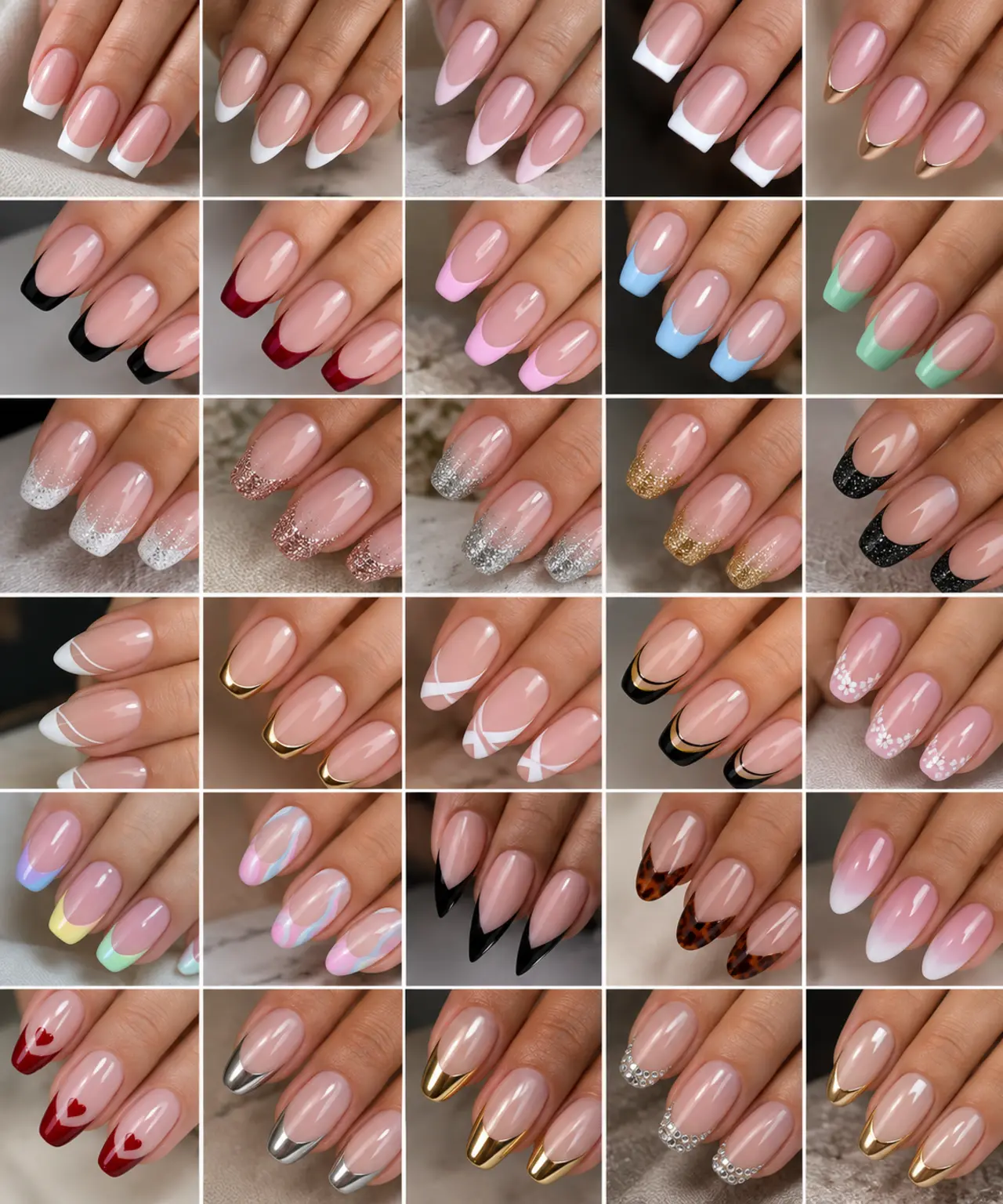
French tip nails combine a natural-looking or colored base with a contrasting line along the free edge of the nail. The classic version uses a sheer pink or nude base with crisp white tips, but modern French manicures can feature micro lines, bright colors, chrome, glitter, patterns, double tips, and unexpected textures.
That flexibility is a big reason the style works on everything from short natural nails to long almond, coffin, and stiletto shapes. You can keep French tips subtle enough for everyday wear or turn the same basic design into statement nail art.
If you are deciding what to ask for at your next manicure, the most important choices are the tip thickness, nail shape, base color, and finish. Here are the French tip nail ideas worth considering, along with practical guidance for choosing a version that suits your nails and lifestyle.
What Do French Tip Nails Look Like?
A traditional French manicure has a pale pink, beige, or translucent base and an opaque white tip that follows the nail’s natural smile line. The contrast creates the appearance of a clean, defined free edge without covering the entire nail in a strong color.
Modern French tips use the same basic placement but are much less restrictive. The tip can be black, red, pastel, metallic, glittery, patterned, or even translucent. Nail artists can also change its proportions, from an ultra-thin micro French line to a deep curved tip that occupies a larger part of the nail.
This makes the French manicure more of a design framework than one specific look.
Classic French Tip Nails
Classic white French tips remain one of the easiest options to wear because they pair with almost any outfit, jewelry choice, or occasion.
For the traditional look, choose a sheer pink or neutral base with an opaque white tip. A glossy top coat gives the manicure the familiar polished finish. Keeping the white section proportional to the nail is important. An excessively thick white band can visually shorten the nail bed, especially on short nails.
For a softer result, replace stark white with ivory, cream, or milky white. The lower contrast creates a more blended appearance while retaining the recognizable French manicure structure.
Classic French tips are particularly suitable for:
- Weddings and bridal events
- Work and professional settings
- Everyday manicures
- Minimalist styles
- Formal occasions
- People who frequently change clothing colors
They are also a useful starting point if you like understated nails but want more definition than a single nude polish provides.
Micro French Tip Nails for a Minimal Look
A micro French manicure uses an extremely thin line of color along the nail’s free edge. It retains the basic French-tip structure without the wider band associated with traditional versions.
Micro French tips are especially useful on short nails because they leave more of the nail bed visible. Current 2026 interpretations also combine micro tips with colored lines, velvet or magnetic finishes, and subtle nail art.
White is the obvious choice, but micro tips work equally well in black, red, cobalt blue, chocolate brown, silver, or pastel shades.
The precision matters more than the color. Because the line is so narrow, uneven thickness becomes easier to notice. A fine nail-art brush is usually better than a standard polish brush when recreating the style at home.
French Tip Ideas for Short Nails
Short nails do not need a wide white edge to make a French manicure noticeable. In fact, thinner tips usually preserve more visual length.
A micro French is one of the easiest approaches, but it is not the only option. Short nails can also carry diagonal tips, colored smile lines, corner French designs, glitter edges, and miniature double tips.
Good combinations include:
| Short-Nail Style | Base | Tip | Overall Effect |
|---|---|---|---|
| Micro French | Sheer pink | Thin white | Clean and classic |
| Black micro tip | Nude | Black | Minimal with contrast |
| Pastel French | Milky nude | Mixed pastels | Soft and playful |
| Glitter edge | Clear pink | Fine glitter | Subtle sparkle |
| Red French | Neutral | Cherry or deep red | Bold without covering the nail |
| Chrome tip | Sheer nude | Silver or pearl chrome | Modern and reflective |
Square and squoval shapes naturally provide a straighter edge for the design. Short oval nails can look softer, while short almond shapes can create the impression of extra length if enough natural nail is available to form the tapered sides.
Almond French Tip Nails
Almond nails taper toward a softly rounded point, giving the French tip a more curved, elongated appearance.
Instead of drawing a nearly horizontal white band, the tip can extend slightly farther down each side of an almond nail. This deeper smile line emphasizes the tapered silhouette and makes the nail appear more defined.
Almond French tips work particularly well with:
- Classic white tips
- Deep V-shaped tips
- Red French tips
- Gold or silver chrome
- Double French lines
- Ombré French designs
- Floral accents
- Glitter edges
If you want noticeable nail art without using an extremely long extension, a medium almond shape offers enough surface area for decorative details while remaining less dramatic than a long stiletto.
Square French Tip Nails
Square nails give French tips a crisp, graphic appearance because the free edge runs relatively straight across the top.
A medium-width white tip produces the familiar salon French manicure, while a thin colored edge makes the same shape look more contemporary. Square nails are also well suited to double lines and geometric designs because their straight sides complement structured nail art.
For very short square nails, keep the tip relatively narrow. A deep band of color can consume too much of the visible nail and make the proportions feel heavy.
If sharp corners are inconvenient in daily life, a squoval shape offers a similar appearance with slightly rounded edges.
Coffin French Tip Nails
Coffin nails, sometimes called ballerina nails, taper inward and finish with a flat edge. Their extra length creates substantially more room for French-tip variations.
The classic approach is a deep white smile line, but coffin nails can support more elaborate treatments such as marble tips, ombré edges, rhinestones, chrome, flames, animal prints, or layered French lines.
A useful design rule is to balance the length with the artwork. Long coffin nails already create a strong silhouette, so a simple micro tip can look surprisingly sophisticated. If you want statement nails, however, the larger surface gives a nail artist room to create detailed patterns without making individual elements excessively small.
Colored French Tip Nails
Replacing white with color is one of the simplest ways to modernize French tips without changing their basic structure.
Red creates strong contrast and works particularly well with a nude or transparent base. Black produces a sharper, more graphic manicure. Pastels soften the design, while jewel tones and darker shades can make French tips feel more seasonal.
Color also allows you to change the manicure without abandoning a style you already know suits your nails.
Consider these combinations:
| Tip Color | Base Color | Look |
|---|---|---|
| Cherry red | Sheer nude | Classic but bold |
| Black | Milky pink | Graphic and modern |
| Baby blue | Neutral pink | Soft and fresh |
| Chocolate brown | Beige nude | Warm and understated |
| Lilac | Milky base | Soft color contrast |
| Cobalt blue | Clear nude | High-impact color |
| Emerald | Neutral beige | Rich and polished |
| Multicolor | Sheer pink | Playful and expressive |
Another option is to give every nail a different tip color while keeping the same base. Because the placement remains consistent, the result can still look cohesive even when five or ten colors are involved.
Red French Tip Nails
Red French tips sit between a neutral manicure and full red nails. You get the impact of red while retaining plenty of negative space.
Bright cherry red creates a clean, high-contrast finish, while burgundy, wine, and oxblood shades feel deeper and moodier. A very thin red micro tip works on short nails, while longer almond nails can support a deeper curved red section.
For additional detail, pair red tips with a tiny heart accent, red half-moons, a second fine line, or a glossy red tip over a matte neutral base.
Because red already attracts attention, you do not need elaborate decoration to make this design noticeable.
Black French Tip Nails
Black French tips replace the softness of the traditional white edge with stronger contrast.
On short nails, a narrow black line looks clean and minimal. On almond or stiletto nails, a deep V-shaped black tip can create a sharper silhouette. Long square or coffin nails provide room for black-and-white patterns, metallic outlines, or negative-space designs.
The base changes the effect considerably. Black over clear or pale pink feels graphic, while black over beige or a deeper nude creates a warmer result.
For an evening manicure, black tips can also be combined with fine silver details, chrome, crystals, or a high-gloss finish.
Pink French Tip Nails
Pink-on-pink French tips offer a softer alternative to white while still creating enough contrast to define the nail.
Try a sheer blush base with hot-pink tips for a noticeable difference, or combine a milky pink base with baby-pink edges for a low-contrast manicure. A pink chrome tip is another option if you want shine without switching to a darker color.
The tonal approach is particularly useful when you want nail art that remains relatively subtle from a distance.
For extra detail, alternate solid pink tips with tiny hearts, flowers, dots, or glitter accents.
Pastel French Tips
Pastel tips work well when you want color without the intensity of neon or dark polish.
Lavender, mint, pale yellow, powder blue, peach, and soft pink can be worn individually or combined as a mismatched set. Keeping the base consistent prevents a multicolor manicure from becoming visually busy.
Pastels also work particularly well as micro tips. Only a narrow amount of color is visible, so you can experiment with shades that you might not want across the entire nail.
A milky or translucent base generally creates a softer transition than an opaque beige foundation.
Chrome French Tip Nails
Chrome changes the finish rather than the basic architecture of a French manicure. Instead of an opaque painted edge, the tip has a reflective or pearlescent surface.
Silver creates the strongest metallic effect. Gold adds warmth, while pearl or white chrome produces a subtler glow. Current French manicures also use chrome over sculpted or textured tips, allowing the reflective finish to highlight three-dimensional details.
Chrome can be applied to every tip or used on one or two accent nails alongside conventional French tips.
The color beneath chrome powder affects the finished appearance, so showing your nail technician a reference image is more reliable than requesting only “gold chrome” or “pearl chrome.”
Glitter French Tip Nails
Glitter tips are useful when you want sparkle without covering the whole nail.
Fine glitter produces a smoother, more delicate edge. Chunkier particles make the tip more obvious and can create a textured visual effect. Silver, champagne, rose gold, and iridescent glitter are easy to combine with neutral bases.
You can also fade glitter downward from the tip instead of creating a sharply defined smile line. This makes minor growth or small imperfections less visually obvious than an extremely precise solid edge.
For special occasions, glitter French tips can provide enough decoration without requiring rhinestones or complex nail art.
Double French Tips
A double French manicure adds a second line beneath or alongside the primary tip.
The two lines can match or contrast. White and gold create a refined combination, while black and white produce a stronger graphic effect. Two shades from the same color family create a more subtle tonal design.
Spacing is important. Leaving visible negative space between the lines makes the double-tip structure easier to see.
This design works best when the nail has enough length to accommodate two lines without crowding the nail bed. On short nails, both lines should remain very thin.
Reverse French Manicure
A reverse French manicure moves the visual emphasis from the free edge to the base of the nail.
Instead of outlining the tip, color follows the curved area near the cuticle. Some designs combine this half-moon detail with conventional French tips, effectively framing both ends of the nail.
This style is useful when you like the clean base of a French manicure but want something less expected than another tip variation.
Because polish placed too close to the skin can look messy and may increase skin exposure to nail products, clean application around the cuticle area is especially important.
Ombré French Nails
Ombré French nails soften the boundary between the base and the tip. Rather than a distinct white line, pink or nude gradually fades into white.
This style is sometimes described as a baby boomer manicure. The result is softer than traditional French tips because there is no sharp smile line separating the two colors.
Ombré works particularly well on medium and long nails, where there is enough surface area to create a gradual transition. Almond, coffin, and square shapes can all carry the effect.
It is also a practical option for people who like the colors of a traditional French manicure but prefer a less graphic finish.
French Tips With Nail Art
A French manicure can act as the foundation for more detailed nail art rather than being the finished design itself.
Popular additions include flowers, cherries, hearts, stars, dots, bows, abstract lines, animal prints, metallic details, and small crystals. Another approach is to turn the tip itself into the artwork by replacing a solid color with tortoiseshell, marble, flames, leopard print, or another pattern.
You do not have to decorate all ten nails. Keeping most nails simple and using one or two accent nails often makes intricate artwork easier to notice.
A practical formula is:
Neutral base + consistent French tips + one repeating accent = cohesive nail art.
For example, use thin red tips on every nail and place one miniature red heart on each ring finger. The manicure remains clearly French while gaining a recognizable theme.
How to Choose the Right French Tip Style
The best French manicure is not necessarily the most elaborate one. Start with your natural nail length and the amount of maintenance you are comfortable with.
Short natural nails generally pair well with micro tips, narrow colored tips, or subtle glitter. Medium almond nails offer more room for curved designs, double lines, and chrome. Long coffin or stiletto extensions provide the largest canvas for patterns and dimensional details.
Then consider contrast.
A tip close to your base color will look softer. A dark or saturated tip over a light neutral base will appear much more graphic.
Finally, consider how quickly visible growth bothers you. French manicures with sheer bases can make the area near the cuticle less conspicuous as the nail grows compared with an opaque color extending all the way to the cuticle.
How to Ask for French Tip Nails at a Salon
Showing a reference photo is usually the clearest way to communicate a specific French-tip design, particularly when the manicure involves unusual proportions or finishes.
Tell the nail technician:
- Your preferred nail length.
- Your desired shape, such as square, almond, oval, coffin, or stiletto.
- Whether you want a sheer, milky, nude, or colored base.
- How thick you want the French tip.
- Whether you prefer a curved, straight, V-shaped, or angled tip.
- The exact tip color and finish.
- Whether you want nail art, chrome, glitter, or accent nails.
The phrase “thin French tip” can still be interpreted differently by different people. A reference image eliminates much of that ambiguity.
How to Do French Tip Nails at Home
A simple French manicure is possible at home with regular nail polish, although clean lines require patience.
Start by shaping the nails and gently preparing the nail surface. Apply a base coat followed by your sheer pink, nude, or neutral color. Allow the layers to dry adequately before attempting the tips.
Use a fine nail-art brush to paint a narrow line along the free edge. Instead of trying to draw the entire smile line in one movement, work from each side toward the center. Correct small mistakes before sealing everything with a clear top coat.
French-tip guide stickers can help, but applying them before the underlying polish has dried completely may lift or mark the base.
For your first attempt, a slightly shimmery or glitter tip can be more forgiving than opaque white because tiny inconsistencies are less noticeable.
How to Help a French Manicure Last
Longevity depends partly on the manicure system used, your nail condition, application quality, and how much wear your hands receive.
Regardless of the product, avoid using your nails as tools to pry open containers or scrape surfaces. Moisturizing the nails and surrounding skin can also help prevent excessive dryness.
If you wear gel polish, do not peel it off when it starts lifting. Peeling can remove layers from the nail plate along with the coating.
Removal matters as much as application. Artificial enhancements and repeated filing can leave natural nails thinner or more brittle, so professional removal or the appropriate soak-off method may be preferable to pulling or picking at the product.
Protect Your Natural Nails
French tips can be created with ordinary polish, gel, acrylic, extensions, or other manicure systems, and those options do not affect natural nails in exactly the same way.
Dermatologists warn that artificial nails can contribute to thinning, brittleness, and dryness, particularly when the natural nail is heavily filed or enhancements are repeatedly applied and removed. Gel manicures can also contribute to brittleness, peeling, and cracking.
Cuticles provide a protective barrier around the nail, so cutting them aggressively is not necessary for achieving clean French tips. Good salon hygiene and properly disinfected tools also matter.
Gel manicures require curing equipment that exposes the hands to ultraviolet radiation. Dermatologists recommend protecting the skin with broad-spectrum, water-resistant SPF 30 or higher sunscreen or using dark, opaque, fingertip-free gloves before curing.
If a nail product causes persistent redness, swelling, pain, itching, or another unusual reaction, stop using it and seek appropriate medical advice rather than simply covering the problem with another manicure.
French Tip Nail Ideas by Mood and Occasion
If you have saved dozens of designs and still cannot decide, choose according to where you will wear the manicure.
For everyday wear: Try a sheer pink base with micro white tips.
For a wedding: Consider classic white, pearl chrome, soft ombré, or a fine glitter French manicure.
For a bold look: Choose black, cobalt, red, metallic, or multicolored tips.
For understated color: Use pastel micro tips over a milky base.
For an evening event: Try black French tips, gold chrome, silver metallic edges, or strategically placed crystals.
For seasonal nails: Keep the French structure but change the color palette. Pastels can create a lighter look, while chocolate, burgundy, emerald, and other rich shades create a deeper seasonal effect.
This approach is more useful than choosing a design purely because it is trending. A manicure you enjoy wearing for the full appointment cycle is usually a better choice than elaborate nail art that does not fit your normal style.
Frequently Asked Questions About French Tip Nails
Are French tip nails still in style?
Yes. The traditional white French manicure remains recognizable, but current versions frequently use micro tips, chrome, color, unusual textures, and less conventional smile lines. The adaptability of the basic design allows it to change without losing its recognizable structure.
Can you get French tips on very short nails?
Yes. A micro French tip is particularly suitable for short nails because the narrow line leaves most of the nail bed visible. White, black, red, pastel, and metallic micro tips can all work on short nails.
Which nail shape looks best with French tips?
There is no single best shape. Square nails create a crisp traditional look, almond nails emphasize curved tips, oval nails create a softer appearance, and coffin nails provide more space for elaborate designs. The right choice depends on your natural nail length and preferred style.
What color base is best for French tip nails?
Sheer pink and neutral nude are the traditional choices. Milky white creates a softer modern effect, while clear bases make colored tips stand out. A base that complements your skin tone generally produces the most natural-looking manicure.
What is the difference between French tips and an ombré French manicure?
Traditional French tips have a visible boundary between the base color and the contrasting tip. An ombré French manicure blends the base gradually into the lighter tip, creating a softer transition without a sharply defined smile line.
Can French tip nails damage natural nails?
The French-tip design itself is not the main issue. Potential damage depends more on the manicure system, preparation, application, removal, and frequency of artificial enhancements. Excessive filing, picking off gel, aggressive cuticle cutting, and repeated artificial-nail applications can contribute to nail problems.
Final Thoughts
French tip nails have moved far beyond a sheer pink base and thick white edge. The same design can now be adapted into micro tips for short nails, curved French tips for almond nails, colorful edges, chrome finishes, glitter, double lines, ombré effects, and detailed nail art.
For the most wearable result, match the design to your nail length first, then choose the tip thickness, color, and finish. A thin French line usually works well when you want something subtle, while deeper tips, strong colors, chrome, and patterned edges create more impact.
You do not need long extensions or elaborate artwork to make French tips look current. Sometimes the smallest change, such as replacing white with red, adding a razor-thin metallic edge, or switching to a milky base, is enough to make the classic manicure feel completely different.
For more helpful guides please visit RoyalSprinter.
