


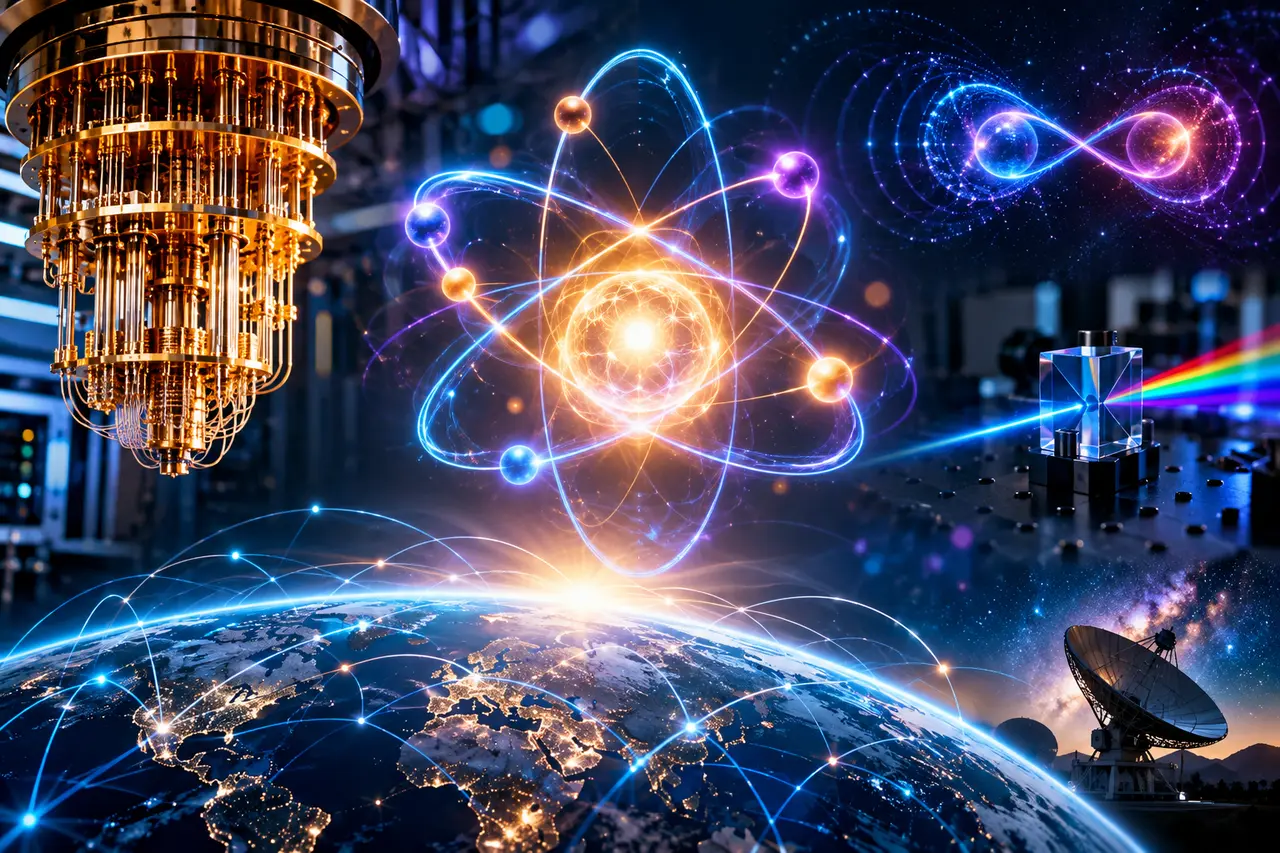
World Quantum Day is celebrated every year on April 14 to increase public awareness and understanding of quantum science and quantum technology. The date is not arbitrary. April 14, written as 4/14 or 4.14, reflects the rounded first digits of Planck’s constant when expressed in electron volt-seconds, approximately 4.14 × 10⁻¹⁵ eV·s.
The observance connects researchers, students, teachers, engineers, technology companies, science communicators, and the public through educational events and discussions. More importantly, it gives people an accessible way to explore a field that already underpins technologies such as semiconductor electronics and is driving research in quantum computing, communication, sensing, and other emerging applications.
World Quantum Day at a Glance
| Fact | Details |
|---|---|
| Date | April 14 every year |
| Abbreviation | WQD |
| Why April 14? | 4.14 represents the rounded first digits of Planck’s constant in eV·s |
| Initiative launched | April 14, 2021 |
| First global celebration | April 14, 2022 |
| Main purpose | Increase understanding and awareness of quantum science and technology |
| Typical activities | Talks, exhibitions, workshops, laboratory tours, discussions, educational activities, and artistic projects |
| Who can participate? | Students, educators, scientists, organizations, companies, communicators, and the general public |
The initiative began on April 14, 2021, as a countdown to the first worldwide celebration on April 14, 2022. It was conceived as a decentralized, community-driven effort rather than an observance controlled by a single institution.
Why Is World Quantum Day Celebrated on April 14?
The choice of April 14 contains a scientific reference hidden in the date itself.
Planck’s constant is a fundamental constant in quantum physics. Expressed in electron volt-seconds, its value begins approximately:
h = 4.1356677 × 10⁻¹⁵ eV·s
Rounding the beginning of that value gives 4.14, corresponding neatly to the fourth month and fourteenth day, April 14.
Planck’s constant describes the relationship between a photon’s energy and its frequency:
E = hf
Here, E represents energy, h is Planck’s constant, and f represents frequency.
The constant is important far beyond a clever calendar connection. It sits at the foundations of quantum mechanics and helps describe physical behavior at atomic and subatomic scales. Planck’s constant also has a modern role in measurement science: its fixed numerical value is part of the International System of Units’ definition of the kilogram.
That makes April 14 particularly fitting. The date turns one of quantum physics’ fundamental numbers into an annual invitation to learn about the science behind it.
What Is the Purpose of World Quantum Day?
World Quantum Day aims to make quantum science understandable and relevant to people beyond specialist research communities. The initiative emphasizes public understanding of how quantum science explains nature, how it contributed to technologies already used today, and how emerging quantum technologies could affect society in the future.
That distinction matters because quantum physics is sometimes presented as an exotic subject concerned only with strange behavior at extremely small scales. In reality, understanding quantum mechanics has contributed to major areas of modern science and engineering.
The observance therefore creates a bridge between advanced research and public understanding. A university might organize a laboratory tour, for example, while a school might introduce students to basic quantum concepts. A research organization could host a public lecture, and an artist might explore quantum ideas through visual or interactive work.
There is no requirement that every activity happen precisely on April 14. World Quantum Day events can take place around the date, allowing organizations in different countries to develop programs appropriate for their audiences.
How Did World Quantum Day Begin?
World Quantum Day was initiated by quantum scientists internationally on April 14, 2021, with the first global celebration taking place a year later on April 14, 2022.
The initiative subsequently expanded to involve scientists, engineers, educators, communicators, entrepreneurs, technologists, historians, philosophers, artists, museums, and other organizations.
Its decentralized structure is one reason the celebration can take many forms. Instead of prescribing one worldwide event, the initiative encourages participating communities to create their own activities.
These can include:
- Public lectures and scientific meetings
- Classroom activities and demonstrations
- Laboratory and research-facility tours
- Exhibitions and workshops
- Panel discussions and interviews
- Quantum computing demonstrations
- Artistic projects inspired by quantum science
- Career discussions for students
- Online educational events and resources
This approach allows a high-school classroom and an advanced physics laboratory to participate in the same global observance at very different technical levels.
Why Does Quantum Science Matter in Everyday Life?
Quantum mechanics describes physical behavior at scales where classical physics alone cannot adequately explain what happens. Although those scales are extraordinarily small, technologies built using knowledge of quantum physics are very much part of ordinary life.
Semiconductor devices provide a familiar example. The electronic chips inside computers and smartphones depend in part on principles understood through quantum mechanics.
Quantum science also has important connections with lasers, atomic clocks, precision measurement, materials research, and modern electronics.
The next wave of development seeks to control quantum systems more deliberately rather than merely applying knowledge derived from quantum mechanics. That distinction helps explain growing interest in areas such as quantum computing, quantum communication, and quantum sensing.
| Area | What Quantum Science Contributes |
|---|---|
| Computing | Qubits and quantum algorithms designed to exploit quantum behavior |
| Communication | Research into transferring and protecting quantum information |
| Sensing | Extremely sensitive measurements of physical quantities |
| Electronics | Physical principles underlying semiconductor behavior |
| Metrology | Highly precise measurement standards |
| Materials | Understanding and designing matter at microscopic scales |
Not every proposed quantum technology will necessarily become commercially practical. Research maturity, engineering difficulty, cost, scalability, and error control vary considerably between applications.
World Quantum Day provides an opportunity to discuss both the possibilities and those limitations instead of treating “quantum” as synonymous with an inevitable technological breakthrough.
Quantum Computing Is Only One Part of the Story
Public discussion of quantum technology often concentrates on quantum computers, but World Quantum Day covers a much wider scientific landscape.
Quantum computing uses quantum systems to process information in ways fundamentally different from conventional computers. Instead of classical bits restricted to 0 or 1, quantum information can be represented using qubits, whose states can involve superposition. Multiple quantum systems can also exhibit correlations associated with entanglement.
These properties open possibilities for specialized quantum algorithms, but they do not mean quantum computers will simply replace conventional computers.
Quantum communication investigates ways of transmitting quantum information and using quantum phenomena in communication systems. Quantum sensing seeks exceptionally precise measurements by exploiting controlled quantum states. Quantum metrology applies quantum physics to measurement and standards.
World Quantum Day therefore concerns the underlying science and its many applications, not simply the race to build more powerful quantum computers.
World Quantum Day and the International Year of Quantum Science and Technology
World Quantum Day gained additional visibility in 2025, when the United Nations proclaimed the International Year of Quantum Science and Technology.
The year was especially significant because 2025 marked approximately 100 years since the development of modern quantum mechanics. Scientific and educational organizations around the world used the occasion to highlight quantum research, education, technological development, and its potential implications for society.
The International Year concluded, but World Quantum Day continued as an annual observance. This distinction is useful because the two initiatives are related but are not the same event.
How Schools and Students Can Celebrate World Quantum Day
Students do not need advanced mathematics to participate. A useful World Quantum Day activity can begin with a simple question: Where does quantum physics appear in technologies we already use?
Schools can build activities around photons, atoms, light, measurement, computing, or the history of quantum mechanics. Teachers can also use April 14 to introduce careers in physics, engineering, computer science, mathematics, and quantum information science.
For older students, activities can progress from concepts to experiments or simulations. They might investigate the relationship between photon frequency and energy, learn how classical bits differ from qubits, explore interference, or study the contributions of scientists who developed quantum theory.
Students can also investigate familiar technologies and identify where quantum physics contributes to their operation. This approach makes an abstract scientific subject more closely connected to everyday life.
How Universities, Laboratories, and Organizations Can Participate
Universities and research institutions can use World Quantum Day to make work that normally happens behind laboratory doors more accessible.
Laboratory tours are particularly useful because they show that quantum research is not merely theoretical. Visitors can see experimental equipment and learn why quantum systems often require highly controlled environments.
Organizations can also arrange public talks, researcher Q&A sessions, demonstrations, career events, exhibitions, competitions, workshops, or discussions about the economic and societal implications of quantum technologies.
Businesses working in quantum technology can contribute through educational programs rather than simply promoting products. Explaining technical limitations alongside potential applications can help audiences develop a more realistic understanding of the field.
What World Quantum Day Can Teach Us About the Future
The most useful lesson of World Quantum Day is not that every future technology will become “quantum.” It is that fundamental scientific research can eventually produce consequences far beyond the questions researchers originally set out to answer.
Quantum theory transformed physicists’ understanding of matter, light, atoms, and elementary particles. Knowledge developed through that research later became relevant to technologies that billions of people use.
Current quantum research may follow a similar path, although its eventual effects cannot be predicted with certainty. Quantum computing, communication, sensing, materials, and precision measurement are developing at different rates and face different technical challenges.
Understanding those distinctions helps people evaluate announcements about quantum breakthroughs more critically. A laboratory demonstration, a prototype quantum processor, and a commercially useful system are not the same thing.
Celebrating the science should therefore include learning what quantum technologies can currently do, where researchers are making progress, and what problems remain unresolved.
Frequently Asked Questions About World Quantum Day
When is World Quantum Day?
World Quantum Day is celebrated annually on April 14. Educational and scientific events may also take place on surrounding dates.
Why is April 14 called World Quantum Day?
April 14 represents 4.14, the rounded first digits of Planck’s constant when expressed as approximately 4.14 × 10⁻¹⁵ eV·s.
When was the first World Quantum Day celebrated?
The initiative began on April 14, 2021, and the first global World Quantum Day celebration took place on April 14, 2022.
Is World Quantum Day only about quantum computing?
No. It covers quantum science and technology broadly, including fundamental quantum physics, computing, communication, sensing, metrology, engineering, education, history, and related subjects.
Who can participate in World Quantum Day?
Participation extends beyond professional physicists. Students, schools, universities, researchers, engineers, businesses, museums, artists, science communicators, and members of the public can organize or join activities.
How can I celebrate World Quantum Day?
You can attend a public lecture or laboratory tour, participate in a school activity, explore introductory quantum resources, organize a discussion or demonstration, learn about quantum computing, or investigate how quantum physics contributes to technologies used in everyday life.
Conclusion
World Quantum Day on April 14 turns the number 4.14, drawn from the beginning of Planck’s constant in electron volt-seconds, into a worldwide celebration of quantum science.
What began as an international scientific initiative has developed into an annual opportunity for researchers, educators, students, organizations, and the public to explore how quantum physics describes nature and contributes to technology.
Its broader value is educational. Quantum mechanics can seem remote from everyday life, yet its principles underpin important existing technologies while supporting research into new forms of computing, communication, sensing, and measurement.
World Quantum Day creates a reason to understand both sides of that story: what quantum science has already made possible and what researchers are still trying to achieve.
For more helpful guides please visit RoyalSprinter.
