


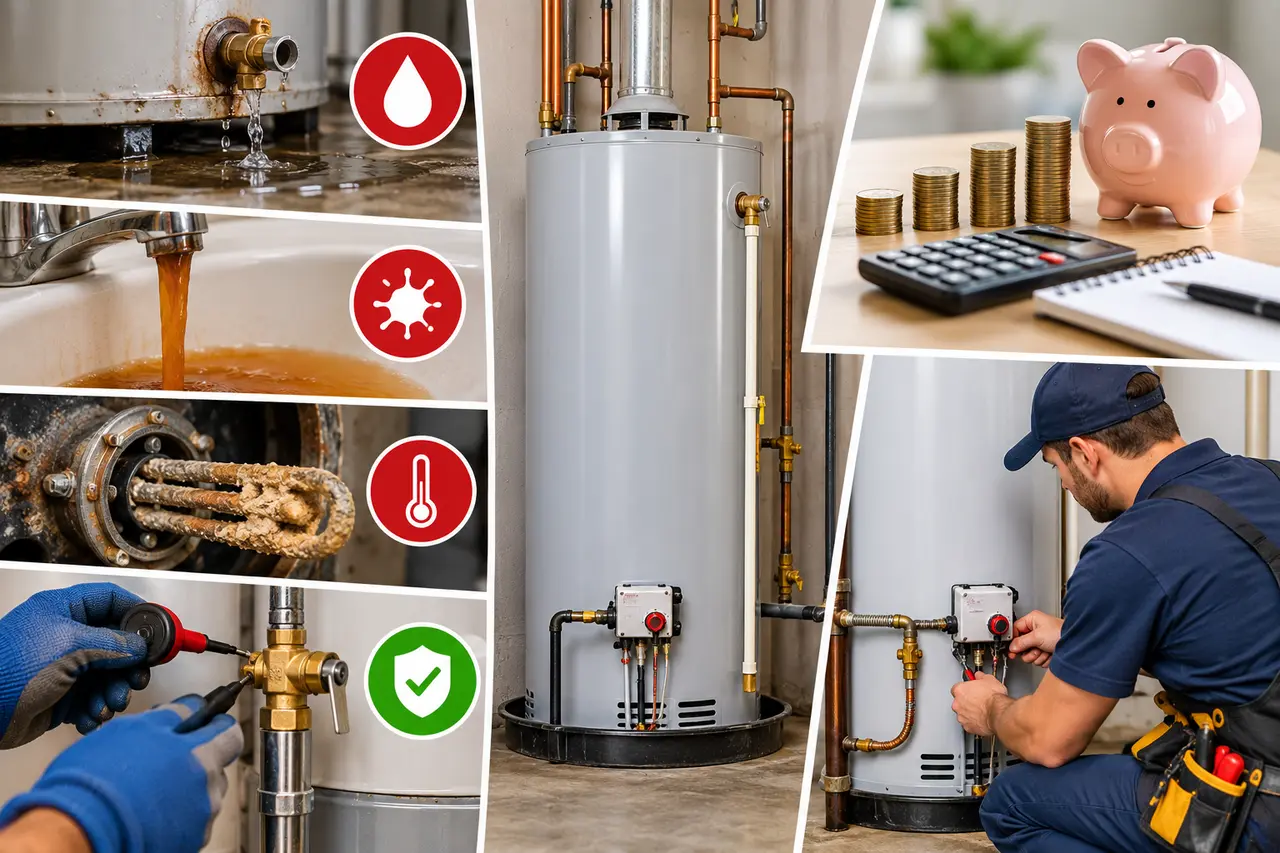
A reliable water heater repair can restore hot water without the expense of replacing the entire unit, but the right solution depends on the heater type, its age, and the failed component. Problems such as a bad heating element, thermostat, pilot or ignition system, leaking valve, sediment buildup, or faulty control may be repairable. A leaking or badly corroded storage tank, however, often points toward replacement rather than another repair.
The most useful first step is identifying the symptom without dismantling gas or electrical components. Water around the heater, unusual noises, discolored water, inconsistent temperatures, and a complete loss of hot water can each indicate different problems.
This guide explains how to recognize common water heater failures, what a technician may check, when repair makes sense, and which warning signs should be treated as safety issues.
Common Signs Your Water Heater Needs Repair
Water heater problems do not always begin with a complete loss of hot water. Many units show smaller warning signs before they stop working.
Watch for:
- No hot water or water that never gets hot enough
- Hot water running out much faster than usual
- Water that becomes excessively hot
- Temperature that changes unexpectedly
- Popping, rumbling, or banging noises from a storage tank
- Water leaking around the heater
- Rust-colored or otherwise discolored hot water
- Unusual odors from the hot water
- A gas burner that will not ignite or remain lit
- An electric water heater that repeatedly trips its circuit breaker
- Error codes on tankless or electronically controlled units
Some symptoms can have causes outside the heater itself. For example, hot water at one fixture but not another can point to a faucet, shower valve, or plumbing problem rather than a failed water heater.
That distinction matters because replacing heater components will not correct a problem located elsewhere in the plumbing system.
Why Is My Water Heater Not Producing Hot Water?
A complete loss of hot water has different likely causes depending on whether the unit uses electricity, gas, or an on-demand heating system.
An electric storage heater may stop heating because of a tripped breaker, failed heating element, thermostat problem, damaged wiring, or activated high-temperature cutoff. Many conventional electric tanks contain more than one heating element, so element and thermostat testing can help isolate the failure.
Gas water heaters introduce different possibilities. Depending on the design, a technician may inspect the gas supply, pilot or electronic ignition system, burner, thermocouple or flame-sensing components, controls, and venting system.
Tankless heaters can stop producing hot water because of ignition failures, inadequate flow, mineral buildup, blocked intake or exhaust paths, sensors, controls, or other model-specific faults.
Modern water heaters vary considerably. Storage, instantaneous, and heat-pump water heaters operate differently, which is why diagnostic procedures are not interchangeable between every unit.
Troubleshooting Common Water Heater Problems
The symptom can provide a useful starting point, but it should not be treated as a definitive diagnosis.
| Symptom | Possible Causes | Typical Next Step |
|---|---|---|
| No hot water | Power, ignition, heating element, thermostat, or control problem | Verify basic supply conditions, then diagnose components |
| Water is lukewarm | Element, thermostat, burner, capacity, or mixing issue | Check temperature and heater operation |
| Hot water runs out quickly | Failed element, sediment, excessive demand, or undersized heater | Diagnose heater and compare demand with capacity |
| Tank makes popping noises | Sediment or mineral accumulation | Inspect and determine whether flushing is appropriate |
| Water around heater | Valve, fitting, pipe, drain, relief system, or tank leak | Locate the actual source before repairing |
| Water is too hot | Thermostat, control, or temperature-setting problem | Stop unsafe use and inspect temperature controls |
| Tankless unit shows an error | Ignition, flow, venting, scale, sensor, or control issue | Check the manufacturer’s error code and service instructions |
A technician should diagnose the actual failure before parts are replaced. A symptom such as “no hot water” can have several causes, and changing components based on guesswork can increase the repair bill without solving the problem.
What to Do When a Water Heater Is Leaking
A leaking water heater deserves prompt attention because the source determines whether the unit needs a minor repair or replacement.
Water can escape from connections, valves, nearby plumbing, a drain fitting, or the temperature and pressure relief system. These leaks should not automatically be interpreted as a failed tank.
A storage tank leaking through its body or from severe corrosion is different. The tank itself is not normally treated like a replaceable valve or heating element, so substantial tank failure often shifts the decision toward replacing the heater.
Never plug, cap, or otherwise disable a temperature and pressure relief valve to stop water from coming out. The relief system is a critical safety device.
If water is actively spreading, take appropriate steps to prevent additional property damage without exposing yourself to electricity, gas, steam, or dangerously hot water.
Why a Water Heater Makes Popping or Rumbling Noises
Popping and rumbling from a storage water heater can indicate material accumulated inside the tank. Minerals and sediment may settle near the bottom over time, particularly where the water supply has significant mineral content.
The noise alone does not identify the condition of the tank. A technician may consider the heater’s age, maintenance history, water conditions, efficiency, and whether there are additional symptoms before recommending service.
Flushing is a maintenance procedure for some storage heaters. However, the correct procedure and interval depend on the equipment. Owners should follow the instructions for their actual model rather than assuming one maintenance schedule applies to every heater.
An older tank with significant corrosion or an existing leak should be assessed before aggressive maintenance is attempted.
Why Hot Water Runs Out Too Quickly
Running out of hot water does not necessarily mean you need a larger heater.
On an electric storage unit, a failed heating element can reduce effective heating performance. Other possibilities include thermostat problems, sediment accumulation, plumbing or mixing issues, increased household demand, or a tank that simply cannot meet current usage.
Consider whether the problem appeared suddenly or gradually. A household that previously had adequate hot water and suddenly does not is more likely to have developed a fault than a household that has always exceeded the heater’s capacity.
Usage patterns matter too. Several showers, laundry, dishwashing, and other hot-water demands occurring close together can exhaust a functioning storage heater.
This distinction can prevent unnecessary replacement. Diagnosis should establish whether the heater is malfunctioning or merely being asked to provide more hot water than it was designed to deliver.
Water Temperature Problems Should Not Be Ignored
Water that suddenly becomes excessively hot can cause burns and may indicate a thermostat or control problem.
For many residential applications, a water-heater setting around 120°F (approximately 49°C) is commonly used to reduce scald risk while providing usable hot water. However, appropriate settings can vary depending on the system, household needs, equipment, and applicable requirements.
Temperature management can become more complicated in systems that use higher storage temperatures. Mixing or tempering valves may be used in certain installations to control the temperature delivered to fixtures.
Always follow the heater manufacturer’s instructions and applicable plumbing requirements. If the heater cannot maintain a safe, predictable outlet temperature, have the problem diagnosed rather than repeatedly changing its thermostat setting.
Gas Water Heater Problems Require Extra Caution
Gas-fired water heaters involve combustion, fuel supply, ignition, and exhaust gases, so troubleshooting has additional safety implications.
A unit that repeatedly fails to ignite, shuts down unexpectedly, or appears to have combustion or venting problems needs proper diagnosis. Do not bypass safety switches or modify combustion components simply to make the burner operate.
Combustion gases must vent correctly. Problems with the venting system can create potentially serious safety hazards inside a building.
If you smell gas, suspect a fuel leak, or have reason to suspect a carbon monoxide problem, treat the situation as a safety issue rather than an ordinary hot-water inconvenience. Follow your gas utility’s emergency instructions and local emergency guidance.
Electric Water Heater Problems Also Carry Serious Risks
Electric water heaters can contain high-voltage circuits even though they do not have burners or fuel lines.
Common serviceable components can include heating elements, thermostats, wiring, controls, and safety cutoffs. Testing these components generally requires electrical knowledge and appropriate instruments.
Repeated breaker trips deserve particular attention. Continually resetting a breaker without determining why it trips can leave an electrical fault unresolved.
Power should be isolated before accessing electrical components, and the manufacturer’s service procedures should be followed. If you cannot safely verify that the equipment is de-energized, leave internal electrical diagnosis to a qualified professional.
Tankless Water Heater Repair Is Different From Tank Repair
Tankless water heaters heat water as it is needed rather than storing a conventional tank of heated water. That changes both their components and their troubleshooting process.
Depending on the model, problems can involve:
- Mineral scale
- Water-flow sensors
- Ignition components
- Gas supply
- Intake or exhaust restrictions
- Heat exchangers
- Temperature sensors
- Electronic controls
- Insufficient flow to activate heating
- Model-specific fault codes
Start with the displayed error code when one is available. The manufacturer’s documentation can often narrow the problem considerably.
Descaling may be part of routine service in areas with hard water, but procedures and approved chemicals vary by manufacturer. Follow the instructions for the specific unit rather than applying a generic cleaning procedure.
How Much Does Water Heater Repair Cost?
There is no reliable universal price for water heater repair. Costs vary by country and city, heater type, part availability, labor rates, access, unit design, and whether emergency service is required.
A more useful way to understand the bill is to separate its components.
| Cost Component | What Can Affect It |
|---|---|
| Diagnostic/service fee | Location, company, travel distance, time of visit |
| Labor | Repair complexity and accessibility |
| Replacement parts | Heater model, brand, component, availability |
| Additional plumbing work | Corroded fittings, valves, piping, drainage |
| Gas or electrical work | Extent of the fault and local requirements |
| Emergency service | Nights, weekends, holidays, urgent response |
Ask for an itemized estimate when possible. The estimate should make clear whether the quoted price covers diagnosis, labor, parts, additional materials, and applicable taxes or fees.
For an older heater, also ask whether the repair addresses the underlying problem or merely replaces one component on equipment that has other signs of deterioration.
Repair or Replace Your Water Heater?
Repair is often reasonable when the tank is structurally sound, the failed component is replaceable, parts are available, and the expected repair cost is proportionate to the heater’s remaining useful value.
Replacement becomes more attractive when the tank itself leaks, corrosion is extensive, breakdowns are recurring, critical parts are unavailable, or the repair approaches the economic value of keeping an aging heater.
Consider several factors:
Condition: Look for tank corrosion, leakage, and deterioration around connections.
Repair history: Repeated failures can change the economics of another repair.
Repair price: Compare the complete repair estimate with the installed cost of an appropriate replacement.
Performance: Determine whether the existing heater still meets household demand.
Efficiency: A replacement provides an opportunity to consider a different water-heating technology.
Expected ownership period: Spending heavily on an aging heater may make less sense when another major failure is reasonably foreseeable.
For example, suppose an older heater needs an expensive repair and has already required several service calls. Comparing the repair expense with the complete installed replacement cost gives a more useful decision basis than comparing the price of one replacement part with the retail price of a new tank.
What a Water Heater Repair Technician May Check
Professional diagnosis should identify the cause of the problem before recommending a solution. The exact inspection depends on the heater.
A technician may evaluate the water supply and visible plumbing, temperature controls, heating elements, burner or ignition components, electrical connections, error codes, signs of leakage, safety controls, and venting where applicable.
The service visit is also an opportunity to distinguish a water-heater fault from a broader plumbing problem.
Ask the technician to explain what failed, why the recommended repair addresses the symptom, and whether any other significant deterioration was discovered. That information makes it easier to compare repair and replacement on practical grounds.
When Water Heater Repair Becomes an Emergency
Some failures can wait for a scheduled service appointment. Others deserve immediate attention.
Treat the situation more urgently when there is a suspected gas leak, signs of combustion gases entering the building, uncontrolled water leakage, electrical burning or arcing, dangerously hot water, major overheating, or a suspected pressure-related problem.
Do not defeat safety controls to keep the heater operating.
When there is an immediate risk of fire, gas exposure, electrical shock, serious flooding, or injury, prioritize personal safety and the appropriate utility or emergency response over troubleshooting the appliance.
How to Reduce Future Water Heater Problems
Preventive maintenance cannot eliminate every breakdown, but it can help identify developing problems before they become major failures.
Start with the manufacturer’s maintenance schedule because different technologies have different requirements. Storage tanks, tankless heaters, and heat-pump water heaters should not automatically receive identical maintenance.
Periodically look for moisture, corrosion, damaged connections, unusual noises, or unexpected temperature changes. Address leaks promptly rather than allowing them to damage the heater or surrounding structure.
Heat-pump water heaters have additional maintenance requirements, including attention to components such as air filters. Follow the manufacturer’s instructions for inspection and cleaning intervals.
Keep the model and serial information accessible as well. Those details can help a service company identify compatible parts and determine whether manufacturer warranty coverage may still apply.
FAQs About Water Heater Repair
Can a leaking water heater be repaired?
Sometimes. Leaks from replaceable valves, connections, fittings, or nearby plumbing may be repairable. A storage tank that is leaking through the tank body because of corrosion generally presents a much stronger case for replacing the unit. The source should be identified before making that decision.
Why do I have warm water but not truly hot water?
Possible causes include a thermostat or heating-element problem, burner performance, mixing issues, sediment, or excessive demand. On electric tanks with multiple elements, one failed component may reduce heating performance without eliminating hot water completely.
Should I repair an old water heater?
Age is only one consideration. Compare the repair price, tank condition, breakdown history, parts availability, efficiency, and installed replacement cost. An inexpensive repair on a sound unit can make sense, while an expensive repair on a leaking or severely corroded tank may not.
Is it safe to repair a water heater yourself?
Basic observations and manufacturer-approved homeowner maintenance may be appropriate for someone with the necessary skills. Internal gas, combustion, high-voltage electrical, pressure-control, and certain plumbing repairs can create serious hazards when performed incorrectly. Manufacturer instructions and local requirements should determine what work is appropriate.
Why does my water heater keep needing repairs?
Repeated failures can result from aging components, corrosion, mineral accumulation, unfavorable water conditions, installation issues, or unresolved electrical, plumbing, combustion, or pressure problems. Instead of replacing another part automatically, ask for a diagnosis of the recurring cause.
How long does a water heater repair take?
It depends on the failure. Straightforward component replacement can be relatively quick when the correct part is available, while intermittent electrical faults, tankless error conditions, venting problems, difficult access, or unavailable parts can require substantially more time. A technician usually needs to diagnose the problem before providing a meaningful timeline.
Getting the Right Water Heater Repair
Effective water heater repair starts with diagnosis, not guesswork. Determine whether the problem involves the heater, plumbing, electrical supply, gas or combustion system, temperature controls, or the storage tank itself. Repairing a serviceable component can extend the useful life of an otherwise sound heater, while a leaking or severely deteriorated tank may make replacement the more practical path.
Most importantly, treat gas odors, combustion problems, uncontrolled leaks, electrical faults, overheating, and pressure-related problems as safety concerns. For ordinary performance issues, document the symptoms and heater model before contacting a qualified service professional. That information can make diagnosis faster and help you compare repair and replacement based on the actual condition of the equipment rather than its age alone.
For more helpful guides please visit RoyalSprinter.
