


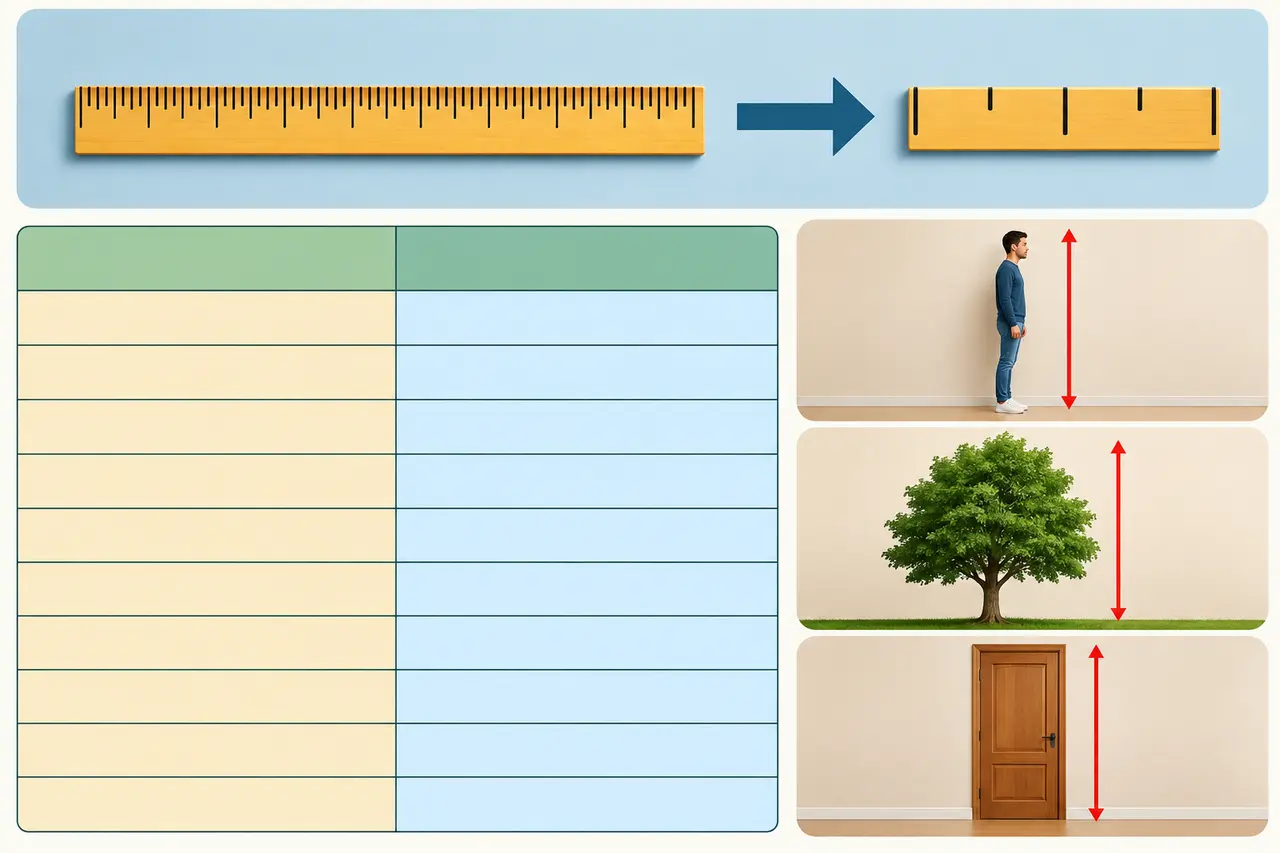
Converting inches to feet is simple: divide the number of inches by 12. There are exactly 12 inches in 1 foot, so the formula is:
Feet = Inches ÷ 12
For example, 36 inches = 3 feet, while 30 inches = 2.5 feet, or 2 feet 6 inches. This guide explains how to convert inches into decimal feet and feet-and-inches notation, with quick-reference tables and practical examples.
How to Convert Inches to Feet
To convert inches to feet, divide the measurement in inches by 12.
Formula:
ft = in ÷ 12
For example, suppose you need to convert 48 inches to feet:
48 ÷ 12 = 4 feet
The conversion works because the relationship between inches and feet is fixed:
12 inches = 1 foot
That also means:
1 inch = 1/12 foot ≈ 0.08333 feet
The same formula works for any measurement, including values that do not convert into a whole number of feet.
Inches to Feet Conversion Chart
The following table provides common inch-to-foot conversions.
| Inches | Feet (Decimal) | Feet and Inches |
|---|---|---|
| 1 in | 0.0833 ft | 0 ft 1 in |
| 6 in | 0.5 ft | 0 ft 6 in |
| 12 in | 1 ft | 1 ft 0 in |
| 18 in | 1.5 ft | 1 ft 6 in |
| 24 in | 2 ft | 2 ft 0 in |
| 30 in | 2.5 ft | 2 ft 6 in |
| 36 in | 3 ft | 3 ft 0 in |
| 42 in | 3.5 ft | 3 ft 6 in |
| 48 in | 4 ft | 4 ft 0 in |
| 60 in | 5 ft | 5 ft 0 in |
| 72 in | 6 ft | 6 ft 0 in |
| 84 in | 7 ft | 7 ft 0 in |
| 96 in | 8 ft | 8 ft 0 in |
| 108 in | 9 ft | 9 ft 0 in |
| 120 in | 10 ft | 10 ft 0 in |
For measurements that are exact multiples of 12, the result is a whole number of feet. Other measurements can be expressed either as decimal feet or as a combination of feet and inches.
Converting Inches to Feet and Inches
Sometimes a decimal answer is not the most useful format. Height, furniture dimensions, construction measurements, and room features are commonly written as feet and inches instead.
To convert inches to feet and inches:
- Divide the total inches by 12.
- Keep the whole-number quotient as the number of feet.
- Use the remainder as the number of inches.
For example, convert 65 inches:
65 ÷ 12 = 5 remainder 5
Therefore:
65 inches = 5 feet 5 inches, commonly written as 5 ft 5 in or 5′5″.
Consider another example using 50 inches:
50 ÷ 12 = 4 remainder 2
So:
50 inches = 4 feet 2 inches.
This method is often easier than converting a decimal result back into inches.
Decimal Feet vs. Feet and Inches
Decimal feet and feet-and-inches notation describe the same length, but they serve different purposes.
| Measurement | Decimal Feet | Feet and Inches |
|---|---|---|
| 15 inches | 1.25 ft | 1 ft 3 in |
| 27 inches | 2.25 ft | 2 ft 3 in |
| 45 inches | 3.75 ft | 3 ft 9 in |
| 66 inches | 5.5 ft | 5 ft 6 in |
| 75 inches | 6.25 ft | 6 ft 3 in |
Decimal feet are convenient for calculations. Feet and inches are often easier to read when describing physical dimensions.
One common mistake is treating the decimal portion as inches. For example, 5.5 feet does not mean 5 feet 5 inches. The 0.5 represents half a foot:
0.5 × 12 = 6 inches
Therefore, 5.5 feet = 5 feet 6 inches.
Examples of Inches to Feet Conversions
Here are several examples showing how the formula works with different measurements.
Convert 20 Inches to Feet
Divide 20 by 12:
20 ÷ 12 = 1.6667
So:
20 inches ≈ 1.667 feet
In feet-and-inches notation:
20 inches = 1 foot 8 inches
Convert 32 Inches to Feet
32 ÷ 12 = 2.6667
Therefore:
32 inches ≈ 2.667 feet
Since 24 inches make 2 feet and 8 inches remain:
32 inches = 2 feet 8 inches
Convert 54 Inches to Feet
54 ÷ 12 = 4.5
Therefore:
54 inches = 4.5 feet
The decimal portion represents 6 inches, so the same measurement is:
4 feet 6 inches
Convert 70 Inches to Feet
70 ÷ 12 = 5.8333
Therefore:
70 inches ≈ 5.833 feet
In feet and inches:
70 inches = 5 feet 10 inches
Convert 100 Inches to Feet
100 ÷ 12 = 8.3333
Therefore:
100 inches ≈ 8.333 feet
Because 8 feet equals 96 inches, 4 inches remain:
100 inches = 8 feet 4 inches
How to Convert Decimal Feet Back to Feet and Inches
If an inches-to-feet calculation produces a decimal, you can convert the decimal portion into inches by multiplying it by 12.
Suppose the result is 6.75 feet.
Keep the whole number:
6 feet
Then multiply the decimal part by 12:
0.75 × 12 = 9 inches
Therefore:
6.75 feet = 6 feet 9 inches
This is particularly useful when a calculator gives an answer in decimal feet but you need a measurement suitable for a tape measure.
Rounding matters when the calculation produces a repeating decimal. Keep enough decimal places for the precision required rather than rounding too early.
Why 12 Inches Equal 1 Foot
The inch and foot are units of length used in the U.S. customary system, while they also have defined relationships within the international yard-and-pound system.
The key relationship for everyday conversion is fixed:
1 foot = 12 inches
A foot is also exactly 0.3048 meters, while an inch is exactly 25.4 millimeters. These definitions maintain a consistent relationship between customary and metric measurements.
For a straightforward inches-to-feet calculation, however, you only need to remember the number 12.
Common Mistakes When Converting Inches to Feet
The most frequent mistake is multiplying by 12 instead of dividing. When moving from a smaller unit, inches, to a larger unit, feet, divide by 12. When converting feet to inches, multiply by 12.
Another mistake involves reading decimal feet as if the digits after the decimal point were inches. For example:
3.25 feet = 3 feet 3 inches, not 3 feet 25 inches.
To find the inches, multiply the decimal portion by 12:
0.25 × 12 = 3
Also consider how much precision you actually need. A rounded decimal such as 2.67 feet may be adequate for an estimate but less useful for precise cutting or installation. In those situations, retaining the original measurement in inches or using feet-and-inches notation can reduce rounding errors.
Frequently Asked Questions
How many inches are in a foot?
There are exactly 12 inches in 1 foot.
How do you calculate inches to feet?
Divide the number of inches by 12. For example, 96 ÷ 12 = 8, so 96 inches equals 8 feet.
What is 24 inches in feet?
24 inches equals 2 feet because 24 ÷ 12 = 2.
What is 60 inches in feet?
60 inches equals 5 feet because 60 ÷ 12 = 5.
What is 72 inches in feet?
72 inches equals 6 feet because 72 ÷ 12 = 6.
How do you convert inches into feet and inches without a calculator?
Find the largest multiple of 12 that does not exceed the measurement. The number of groups of 12 gives you the feet, and the amount left over gives you the inches. For example, 67 inches contains five complete groups of 12 (60 inches), leaving 7 inches. Therefore, 67 inches = 5 feet 7 inches.
Conclusion
To convert inches to feet, divide the number of inches by 12. Whole-number results can be written directly in feet, while measurements with a remainder can be expressed as decimal feet or as feet and inches.
For everyday measurements, remembering 12 inches = 1 foot is usually all you need. When precision matters, avoid rounding too early and use feet-and-inches notation when it makes the measurement easier to interpret.
For more helpful guides please visit RoyalSprinter.
