


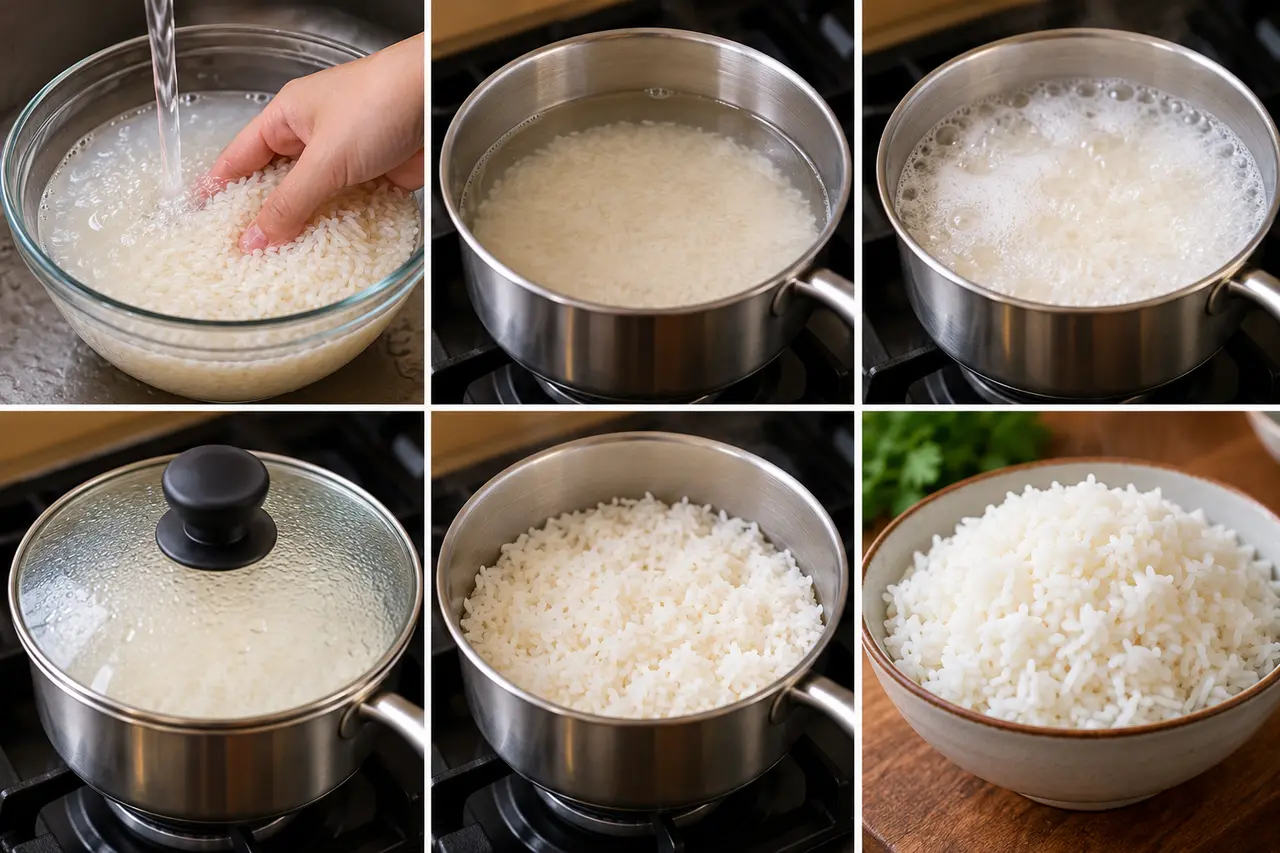
Learning how to cook rice is straightforward once you get three things right: the rice-to-water ratio, cooking temperature, and resting time. For basic white rice, rinse the grains, combine 1 cup of rice with about 1½ cups of water, bring it to a boil, then cover and cook over low heat until the water is absorbed. Letting the rice rest before fluffing helps produce separate, tender grains instead of wet or sticky rice.
The exact amount of water and cooking time can change depending on the type of rice, your cookware, and whether you are using a stovetop, rice cooker, or pressure cooker. The method below focuses on reliable stovetop rice while explaining how to adjust it for common varieties.
What You Need to Cook Rice
You do not need specialized equipment to make good rice on the stove. A saucepan with a tight-fitting lid is usually enough.
For a basic batch, use:
- 1 cup white rice
- About 1½ cups water
- ¼ teaspoon salt, optional
- 1 teaspoon butter or oil, optional
- A medium saucepan with a tight-fitting lid
- A fine-mesh strainer for rinsing
One cup of uncooked rice generally makes enough cooked rice for several side-dish servings, although the final yield varies by rice variety.
Water deserves particular attention. Too little can leave the center of the grains hard, while too much can produce overly soft or mushy rice.
Choose the Right Rice-to-Water Ratio
There is no single water ratio that works perfectly for every kind of rice. Grain type, processing, cooking equipment, and evaporation all affect how much water is needed.
The following amounts are useful stovetop starting points:
| Rice type | Starting water for 1 cup rice | Approximate covered cooking time |
|---|---|---|
| Long-grain white rice | 1½ cups | 15 to 18 minutes |
| Basmati rice | 1½ cups | 12 to 15 minutes |
| Jasmine rice | 1¼ to 1½ cups | 12 to 15 minutes |
| Brown rice | 2 cups | 40 to 50 minutes |
Treat these figures as practical ranges rather than universal rules. Some packaged rice is processed differently and may specify another ratio. When the package provides cooking directions for that particular product, those directions are a useful starting point.
The saucepan also matters. A loose lid allows more steam to escape, while a wide pan can lose water faster than a narrow one. This explains why the same ratio does not always give identical results in different kitchens.
Rinse the Rice Before Cooking
Place the rice in a fine-mesh strainer and rinse it under cool running water. Gently move the grains with your fingers until the draining water becomes noticeably clearer.
Rinsing removes loose surface starch. This can reduce excessive stickiness and help varieties such as basmati and long-grain white rice cook into more distinct grains.
Do not confuse rinsing with soaking. Rinsing takes only a short time, whereas soaking leaves rice in water for a longer period. Some varieties, particularly basmati, can be soaked before cooking to change their texture and reduce cooking time, but soaking is not necessary for basic stovetop white rice.
Cook Rice on the Stove Step by Step
1. Add the rice and water to a saucepan
Put 1 cup of rinsed and drained white rice into a saucepan. Add approximately 1½ cups of water.
Add salt if desired. A teaspoon of butter or oil is also optional. Fat can add flavor and may help the grains remain separate, but rice does not require it to cook properly.
2. Bring the water to a boil
Place the saucepan over medium-high heat and bring the water to a boil.
Once it reaches a steady boil, give the rice a brief stir if needed to ensure nothing is stuck to the bottom.
Avoid repeatedly stirring rice after this point. Frequent stirring releases more starch and can create a softer, stickier texture.
3. Cover and reduce the heat
Put the lid on the saucepan and reduce the burner to low.
The goal is a gentle simmer, not vigorous boiling. High heat can make the water evaporate too quickly and may scorch the rice on the bottom before the grains have finished absorbing moisture.
4. Let the rice cook undisturbed
Cook long-grain white rice for roughly 15 to 18 minutes.
Try not to repeatedly lift the lid. Opening the saucepan releases steam and changes the cooking environment.
If you are uncertain whether the rice is ready near the end of the cooking period, briefly check it. Properly cooked rice should have absorbed the free water and should be tender rather than hard in the center.
5. Turn off the heat and let it rest
Remove the saucepan from the heat, or simply switch off the burner if residual heat is not excessive.
Keep the lid on and let the rice rest for approximately 10 minutes.
This small step makes a noticeable difference. Moisture continues to redistribute through the rice while it rests, helping the grains finish cooking more evenly.
6. Fluff before serving
Remove the lid and gently fluff the rice with a fork.
Rather than aggressively stirring or mashing it, lift and separate the grains. Serve immediately or keep it covered briefly so it remains warm.
How to Tell When Rice Is Properly Cooked
Properly cooked rice should be tender all the way through without becoming waterlogged. For varieties intended to produce separate grains, the finished rice should also fluff easily.
Taste a few grains if you are uncertain. A hard or chalky center usually indicates that the rice needs more moisture or cooking time.
You can also inspect the bottom of the saucepan. There should not be a pool of water remaining once absorption-method rice is finished. If the grains are already tender but a small amount of water remains, covering and resting the rice may allow the remaining moisture to redistribute.
Fix Common Rice Cooking Problems
Rice is surprisingly forgiving, and many problems can be corrected before you discard the batch.
| Problem | Likely cause | What to do |
|---|---|---|
| Rice is hard or dry | Too little water or insufficient cooking time | Add a small splash of hot water, cover, and cook gently for a few more minutes |
| Rice is mushy | Too much water or excessive cooking | Remove the lid and allow excess moisture to escape |
| Bottom is burned | Heat was too high or water evaporated too soon | Stop cooking and transfer the unburned upper layer without scraping the bottom |
| Rice is excessively sticky | Too much water, stirring, or loose surface starch | Rinse more thoroughly and avoid stirring during cooking |
| Rice is wet after cooking | Excess water remains | Rest covered first, then uncover briefly if necessary |
| Rice cooks unevenly | Steam escaped or heat was inconsistent | Use a tight lid and maintain low, steady heat |
If rice frequently comes out dry even when you follow the same measurements, your saucepan may be losing more steam than expected. Instead of dramatically increasing the water, try adding a few tablespoons more to the next batch and compare the result.
Small adjustments are easier to control than changing the ratio by a large amount.
How to Cook Basmati Rice
Basmati is prized for its long grains and relatively separate texture. Rinse 1 cup of basmati thoroughly, then combine it with roughly 1½ cups of water for a simple stovetop preparation.
Bring it to a boil, cover the saucepan, reduce the heat, and simmer gently for approximately 12 to 15 minutes. Turn off the heat and leave it covered for another 10 minutes before fluffing.
Some cooks soak basmati before cooking. If you soak it, the grains absorb water in advance, so cooking requirements can change. Follow instructions designed specifically for the soaking method rather than automatically using the same ratio and cooking time.
How to Cook Jasmine Rice
Jasmine rice generally benefits from slightly less water than some standard long-grain white rice because too much moisture can make its naturally soft texture overly wet.
Rinse 1 cup of jasmine rice and start with approximately 1¼ to 1½ cups of water, depending on the rice and your preferred texture. Bring it to a boil, cover it, reduce the heat, and cook gently for roughly 12 to 15 minutes.
Rest the covered rice for about 10 minutes afterward. Fluff gently to avoid crushing the tender grains.
How to Cook Brown Rice
Brown rice takes longer to cook because the grain retains its bran layer. It also typically requires more water than white rice.
For an absorption-style stovetop method, approximately 2 cups of water for 1 cup of brown rice is a reasonable starting point. Simmer it covered for around 40 to 50 minutes, checking the particular package instructions because varieties differ.
Once tender, let the rice rest covered for approximately 10 minutes. Brown rice should be pleasantly chewy, but it should not have a hard center.
How to Add More Flavor to Plain Rice
Water produces perfectly usable rice, but replacing some or all of it with an appropriate broth can add flavor. Keep in mind that packaged broth may already contain substantial salt, so adjust additional seasoning accordingly.
You can also cook rice with aromatics such as garlic, ginger, bay leaf, cardamom, or other spices that complement the meal. Toasting dry, drained rice briefly in a little oil or butter before adding water can produce a slightly nuttier flavor.
Match the seasoning to the dish rather than adding everything at once. For example, basmati served alongside a South Asian curry may work well with whole spices, while simple lightly salted rice may be preferable when accompanying a strongly flavored main dish.
Cook Larger Batches Carefully
Doubling the amount of rice does not always mean that every part of the process should be doubled mechanically.
A larger quantity changes the depth of the rice and water in the saucepan, the time required to reach a boil, and the way steam circulates. Use an adequately sized pot and avoid filling a small saucepan too deeply.
If you regularly cook large batches, keep notes on the rice brand, amount of water, saucepan, and cooking time that work in your kitchen. This simple approach is often more reliable than searching for a supposedly universal ratio each time.
Store and Reheat Cooked Rice Safely
Cooked rice should not be left sitting at room temperature for extended periods. Rice can contain spores of Bacillus cereus, and improper cooling or storage can allow bacteria to multiply and toxins to develop.
If you plan to save leftovers, cool the rice promptly and refrigerate it in a covered container. Food-safety guidance can vary by country, so follow the current recommendations of your local food-safety authority for storage times and reheating.
When reheating rice, heat it thoroughly. Adding a small splash of water before reheating can help replace moisture lost during refrigeration and produce a softer texture.
FAQs About Cooking Rice
Should you rinse rice before cooking it?
Rinsing is useful for many varieties because it removes loose surface starch and can produce less sticky, more separate grains. Follow package directions when rice has special preparation requirements.
How much water do you need for 1 cup of rice?
For basic long-grain white rice cooked on the stovetop, about 1½ cups of water is a useful starting point. Jasmine rice may require somewhat less, while brown rice generally needs more.
How long does rice take to cook?
Many white rice varieties cook in approximately 12 to 18 minutes after reaching a boil and being reduced to a gentle simmer. Brown rice can require around 40 to 50 minutes. Resting time comes afterward.
Why does my rice turn out mushy?
Excess water is one of the most common causes. Overcooking and frequent stirring can also contribute. Measure carefully, cook over low heat, and avoid unnecessary stirring once the rice begins simmering.
Why is my rice still hard after the water is gone?
The rice may not have received enough water, or excessive heat may have caused the water to evaporate before the grains finished cooking. Add a small amount of hot water, cover the pan, and continue cooking gently for a few minutes.
Do you need to let rice rest after cooking?
Resting is worthwhile. Leaving the rice covered for about 10 minutes after cooking allows residual steam and moisture to distribute more evenly, which can improve the final texture.
Conclusion
The easiest way to learn how to cook rice consistently is to control the ratio, heat, and resting period rather than relying on cooking time alone. For basic long-grain white rice, start with 1 cup of rinsed rice and about 1½ cups of water, simmer it covered over low heat for roughly 15 to 18 minutes, then let it rest for 10 minutes before fluffing.
Use that method as a starting point rather than a rule for every grain. Basmati, jasmine, brown rice, different cookware, and individual rice brands can require adjustments. Once you identify the ratio and timing that work with your rice and saucepan, repeat those measurements for much more consistent results.
For more helpful guides please visit RoyalSprinter.
