


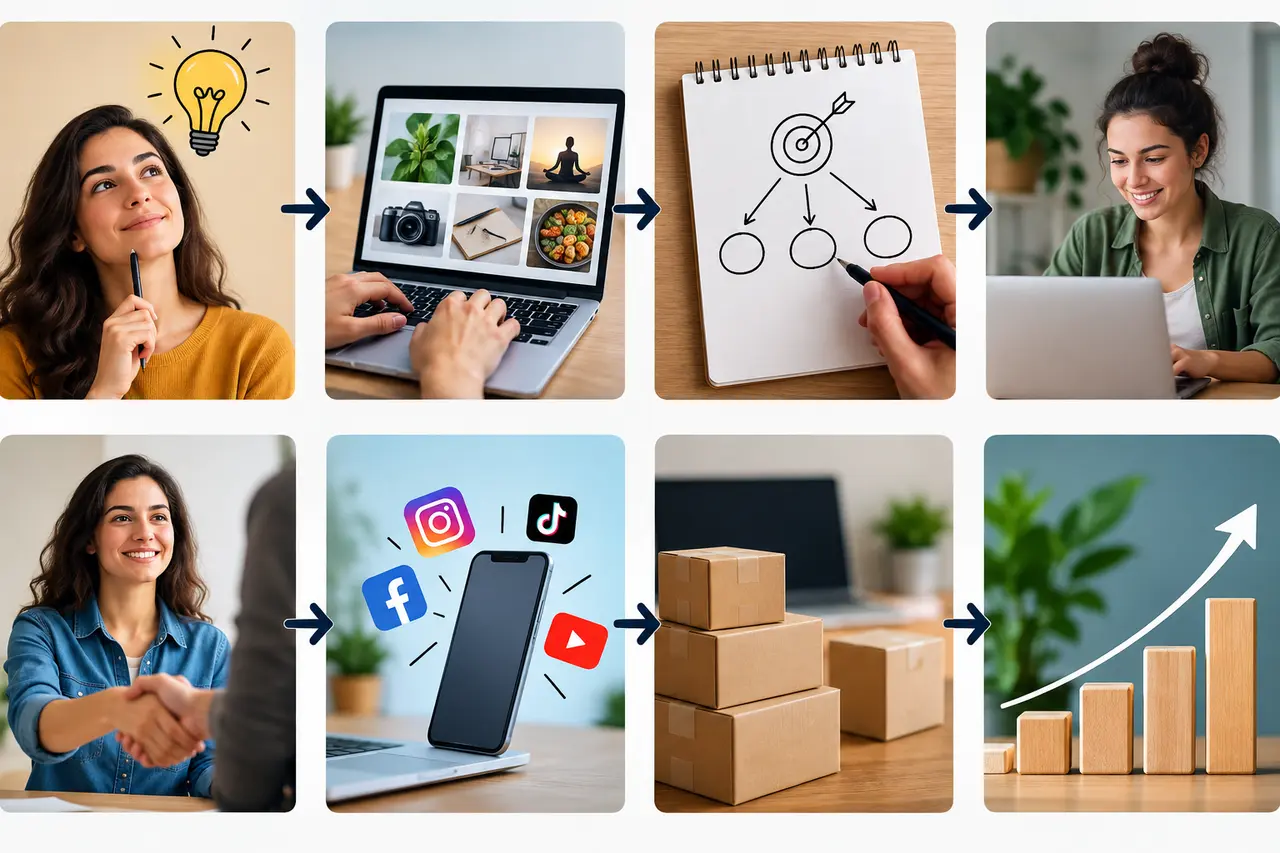
You can start a business without much money if you choose a model that uses skills, time, relationships, or equipment you already have instead of requiring inventory, employees, rented space, or expensive software. The easiest businesses to launch this way are usually service businesses because you can find a customer, perform the work, get paid, and use that revenue to fund future expenses.
That does not mean every business can literally be started for $0. Registration fees, licenses, insurance, transportation, equipment, payment processing, and other requirements can create unavoidable costs depending on your business and location. The goal is therefore not simply to spend nothing. It is to avoid spending money before you have evidence that customers will pay you.
This approach changes the usual startup sequence. Instead of building a company and then searching for customers, you identify a customer problem, create a simple offer, make the first sale, and gradually build the business around proven demand.
Can You Really Start a Business With No Money?
Yes, but only certain types of businesses are suitable for a near-zero-cost launch.
A business needs resources even when it does not need much cash. Those resources might be your professional skills, knowledge, smartphone, computer, internet connection, personal network, spare time, transportation, or tools you already own.
The key distinction is between businesses that require capital before the first sale and businesses that can generate revenue before significant expenses occur.
For example, someone offering bookkeeping services from an existing laptop may be able to find and serve a client before buying specialized software. Someone opening a restaurant cannot realistically follow the same model because food businesses can require premises, equipment, inventory, permits, insurance, inspections, and other upfront expenditures.
The U.S. Small Business Administration identifies licenses, permits, insurance, equipment, inventory, professional services, marketing, and websites among the expenses entrepreneurs may need to consider before launching. Actual requirements and costs depend on the business and location.
| Business model | Typical cash requirement at the beginning | Why it can or cannot work with little money |
|---|---|---|
| Freelance services | Very low | You can sell an existing skill before purchasing additional resources |
| Consulting | Very low | Knowledge and expertise are the main product |
| Tutoring or lessons | Very low | Existing knowledge can be delivered online or locally |
| Local services | Low | Cleaning, organizing, lawn care, repairs, or similar services may work if you already have the required tools |
| Virtual assistance | Very low | A computer, internet connection, and organizational skills may be enough to begin |
| Agency services | Low | Work can initially be performed by the founder before hiring |
| Digital products | Low | Production can be inexpensive, although generating traffic and sales may take time |
| Print-on-demand | Low to moderate | Inventory risk can be reduced, but samples, transaction fees, marketing, and returns may still cost money |
| Traditional ecommerce | Moderate to high | Inventory, shipping, returns, packaging, and customer acquisition can require capital |
| Restaurant or physical retail | High | Premises, equipment, inventory, licenses, insurance, and staffing often create major startup costs |
| Manufacturing | High | Materials, equipment, facilities, testing, compliance, and production can require substantial capital |
A useful rule is simple: when you have almost no money, start with the shortest possible distance between your effort and customer payment.
Step 1: Start With Resources You Already Have
Before looking for financing, examine what you can already turn into something valuable.
Think about tasks people regularly ask you to perform, professional skills you use at work, subjects you understand well, tools you own, problems you can solve, and groups of people you already understand.
A graphic designer may already have the skills and computer necessary to sell presentation design. A university student who understands mathematics might offer tutoring. Someone experienced with spreadsheets could organize reports for small companies. A competent gardener who already owns basic equipment could offer local maintenance services.
The objective is not to discover the most exciting possible business idea. It is to identify a problem you can solve without needing substantial capital first.
This also reduces financial risk. If customers reject the offer, you have learned something without spending thousands of dollars building a business around an unproven assumption.
Step 2: Choose a Business Model That Produces Cash Early
When money is limited, cash flow matters more than appearances.
Consider two hypothetical businesses. Business A requires $5,000 of inventory before the owner knows whether customers want the product. Business B sells a $500 service that requires only $50 of direct expenses after the customer agrees to purchase it.
Business B has a much easier funding problem.
This is why services are particularly useful for bootstrapped entrepreneurs. You can often sell the result rather than purchasing products in advance.
Another option is to use customer-funded models when appropriate. A business might use deposits, retainers, subscriptions, advance bookings, or legitimate pre-orders to reduce the amount of working capital required.
These arrangements need clear terms. Customers should understand what they are buying, when they will receive it, what the cancellation or refund conditions are, and whether a payment is refundable. Consumer protection and payment rules can differ by jurisdiction and industry.
Do not treat customer deposits as free personal cash. They create an obligation to deliver what the customer purchased.
Step 3: Validate the Idea Before Building the Business
One of the most expensive startup mistakes is solving a problem nobody is sufficiently motivated to pay to solve.
You can test demand before building a website, designing a logo, purchasing inventory, registering trademarks, or paying for sophisticated software.
Start by defining one specific customer and one specific problem.
“Marketing services for businesses” is extremely broad.
“Creating short-form videos for independent real estate agents who do not have time to edit their own content” is much easier to test.
Then speak directly with potential customers. Ask how they currently solve the problem, what frustrates them, what they have already tried, and what happens if the problem remains unsolved.
Market research should establish whether customers exist and what alternatives they already use. The SBA similarly recommends combining market research with competitive analysis to understand customers and identify how a business can differentiate itself.
The strongest validation is not praise.
It is a purchase.
Someone saying “that sounds like a great idea” provides much weaker evidence than someone agreeing to pay for the solution.
Step 4: Create the Smallest Offer Someone Will Pay For
Do not begin by trying to build the final version of the business.
Create the smallest useful version of your offer that produces a clear result for a customer.
Suppose you eventually want to build a social media agency. You do not initially need employees, an office, an expensive agency website, ten software subscriptions, or a complicated range of packages.
You might begin with one straightforward service:
“12 edited short-form videos per month from footage the client provides.”
That offer is easier to explain, price, deliver, and improve.
Your initial offer should make five things clear: who it is for, what problem it solves, what the customer receives, how long delivery takes, and what it costs.
You can document those details in a simple proposal or sales page. An elaborate brand identity does not compensate for an unclear offer.
Step 5: Price the Business for Cash Flow, Not Just Sales
Revenue and profit are different.
Imagine you charge $500 for a service. Delivering it requires $40 of contractor work, $10 of software usage, and $20 of other variable costs. Your contribution before fixed expenses is approximately $430.
If the same $500 sale requires $350 of materials, shipping, and transaction-related costs, the economics are completely different.
Understanding this difference is especially important when you have almost no cash reserves.
The basic break-even calculation is:
Break-even units = Fixed costs ÷ (Selling price per unit – Variable cost per unit)
The SBA uses the same framework in its break-even guidance.
For example, suppose your monthly fixed business costs eventually become $300. You charge $200 for a service and incur $50 in variable expenses each time you deliver it.
Your contribution per sale is $150.
$300 ÷ $150 = 2 sales.
You therefore need two sales per month to cover those fixed costs before considering your personal income needs and taxes.
Doing this calculation before adding subscriptions, advertising, employees, or office expenses helps keep a young business financially flexible.
Step 6: Find Your First Customers Without Paying for Advertising
When your marketing budget is zero, replace advertising expenditure with targeted effort.
| Customer acquisition method | Best suited for | Practical approach |
|---|---|---|
| Personal network | Most service businesses | Tell relevant contacts exactly who you help and what problem you solve |
| Direct outreach | B2B services | Contact businesses that clearly appear to need your service |
| Professional communities | Specialized services | Participate where your target customers already discuss their problems |
| Referrals | Trust-based services | Ask satisfied customers to introduce you to someone with a similar need |
| Local outreach | Local services | Contact nearby households or businesses within a practical service area |
| Educational content | Expertise-based businesses | Answer the questions prospective customers ask before purchasing |
| Partnerships | Complementary services | Build referral relationships with businesses serving the same audience |
Free marketing still has a cost: your time.
For that reason, avoid trying every channel simultaneously. Choose one channel where your likely customers are easy to identify and concentrate there until you understand what messages generate conversations.
Direct outreach, for example, works better when it is based on a visible customer problem rather than mass messaging.
“Do you need marketing?” is generic.
“I noticed your company publishes long interviews but does not turn them into short clips. I help consulting firms turn each interview into several short videos” demonstrates a specific reason for contacting the prospect.
Step 7: Use Free Tools Until a Paid Tool Solves a Real Bottleneck
New entrepreneurs often purchase software because they believe a legitimate business needs a large technology stack.
Usually, it does not.
At the beginning, a basic spreadsheet may be enough to track prospects and customers. A simple document can handle proposals. Free communication and scheduling options may cover initial requirements.
Upgrade when the limitation is costing you measurable time, sales, reliability, or customer satisfaction.
This principle applies beyond software.
A new desk, premium business cards, professional photography, expensive branding, office space, and upgraded electronics may feel business-related, but they are not automatically revenue-producing investments.
Ask one question before every purchase:
Will this expense meaningfully help me acquire customers, deliver the product, reduce an important risk, or satisfy a legal requirement?
If the answer is no, postponing it preserves scarce cash.
Step 8: Separate Essential Startup Costs From Optional Spending
Some expenses should not be avoided merely to maintain a “zero-dollar startup” claim.
Legal registration, required licenses, suitable insurance, safety equipment, tax compliance, and professional advice can be necessary depending on your circumstances.
In the United States, business structure influences taxes, paperwork, fundraising options, and personal liability. The SBA notes that sole proprietorships are relatively easy to establish but do not create legal separation between personal and business liabilities. LLCs can provide liability protection in many circumstances, although formation rules, costs, taxation, and ongoing requirements vary by state.
U.S. entrepreneurs who need an Employer Identification Number should also know that the IRS issues EINs directly at no charge. The IRS specifically warns that you never need to pay a fee simply to obtain an EIN.
Your country, state, province, city, industry, and profession may impose different requirements. A childcare provider, food seller, contractor, financial professional, healthcare provider, and freelance writer will not face identical rules.
Research the requirements that actually apply to your business before accepting customers.
Step 9: Get Paid Before Trying to Look Established
A common startup sequence looks like this:
Idea → business name → logo → website → social profiles → software → equipment → advertising → search for customers.
For an entrepreneur with little capital, a safer sequence is often:
Problem → customer → offer → sale → delivery → feedback → repeatable process → expansion.
The difference is substantial.
In the first sequence, the founder finances the experiment.
In the second, customer demand helps finance the business.
This does not mean professionalism is unimportant. Customers still expect reliable communication, clear pricing, competent delivery, accurate claims, and appropriate records.
It means professionalism should not be confused with expensive presentation.
A beautifully designed company with no customers is still an unvalidated business.
Step 10: Reinvest the First Revenue Instead of Increasing Expenses Immediately
Your first few sales create options.
Rather than immediately increasing your personal spending or adding unnecessary overhead, use some of the business’s early cash to strengthen its weakest point.
If demand is strong but delivery is slow, better equipment or software may improve capacity.
If customers are satisfied but leads are inconsistent, invest in customer acquisition.
If you are losing time to repetitive administration, automation may eventually make sense.
If the business creates meaningful liability exposure, appropriate insurance or professional advice may deserve priority.
This turns bootstrapping into a cycle:
Sell → deliver → collect revenue → identify the constraint → reinvest → increase capacity → sell again.
The objective is not to avoid spending forever. It is to make spending increasingly dependent on evidence.
How to Fund a Business When You Have No Savings
“No money” does not necessarily mean outside investors or loans are your only choices.
Your first source of funding can be customers themselves through ordinary sales. Deposits, retainers, subscriptions, advance bookings, and appropriately structured pre-orders may also improve cash flow when they fit the business.
Other possibilities can include business competitions, accelerators, local entrepreneurship programs, supplier terms, partnerships, crowdfunding, loans, or outside investment. Every option has different eligibility requirements, costs, risks, and implications for ownership.
Be particularly careful about building a plan around grants.
In the United States, the SBA states that it does not provide general grants for starting or expanding ordinary businesses. Its grant programs are concentrated in specific areas such as research, exporting, manufacturing initiatives, and entrepreneurship-support organizations.
Promises of effortless government money should also be treated cautiously. The Federal Trade Commission warns that scammers may charge people to apply for fake business grants or use promises of easy income to collect money or personal information.
Funding should solve an identified business need, not substitute for evidence that customers want the product.
A 30-Day Plan for Starting With Almost No Money
You do not need to complete every element of a conventional business launch before trying to generate revenue. A focused first month can concentrate on validation and sales.
| Time | Main objective | What to accomplish |
|---|---|---|
| Days 1-3 | Choose the problem | Identify your customer, their problem, your existing skills, and the simplest service you can provide |
| Days 4-7 | Research demand | Speak with prospective customers and examine competing solutions |
| Days 8-10 | Create the offer | Define deliverables, price, timeline, payment terms, and scope |
| Days 11-15 | Find prospects | Build a targeted group of potential customers rather than a huge generic contact database |
| Days 16-20 | Sell | Conduct conversations, send proposals, answer objections, and attempt to close the first customer |
| Days 21-25 | Deliver | Perform the work carefully and document the delivery process |
| Days 26-28 | Gather feedback | Find out what the customer valued, what caused friction, and what should change |
| Days 29-30 | Improve the system | Refine pricing, delivery, positioning, and customer acquisition based on actual evidence |
Do not judge the entire business solely by whether you become profitable within 30 days. The purpose of the period is to replace assumptions with information.
At the end of the month, you should understand much more clearly whether the market is interested, which customer responds, what buyers will pay for, and what resources the business actually needs.
What Should You Spend Your First $100, $500, or $1,000 On?
There is no universal answer because the highest-value expense depends on the bottleneck.
If you cannot legally operate without a particular permit, that requirement comes before advertising.
If your equipment prevents you from delivering paid work, equipment may deserve priority.
If delivery already works but nobody knows the business exists, customer acquisition might become the priority.
If you are receiving sales but cannot reliably track revenue and expenses, financial systems may deserve attention.
This is a better approach than copying another entrepreneur’s shopping list.
Spend according to the constraint in your business.
The SBA recommends separating one-time startup expenses from recurring expenses and calculating costs before launching. Common categories can include equipment, supplies, licenses, insurance, professional services, inventory, salaries, marketing, and website costs.
When Starting With No Money Is the Wrong Strategy
Bootstrapping is useful, but minimizing cash at all costs can become dangerous.
A business should not skip necessary safety equipment because the founder wants to preserve a zero-dollar budget. It should not operate without a legally required license, ignore insurance that is necessary for its risk profile, misuse customer deposits, underfund product quality, or accept work it cannot competently deliver.
Businesses involving food, transportation, construction, healthcare, childcare, financial services, regulated products, manufacturing, physical premises, or significant liability may need meaningful capital before operating responsibly.
In those situations, the better question is not “How can I start for free?”
It is:
“What is the minimum amount of capital required to start this business legally, safely, and at a standard customers will accept?”
Calculate that figure first. Then decide whether to save, begin with a smaller related business, find a partner, obtain suitable financing, or postpone the launch.
Common Mistakes When Starting a Business With No Money
The first mistake is purchasing things before validating demand. A professional-looking website does not prove that a market exists.
The second is confusing activity with customer acquisition. Posting content, redesigning a logo, researching business names, and testing software can consume weeks without producing a single sales conversation.
The third is underpricing simply because the business is new. A low price can make it difficult to cover delivery costs and can attract customers whose expectations are expensive to manage.
The fourth is trying to serve everyone. Narrow offers are usually easier to explain and sell because prospects can immediately understand whether the service applies to them.
The fifth is assuming free tools are automatically the best option forever. Free software is useful while it works. Once it begins costing substantial time or creating reliability problems, a paid system may produce a positive return.
The sixth is ignoring taxes, licenses, insurance, contracts, bookkeeping, and other operational requirements because the company is small. Size does not automatically remove legal or financial obligations.
Frequently Asked Questions
What is the easiest business to start without money?
A service business based on a skill you already possess is usually one of the easiest models to start with minimal capital. Examples include freelance writing, design, tutoring, consulting, virtual assistance, editing, bookkeeping, social media services, and some local services. The best option depends on skills you already have and problems people will pay you to solve.
Can I start an online business with $0?
It is possible to test some online businesses with little or no additional cash if you already have internet access and suitable equipment. Freelancing, consulting, tutoring, or certain digital services are good examples. However, payment processing, domains, software, advertising, taxes, registration, or other costs may eventually arise.
Do I need an LLC before I start making money?
Not necessarily. The appropriate structure depends on your location, business risk, tax situation, ownership arrangement, and other circumstances. In the U.S., the SBA notes that sole proprietorships can be suitable for some low-risk businesses testing an idea, while an LLC can provide personal liability protection in many situations. State rules vary, so structure should be evaluated for your specific circumstances.
Can I get a government grant to start my business?
Sometimes specialized grants exist, but entrepreneurs should not assume that governments routinely provide free startup money. In the U.S., the SBA explicitly states that it does not offer general grants for starting or expanding ordinary businesses, although specialized programs exist for certain activities.
Should I take out a loan if I have no startup money?
A loan can provide capital, but it also creates a repayment obligation. Before borrowing, determine exactly how much capital the business needs, what the money will be used for, and how the business is expected to repay it. If you can test demand inexpensively before borrowing, doing so can give you better information for the decision.
How do I get customers when I cannot afford advertising?
Use methods that exchange time for attention instead of money for attention. Direct outreach, referrals, professional communities, partnerships, local networking, useful educational content, and your existing network can all generate early conversations. Focus on one clearly defined customer and explain the specific problem you solve rather than promoting a vague business.
Conclusion
Learning how to start a business without money is largely about changing the order in which you build the company.
Do not begin with everything a mature business owns. Begin with something a customer will pay for.
Use skills and resources you already have, choose a low-overhead model, validate the problem, create a focused offer, find customers manually, deliver the work well, and reinvest the resulting revenue into the next genuine constraint.
At the same time, do not confuse frugality with avoiding necessary expenses. Licenses, insurance, taxes, safety requirements, registration, and professional assistance may still be necessary depending on the business and jurisdiction.
The strongest zero-capital business is therefore not necessarily the one that spends absolutely nothing. It is the one that proves customer demand before committing significant money and allows revenue to finance as much of its growth as possible.
For more helpful guides please visit RoyalSprinter.
