


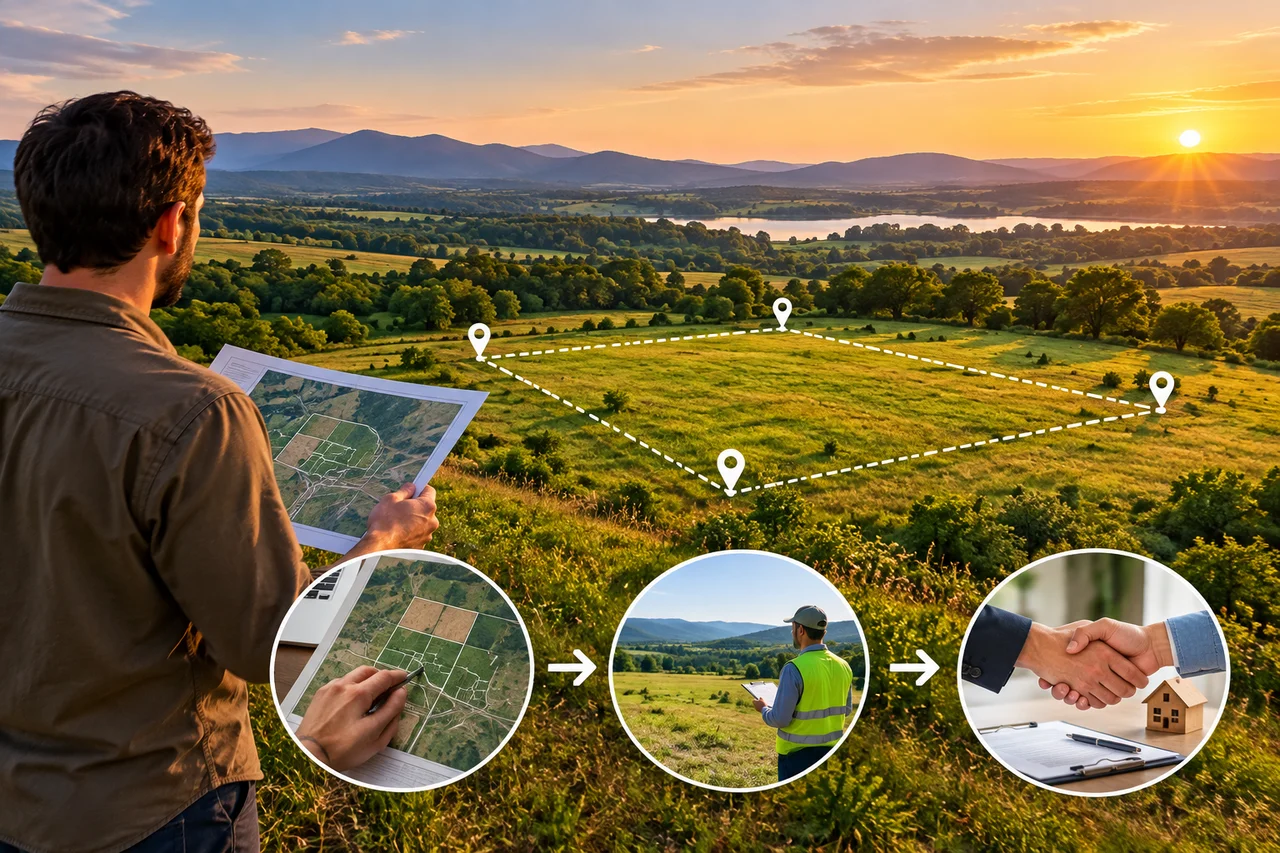
Searching for land for sale is different from shopping for a finished home. Two parcels with the same acreage and similar asking prices can have dramatically different values because of zoning, road access, utilities, terrain, soil conditions, development restrictions, title issues, and what can legally be built on them.
The best land is therefore not necessarily the cheapest parcel or the one with the most acreage. It is the property that fits your intended use at a total cost and level of risk you can accept.
Whether you want land for a home, farming, commercial development, recreation, or a long-term investment, evaluate what you can actually do with the property before committing to the purchase.
Decide What Type of Land You Need
Start with the intended use rather than the listings.
A buyer planning to build a house has different requirements from someone buying farmland, commercial property, recreational acreage, or undeveloped land as an investment. Your intended use determines which locations, zoning classifications, utilities, access conditions, and physical characteristics matter most.
Common categories include:
| Type of land | Typical purpose | Important factors to investigate |
|---|---|---|
| Residential land | Building a home | Zoning, utilities, road access, building setbacks, permits |
| Agricultural land | Crops or livestock | Soil, water, drainage, acreage, access, permitted agricultural uses |
| Commercial land | Shops, offices or other businesses | Commercial zoning, traffic access, infrastructure, development rules |
| Industrial land | Warehouses or industrial facilities | Zoning, transportation links, utilities, environmental restrictions |
| Recreational land | Camping, hunting or private recreation | Legal access, terrain, water, restrictions, surrounding land uses |
| Undeveloped investment land | Holding or future development | Growth patterns, permitted uses, infrastructure and carrying costs |
A parcel advertised simply as “vacant land” should not be assumed to be buildable. The physical existence of an empty lot and the legal or practical ability to develop that lot are separate issues.
Choose the Right Location
Location affects both usability and value.
For residential land, consider commuting distance, schools, healthcare, shopping, road quality, emergency services, and nearby development. A remote parcel may provide privacy and lower acquisition costs but create additional expenses for utilities, road construction, transportation, and maintenance.
Commercial buyers may care more about traffic, visibility, access to customers, workforce availability, parking requirements, and proximity to transportation infrastructure.
Agricultural buyers should consider soil characteristics, water availability, climate, drainage, field access, surrounding agricultural activity, and the suitability of the property for the intended crop or livestock operation.
Also investigate what surrounds the parcel. Nearby industrial activity, planned highways, flood-prone areas, incompatible development, or land-use restrictions can materially affect how useful the property will be.
Check Zoning Before Buying Land
Zoning determines how local authorities permit land to be used. Never assume that owning a parcel automatically gives you permission to build whatever you want on it.
Depending on the jurisdiction, land may be classified for residential, agricultural, commercial, industrial, mixed, conservation, or other uses. Individual classifications can contain additional restrictions.
Before buying, determine:
- The property’s current zoning classification
- Whether your intended use is permitted
- Minimum lot-size requirements
- Building height and density restrictions
- Required setbacks
- Access and parking requirements
- Rules affecting accessory buildings
- Subdivision restrictions
- Environmental or conservation requirements
- Whether rezoning or a variance would be required
If your purchase only makes financial sense after rezoning, treat approval as uncertain until the appropriate authority confirms otherwise. A proposed future use is not the same as a currently permitted use.
Verify Ownership, Boundaries, and Title
A low asking price means little if the seller cannot provide clear ownership or if another party has rights affecting the property.
The legal description should correspond with the land you believe you are buying. A professional survey may also be appropriate to establish boundaries and identify features affecting the parcel.
Investigate potential liens, easements, rights-of-way, restrictions, encroachments, and other title matters before closing.
An easement, for example, may allow another party to cross part of the property or permit utility infrastructure to occupy it. An access easement can also be extremely important when a parcel does not directly connect to a public road.
The exact title-verification and recording process varies by jurisdiction, so buyers should use the relevant land registry, recording authority, title professional, attorney, or other qualified local professional where appropriate.
Confirm Legal and Physical Road Access
A parcel that appears accessible on an online map is not necessarily legally accessible.
Determine whether the property has direct frontage on a public road or legally documented access across neighboring property. If access depends on an easement or private road, review who can use it and who is responsible for construction, repairs, snow removal, drainage, or other maintenance.
Physical conditions matter too. A road that technically reaches the property may be unsuitable for ordinary vehicles, construction equipment, emergency services, or year-round use.
Road improvements can turn seemingly inexpensive land into a costly project, so investigate access before comparing parcels solely by their purchase prices.
Investigate Water, Sewer, Electricity, and Other Utilities
Utility availability can substantially change the true cost of land.
A listing may say that electricity or water is “nearby,” but that does not tell you how much connecting the property will cost. Distance, terrain, capacity, permits, and infrastructure requirements can all affect the final expense.
Check the availability of:
- Potable water
- Sewer service or an approved on-site wastewater solution
- Electricity
- Natural gas where required
- Internet and telecommunications
- Stormwater or drainage infrastructure
For land without municipal water or sewer service, investigate whether local rules allow a private well and on-site wastewater system.
Do this before buying rather than assuming these systems can be installed later.
Evaluate Soil, Drainage, Terrain, and Flood Risk
Land has physical limitations that listing photographs may not reveal.
Soil characteristics can influence agriculture, drainage, foundations, roads, wastewater systems, and other land uses. Terrain can similarly affect excavation, construction costs, accessibility, erosion, and drainage.
Look for conditions such as steep slopes, low-lying areas, wetlands, unstable ground, standing water, erosion, rock near the surface, or evidence of previous filling.
For agricultural property, soil quality deserves particularly close examination because soils can vary significantly even within the same general area.
Flood exposure should also be investigated through the appropriate local or national flood information system. Historical conditions, drainage patterns, waterways, and site-specific characteristics may warrant additional professional investigation.
Calculate the Real Cost of Land
The purchase price is only the starting point.
Suppose two buildable-looking parcels are offered for sale:
| Cost | Parcel A | Parcel B |
|---|---|---|
| Purchase price | $80,000 | $100,000 |
| Survey and due diligence | $3,000 | $3,000 |
| Utility connections | $30,000 | $8,000 |
| Road/site preparation | $20,000 | $5,000 |
| Estimated pre-construction total | $133,000 | $116,000 |
These numbers are hypothetical, but they demonstrate an important principle. The $80,000 parcel appears cheaper until development costs are considered.
Depending on the property, your budget may need to include surveying, legal or title expenses, taxes, utility extensions, clearing, grading, drainage, access improvements, permits, engineering, environmental studies, financing expenses, and ongoing maintenance.
Compare land using its expected total acquisition and preparation cost, not asking price alone.
Compare the Price With Similar Land
Price per acre can be useful, but it should not be used in isolation.
For example, a 10-acre parcel priced at $150,000 costs:
$150,000 ÷ 10 = $15,000 per acre
That figure becomes meaningful only when compared with genuinely similar properties.
A smaller parcel with approved development potential, utilities, paved-road frontage, and favorable zoning can command a much higher price per acre than a larger remote tract without those characteristics.
Useful comparisons should consider location, zoning, parcel size, access, utilities, terrain, development potential, water availability, restrictions, and recent market activity.
Also distinguish between asking prices and completed sale prices where reliable transaction data is available. Sellers can ask any price they choose. A completed transaction provides stronger evidence of what a buyer actually paid.
Visit the Property Before Making a Final Decision
Online maps and listing photographs cannot replace an on-site inspection.
Walk as much of the property as reasonably possible. Look at boundaries, road access, neighboring properties, drainage, slopes, vegetation, utilities, structures, waterways, dumping, erosion, and signs that someone else may be using part of the land.
Visit after rain when practical if drainage is an important concern. Conditions that look harmless during dry weather can become much more obvious after significant rainfall.
For large parcels, compare what you see with available survey documents and maps. If boundaries are uncertain, obtain professional assistance rather than relying on fences, tracks, trees, or informal markers.
Complete Due Diligence Before Closing
A strong land purchase decision combines legal, physical, financial, and regulatory checks.
Before becoming unconditionally committed to a property, investigate the matters that determine whether it can serve your intended purpose.
A practical due-diligence checklist includes:
- Confirm the seller’s ownership and authority to sell.
- Review title information and recorded restrictions.
- Verify the parcel’s legal description and boundaries.
- Confirm zoning and permitted uses.
- Investigate building and development requirements.
- Verify legal road access.
- Determine utility availability and connection costs.
- Evaluate water and wastewater options.
- Review soil, drainage, terrain, and flood conditions.
- Investigate easements and rights-of-way.
- Estimate site-development expenses.
- Check taxes and other recurring ownership costs.
- Review environmental concerns when relevant.
- Compare the property with similar land.
- Obtain appropriate professional advice before closing.
The exact checklist should be adapted to the property and jurisdiction. A rural farm, an urban infill lot, and a large commercial development site require different levels of investigation.
Common Mistakes When Buying Land
One of the biggest mistakes is buying land because it looks inexpensive without determining why it is inexpensive.
A parcel may have a low price because development is difficult, utilities are expensive to extend, legal access is limited, the site has unfavorable terrain, or permitted uses are restricted.
Another mistake is relying entirely on the listing description. Statements such as “buildable,” “utilities available,” “development potential,” or “great investment” should be independently verified when they affect your purchasing decision.
Buyers can also underestimate ongoing costs. Property taxes, private-road maintenance, vegetation management, association charges, security, insurance where applicable, and financing costs can continue even when undeveloped land generates no income.
Finally, do not assume land automatically increases in value. Future land values depend on many variables, and appreciation is never guaranteed.
Buying Land for Investment
Investment land should be evaluated according to a defined strategy rather than a general expectation that prices will rise.
One strategy is long-term holding in an area experiencing infrastructure or population growth. Another involves acquiring land that can potentially be developed or subdivided, subject to regulatory approval. Agricultural or recreational property may also generate income depending on permitted uses and local demand.
Each strategy creates different risks.
For example, expected development may never occur. Rezoning may not be approved. Infrastructure projects may change. Holding costs can accumulate for years. Selling undeveloped property may also take longer than selling property in a more liquid market.
Before purchasing investment land, define what must happen for the investment thesis to work and what the property is worth if those assumptions do not materialize.
Questions to Ask a Seller or Land Agent
Good questions can uncover issues before you spend money on detailed investigations.
Ask why the property is being sold, how long it has been available, what utilities currently reach it, how legal access works, whether surveys are available, whether the owner knows of easements or restrictions, and what the current zoning permits.
You can also ask whether previous owners attempted to develop the site, whether permits or applications have previously been submitted, and whether there are known drainage or environmental concerns.
Seller responses are useful starting points, not substitutes for independent verification.
When Professional Help Is Worth the Cost
Not every land purchase requires the same team, but specialized assistance can prevent expensive mistakes.
Depending on the parcel, you may need a land surveyor, real estate attorney, title professional, engineer, soil specialist, environmental consultant, architect, planner, appraiser, or local real estate professional.
Professional assistance becomes particularly valuable when boundaries are uncertain, access depends on easements, development requires approvals, the parcel has environmental concerns, or the purchase involves substantial capital.
Paying for due diligence before buying can be far less expensive than discovering after closing that the land cannot be used as planned.
FAQs About Land for Sale
Is buying land a good investment?
Land can be an investment, but returns are not guaranteed. Location, permitted uses, infrastructure, supply and demand, development potential, acquisition price, carrying costs, and the eventual resale market all affect performance. Evaluate a specific parcel rather than assuming land generally appreciates.
How do I know whether land is buildable?
Check zoning, legal access, lot dimensions, setbacks, utilities, water and wastewater requirements, terrain, soil conditions, flood exposure, environmental restrictions, and applicable building rules. The relevant local authorities and qualified professionals can verify requirements for a particular parcel.
What should I check before buying vacant land?
At minimum, investigate ownership, title, boundaries, zoning, permitted uses, road access, easements, utilities, water, wastewater, soil, drainage, flood conditions, taxes, development costs, and restrictions affecting your intended use.
Is cheap land worth buying?
Sometimes, but price alone cannot answer the question. Cheap land may be suitable for your purpose, or its price may reflect limited access, development restrictions, expensive utility connections, unfavorable physical conditions, or weak demand. Investigate the reason for the discount.
Can I build a house on any land I own?
No. Ownership does not automatically make a parcel suitable or legally approved for residential construction. Zoning, access, building regulations, wastewater requirements, utilities, environmental restrictions, and site conditions may limit development.
How much should I offer for land?
Base an offer on comparable land transactions where available, the parcel’s physical and legal characteristics, necessary improvements, development costs, market conditions, and your intended use. A low asking price should not compensate for a property that cannot meet your requirements.
Final Thoughts
Finding land for sale is easy. Determining whether a particular parcel is worth buying requires much more work.
Start with your intended use, then investigate zoning, title, boundaries, access, utilities, soil, terrain, drainage, flood exposure, restrictions, and total development costs. Compare parcels on what they can realistically deliver rather than acreage or asking price alone.
The most valuable information often emerges before the purchase contract becomes unconditional. Verify the assumptions that matter to your project, use qualified local professionals when necessary, and know what the land can legally and practically support before you buy.
For more helpful guides please visit RoyalSprinter.
