


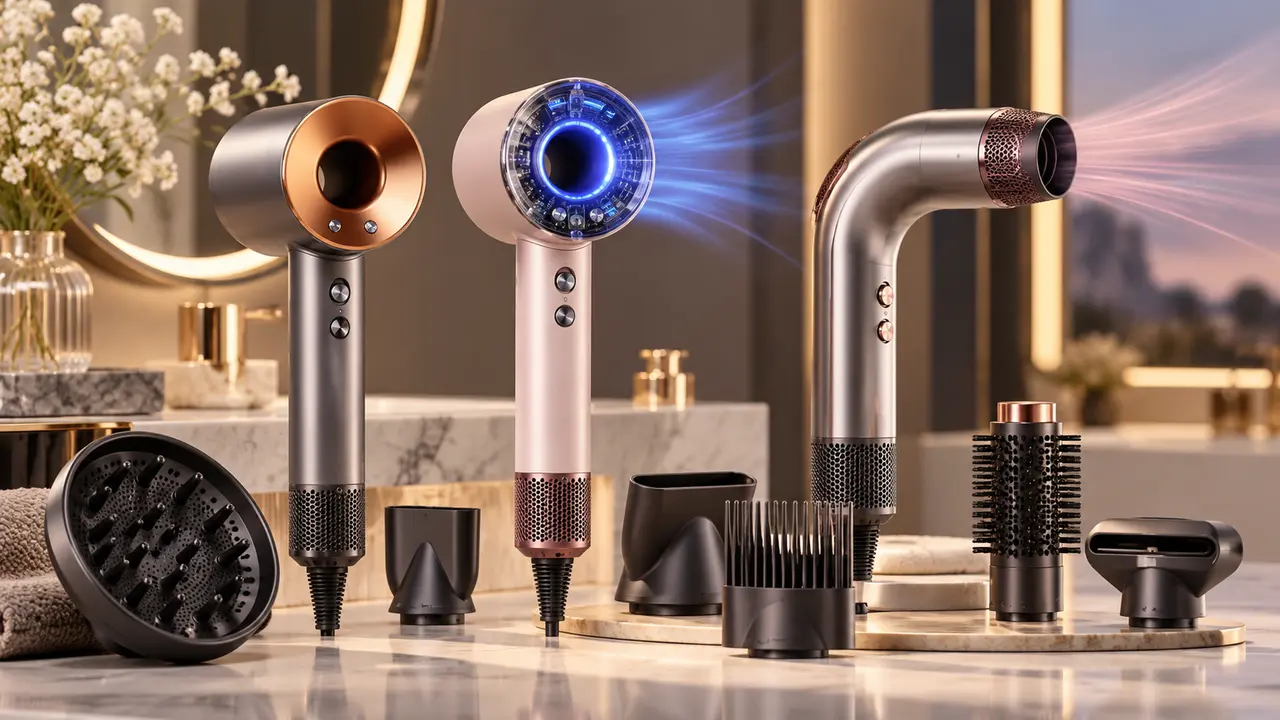
The Dyson hair dryer range is designed around fast, controlled airflow rather than relying primarily on very high temperatures to dry hair. The current lineup includes models for different priorities, from the sensor-equipped Dyson Supersonic Nural and lightweight Supersonic r to the compact Supersonic Travel.
The main reason to consider a Dyson is not simply drying speed. Its combination of intelligent heat regulation, magnetic styling attachments, concentrated airflow, and hair-type-specific tools can make drying and styling easier, particularly for people who regularly blow-dry, smooth, diffuse, or shape their hair.
The tradeoff is price. Dyson hair dryers remain considerably more expensive than conventional dryers, so the best model depends on how often you style your hair and which features you will actually use.
Which Dyson Hair Dryer Models Are Available?
Dyson’s U.S. hair dryer lineup in September 2026 includes several versions of the Supersonic platform. Three models are especially relevant to most home users: the Supersonic Nural, Supersonic r, and Supersonic Travel. Dyson also sells professional models intended primarily for salon environments.
| Dyson hair dryer | Main advantage | Best suited to | Listed U.S. price* |
|---|---|---|---|
| Supersonic Nural | Automatic scalp protection and intelligent features | Everyday home styling and users concerned about heat exposure | $449.99 |
| Supersonic r | Lightweight design and precision airflow | Frequent styling and users who value maneuverability | $549.99 |
| Supersonic Travel | Compact size, low weight, universal voltage | Frequent travelers | $299.99 |
| Supersonic Professional | Salon-focused configuration | Professional stylists | $549.99 |
*Prices are Dyson U.S. listed prices checked in September 2026 and can change with promotions, colors, bundles, and availability. Dyson was listing the Supersonic Nural at $449.99 and the Supersonic r at $549.99 on its main hair-dryer page, while the Supersonic Travel was listed at $299.99.
The important distinction is that paying more does not automatically mean getting the right dryer for your routine. The Nural emphasizes automatic sensing, the Supersonic r emphasizes lighter and more precise handling, and the Travel emphasizes portability.
How Does a Dyson Hair Dryer Work?
Dyson hair dryers combine a high-speed motor with controlled airflow and active temperature monitoring.
The Supersonic Nural, for example, uses Dyson’s Hyperdymium motor to produce a high-velocity stream of air. Air Multiplier technology draws additional surrounding air into that stream, while intelligent heat control regulates temperature rather than allowing the dryer to operate continuously at uncontrolled extreme heat.
That distinction matters because drying requires both air movement and heat. Raising the temperature is one way to remove water faster, but powerful airflow can also accelerate evaporation. Dyson’s engineering approach is therefore designed to obtain fast drying while controlling thermal exposure.
This does not mean a Dyson dryer makes hair immune to damage. Hair can still be affected by excessive heat, repeated styling, mechanical tension, chemical treatments, bleaching, or poor technique. Temperature regulation reduces one potential source of stress rather than eliminating every source of hair damage.
Dyson Supersonic Nural: The Most Sensor-Focused Option
The Dyson Supersonic Nural adds several automatic features to the basic Supersonic concept.
Its most distinctive feature is Scalp Protect mode. A Time of Flight sensor measures the distance between the dryer and the user’s head. As the machine moves closer, it automatically reduces heat to maintain more comfortable up-close drying.
The Nural also includes Pause Detect. An accelerometer recognizes when the machine has been put down and responds by deactivating the heater while reducing airflow. When styling involves frequently stopping to section or brush the hair, this saves the user from repeatedly changing the controls manually.
Another feature, Attachment Learning, recognizes compatible magnetic attachments and remembers the user’s preferred airflow and heat settings for each one. Dyson says a Hall sensor identifies the attachment, after which the dryer can automatically return to the previously selected settings.
Who Should Choose the Supersonic Nural?
The Nural makes the most sense for someone who:
- dries their hair frequently
- wants automatic temperature adjustment near the scalp
- uses several different styling attachments
- regularly switches between drying, smoothing, diffusing, or precision styling
- values automation more than having Dyson’s lightest full-size dryer
People who simply want strong airflow and rarely change settings may not obtain as much practical value from its additional sensors.
Dyson Supersonic r: Designed for Lighter, More Precise Styling
The Dyson Supersonic r uses a curved, more compact body rather than the familiar ring-shaped Supersonic design.
Dyson describes it as its most powerful yet lightest hair dryer and positions it around precision styling. Its heater uses multiple foils distributed through the machine’s curve to create more even heating through the airflow path.
Compatible intelligent attachments can also communicate their intended airflow and temperature settings to the machine. RFID-equipped attachments remember the last-used settings, reducing adjustments when users repeatedly switch tools.
Available tools include:
- Powerful air attachment
- Professional concentrator
- Flyaway attachment
- Wide-tooth comb
- Diffuser
The diffuser is designed for curls, coils, and waves, while the wide-tooth comb can help detangle and lengthen textured hair during drying. The Flyaway attachment uses the Coanda effect to help conceal shorter flyaway hairs beneath longer hair when creating smoother finished styles.
At Dyson’s listed U.S. price of $549.99 in September 2026, the Supersonic r carries a meaningful premium over the Nural.
That premium is easier to justify for frequent styling where lower hand weight, maneuverability, and precise nozzle control matter. For basic drying several times a week, the Nural may offer a more relevant feature set at a lower listed price.
Dyson Supersonic Travel: A Smaller Dryer for Frequent Travelers
The Dyson Supersonic Travel was introduced in 2026 specifically for portable use.
Dyson says it is 32% smaller and 25% lighter than its full-size Supersonic while retaining intelligent heat control. Unlike many travel dryers designed around a simple dual-voltage switch, the Supersonic Travel automatically adapts voltage for international use.
Dyson launched it in select markets at $299.99, making it substantially less expensive than the Nural or Supersonic r, although it is still expensive compared with ordinary travel dryers.
The standard package is also more minimal. Dyson’s U.S. listing shows the Travel with one attachment, while additional compatible tools can be purchased separately.
When Does the Travel Model Make More Sense?
Consider the Travel instead of a full-size Dyson if you:
- fly frequently
- regularly style your hair while traveling
- want to reduce luggage size and weight
- need international-voltage compatibility
- already own compatible Supersonic attachments
For someone who travels only once or twice a year, buying a $299.99 dryer solely for travel may be difficult to justify.
Dyson Hair Dryer Attachments Explained
Attachments can make a larger difference to the styling experience than simply increasing airflow or temperature.
Different Dyson packages contain different tools, so buyers should check the exact bundle rather than assuming every color or model contains the same attachments.
Styling Concentrator
The concentrator produces a narrow stream of air for controlled styling.
It is particularly useful when using a round or paddle brush because the airflow can be directed along the hair rather than blowing surrounding sections in multiple directions.
Diffuser
A diffuser spreads airflow over a larger area rather than concentrating it into a narrow jet.
This makes it useful for curly and wavy hair because aggressive concentrated airflow can disturb curl formation and increase visible frizz.
The Nural’s Wave+Curl diffuser has two configurations. Dyson’s Dome mode is designed to enhance natural waves and curls, while Diffuse mode is intended to add volume around the roots and support more textured curls and coils.
Wide-Tooth Comb
The wide-tooth comb is designed primarily for curly and coily textures.
It combines airflow with widely spaced teeth to help detangle, shape, and lengthen the hair while drying.
Gentle Air Attachment
This tool diffuses the airflow to create gentler drying.
It may be useful around the scalp or when less concentrated airflow is preferred.
Flyaway Attachment
Dyson’s Flyaway attachment is intended for finishing smoother, straighter styles.
Rather than functioning like an ordinary nozzle, it uses Coanda airflow to help position longer hairs above shorter flyaways, reducing their visible appearance in the finished style.
Which Dyson Hair Dryer Is Best for Your Hair Type?
Hair type alone should not determine your dryer. Your preferred finished style matters just as much.
| Hair or styling need | Useful Dyson feature or attachment | Why it helps |
|---|---|---|
| Straight or smooth blowouts | Concentrator + Flyaway attachment | Provides controlled airflow and finishing support |
| Wavy hair | Wave+Curl diffuser | Helps preserve natural pattern while drying |
| Curly hair | Diffuser | Spreads airflow and reduces disruption of curl formation |
| Coily or textured hair | Wide-tooth comb + diffuser | Supports stretching, shaping, detangling, or definition |
| Fine hair | Adjustable heat and airflow | Allows less aggressive settings when full power is unnecessary |
| Scalp-focused drying | Nural Scalp Protect + Gentle air attachment | Automatically lowers heat closer to the head |
| Frequent precision styling | Supersonic r | Lighter format and concentrated styling control |
| International travel | Supersonic Travel | Smaller design with automatic voltage adaptation |
Someone with curly hair who almost always diffuses, for example, should pay more attention to diffuser design than to a Flyaway attachment. Conversely, someone who mainly creates straight blowouts may benefit more from concentrated airflow and smoothing tools.
This is why bundle contents matter. An apparently cheaper configuration can become less attractive if you later need to purchase two additional attachments separately.
Does a Dyson Hair Dryer Damage Hair?
No heated styling device should be described as incapable of damaging hair. The more accurate distinction is that Dyson hair dryers are engineered to control excessive heat exposure.
On the Supersonic Travel, Dyson says temperature is measured more than 100 times each second so the machine can regulate heat. Its other current Supersonic products similarly use intelligent heat-control systems designed to avoid extreme temperatures.
That can be useful because thermal stress is affected by both temperature and exposure.
Technique still matters. Even with temperature regulation, repeatedly holding hot airflow very close to one section for extended periods is unnecessary. Hair that has been bleached, chemically processed, or otherwise weakened may also require more conservative styling practices.
A sensible routine is to remove excess water gently before blow-drying, use only as much heat as necessary, keep the dryer moving, and choose an attachment appropriate to the desired style.
How to Use a Dyson Hair Dryer More Effectively
Start by removing excess water from the hair rather than immediately trying to blow-dry completely saturated strands. A microfiber towel or other gentle drying method can shorten the amount of time the dryer needs to operate.
Next, choose the attachment according to the finish you want.
For a smooth blowout, begin by rough-drying the roots and lengths until the hair is partially dry. Add the concentrator and work through manageable sections with a brush. Directing airflow down the hair shaft generally produces a cleaner finish than repeatedly blowing upward against the hair.
For waves and curls, attach the diffuser and avoid using maximum airflow simply because it is available. A lower or moderate airflow can reduce disturbance of the curl pattern.
Finish with the cold-shot setting when appropriate. Dyson’s current Nural provides three airflow settings, multiple heat settings, and a cold shot intended to cool and set the finished style.
How Long Does a Dyson Hair Dryer Take to Dry Hair?
There is no single reliable drying time that applies to every user.
Drying time changes with:
- hair density
- strand thickness
- length
- porosity
- starting moisture level
- selected heat setting
- airflow setting
- attachment
- styling technique
- whether the goal is simply dry hair or a polished blowout
For example, shoulder-length fine hair that has already been towel-dried may require far less drying than long, dense, coarse hair that is being carefully smoothed section by section.
This distinction is important when comparing reviews. A statement that a dryer finished someone’s hair in a certain number of minutes is useful personal context, but it should not be treated as a universal performance specification.
Independent reviewers have consistently highlighted fast drying as a strength of the Nural, while also noting its premium price. WIRED, for example, praised its drying performance and smart functions but identified cost as a clear disadvantage.
Is the Dyson Hair Dryer Worth the Price?
A Dyson is easier to justify when hair drying is a frequent part of your routine.
Suppose someone dries or styles their hair four times per week. That equals roughly 208 sessions per year. Over four years, that is about 832 uses.
Using a hypothetical $450 purchase price:
$450 ÷ 832 uses = about $0.54 per use
For someone who blow-dries only twice per month, the same four-year period produces approximately 96 uses:
$450 ÷ 96 uses = about $4.69 per use
The dryer costs the same in both cases, but its practical value is very different.
A Dyson Is More Likely to Be Worth It If You:
- blow-dry several times each week
- have thick or dense hair that makes drying laborious
- regularly use multiple attachments
- style curls or create blowouts at home
- value automatic temperature regulation
- want more precise airflow
- intend to keep the dryer for several years
A Less Expensive Dryer May Be Enough If You:
- use a hair dryer occasionally
- mostly air-dry your hair
- need only basic hot and cold airflow
- rarely use styling attachments
- are buying primarily around a limited budget
The strongest argument for buying a Dyson is therefore not that every person needs one. It is that frequent users can repeatedly benefit from features that occasional users may barely notice.
Dyson Supersonic Nural vs Supersonic r
The Nural and Supersonic r overlap in performance goals but emphasize different aspects of styling.
| Feature | Supersonic Nural | Supersonic r |
|---|---|---|
| Primary focus | Intelligent automatic drying | Lightweight precision styling |
| Scalp Protect mode | Yes | No equivalent feature |
| Pause Detect | Yes | No equivalent feature |
| Attachment memory | Yes | Yes, with compatible intelligent attachments |
| Curl-focused attachment available | Yes | Yes |
| Full-size home use | Yes | Yes |
| Listed U.S. price* | $449.99 | $549.99 |
*Checked September 2026. Prices can change.
Choose based on the workflow rather than assuming the more expensive model is automatically better.
The Nural is particularly relevant if scalp-focused temperature management and automatic behavior appeal to you.
The Supersonic r is more compelling when lighter handling and highly controlled styling are higher priorities.
Dyson Supersonic Nural vs Supersonic Travel
These two dryers address very different problems.
The Nural is a feature-rich everyday dryer. The Travel strips the concept down into a smaller machine designed to fit easily into luggage.
TechRadar’s 2026 comparison noted that the two share important underlying technologies, including intelligent heat control, while the Travel’s compactness and lower price make it a distinct proposition.
The biggest mistake would be buying the Travel simply because it is the cheapest Dyson hair dryer.
If it will primarily stay in your bathroom, a full-size model’s broader bundle and styling features may make more sense. If you regularly move between countries, however, the Travel’s smaller size and voltage adaptability become meaningful rather than cosmetic benefits.
What to Check Before Buying a Dyson Hair Dryer
Check the Exact Model
“Dyson Supersonic” can refer to several generations and configurations.
A steep discount may apply to an earlier machine rather than the current Supersonic Nural, Supersonic r, or Travel model.
Compare the Included Attachments
Do not compare price alone.
One package may include the diffuser or wide-tooth comb you need, while another may require buying it separately. Dyson currently sells Supersonic r attachments individually, with several listed at approximately $29.99 to $39.99 each in the U.S.
That means a $40 difference between bundles can disappear quickly if the cheaper package lacks the attachment you actually need.
Consider Where You Will Use It
International travelers should pay particular attention to voltage requirements.
The Supersonic Travel is explicitly designed with automatic voltage adaptation for international use. Do not assume every full-size hair appliance offers the same travel capability simply because the brand sells products globally.
Check Attachment Compatibility
Some earlier Supersonic attachments physically fit the Nural, but that does not guarantee full access to the Nural’s Attachment Learning functionality. Dyson also identifies exceptions to compatibility, including its wide-tooth comb.
Anyone upgrading from an older Supersonic should therefore check individual tools rather than assuming an entire attachment collection will behave identically.
Buy From a Reliable Seller
Premium hair tools attract imitation products and questionable marketplace listings.
Check the seller, warranty terms, return conditions, plug type, voltage specification, model identification, and included accessories before buying. A suspiciously low price deserves closer inspection rather than being treated automatically as a bargain.
Cleaning and Maintaining a Dyson Hair Dryer
Airflow performance depends on keeping the filter clear.
Dyson recommends cleaning the Supersonic Nural filter approximately once a month. Its instructions call for removing the magnetic filter cage, washing it in warm soapy water, rinsing and drying it, and clearing debris from the underlying filter with a clean, dry cloth.
Frequency may need to increase in environments where hair products, dust, or salon use cause buildup more quickly.
Ignoring the filter can restrict airflow, making the machine work less efficiently. Regular filter maintenance is therefore a small task with a direct connection to consistent drying performance.
Common Mistakes When Choosing a Dyson Hair Dryer
One mistake is treating every Dyson dryer as essentially the same device in a different shape. The current models have meaningfully different purposes.
Another is choosing solely by price. A less expensive bundle that lacks your most-used attachment may ultimately cost more once accessories are added.
Buyers can also overestimate how much automation they need. Someone who always uses the same heat and airflow level may obtain little benefit from attachment memory, while someone who changes between a diffuser, concentrator, and smoothing tool may appreciate it every week.
Finally, avoid judging value from the purchase price alone. Think about frequency of use, styling time, desired results, ergonomics, and how long you expect to keep the machine.
Frequently Asked Questions About Dyson Hair Dryers
What is the newest Dyson hair dryer?
Dyson’s current lineup includes multiple recent products rather than one universal successor. The Supersonic r represents its lightweight precision-focused design, while the Supersonic Travel was introduced in 2026 as its compact travel model. The Supersonic Nural remains Dyson’s sensor-focused full-size dryer.
How much does a Dyson hair dryer cost?
As of September 2026, Dyson’s U.S. website listed the Supersonic Nural at $449.99, the Supersonic r at $549.99, and the Supersonic Travel at $299.99. Prices vary with promotions, bundles, colors, countries, and retailers.
Is the Dyson hair dryer good for curly hair?
It can be well suited to curly and coily hair when paired with the appropriate attachments. Dyson offers diffusers for curl definition and wide-tooth comb attachments designed to detangle, shape, and lengthen textured hair during drying.
Can you use an older Dyson attachment on the Supersonic Nural?
Several previous Supersonic attachments can physically fit the Nural, but older attachments do not gain the newer model’s Attachment Learning capability. Dyson also notes an exception for the previous wide-tooth comb.
Is the Dyson Supersonic Travel dual voltage?
It goes further than a conventional manually switched dual-voltage dryer. Dyson states that the Supersonic Travel automatically adapts its voltage for international destinations while maintaining performance.
How often should you clean a Dyson hair dryer filter?
Dyson recommends approximately monthly filter cleaning for the Supersonic Nural. Heavy product use, dusty environments, or professional use may justify checking it more frequently.
Conclusion
A Dyson hair dryer is most compelling for people who dry or style their hair frequently enough to benefit from controlled heat, powerful airflow, specialized attachments, and better styling ergonomics.
The Supersonic Nural emphasizes intelligent scalp protection and automatic settings. The Supersonic r prioritizes lightweight, precise styling. The Supersonic Travel offers the strongest fit for frequent travelers who need a smaller dryer with international-voltage capability.
Before paying the premium, compare more than the model name. Look at your hair type, preferred style, frequency of use, included attachments, travel needs, and the exact price of the bundle. The right Dyson is the one whose features solve problems you encounter regularly, not simply the most expensive model in the range.
For more helpful guides please visit RoyalSprinter.
