


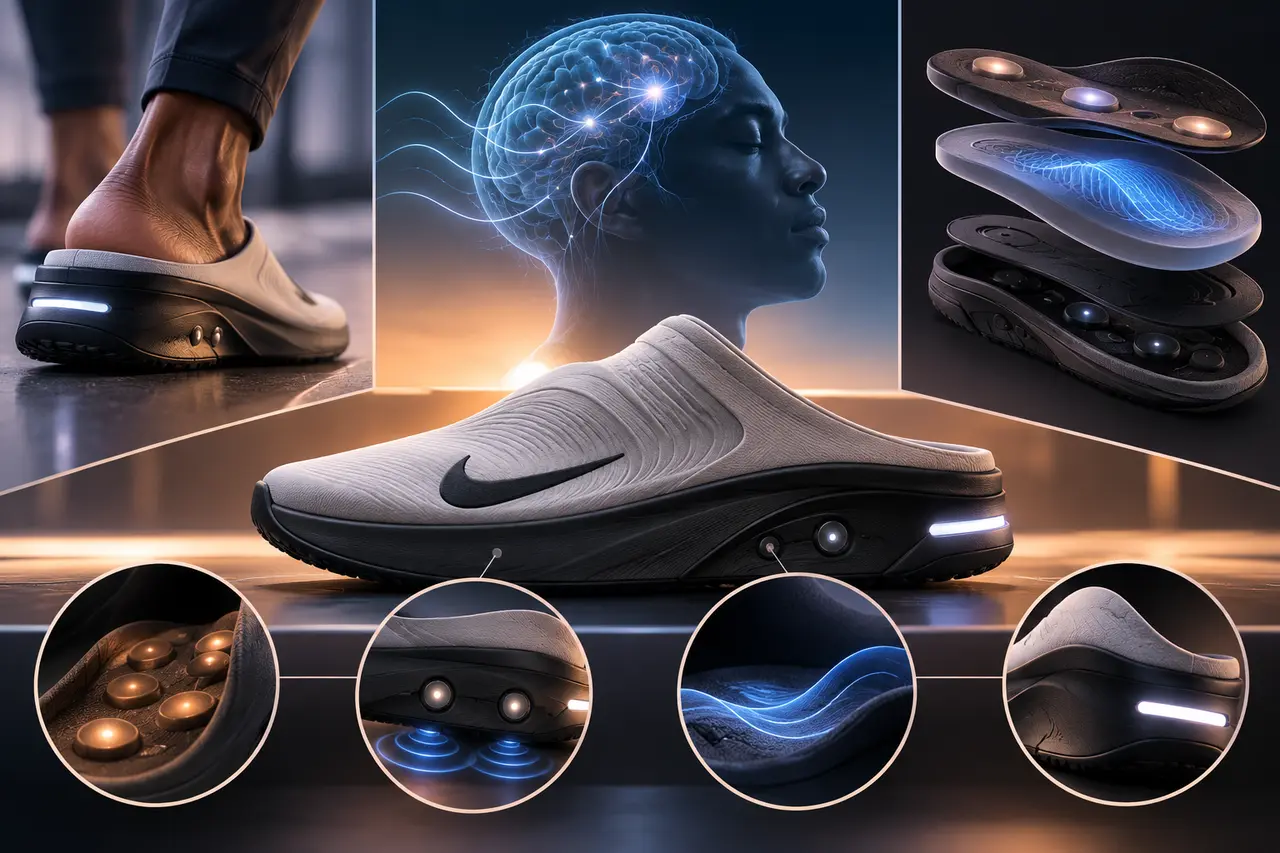
The Nike Mind 001 is a slip-on pregame mule built around an unusual idea: instead of simply cushioning the foot, its sole uses 22 individually moving foam nodes to create noticeable sensory stimulation with every step. Nike developed the shoe through its Mind Science Department and positions it primarily for walking and pregame routines rather than running or competition.
Released in 2026, the Mind 001 also marks the debut of Nike’s Mind footwear platform. Its distinctive underfoot system is designed to increase sensory input from the feet, while a soft midsole and breathable upper make the shoe practical as a comfortable slip-on.
The technology is interesting, but Nike’s claims need context. The company reports measurable activation of sensory areas of the brain during its research. That does not mean the Mind 001 is a medical treatment, nor does it establish that wearing the shoe will improve athletic performance, reduce anxiety, or provide a particular recovery outcome for everyone. Nike itself states that the product is not intended to have a medical effect.
What Is the Nike Mind 001?
The Nike Mind 001 is a closed-toe mule developed as part of Nike Mind, a footwear platform that combines conventional cushioning with targeted underfoot sensory stimulation.
Nike describes it as a “pregame” mule. That distinction matters because the Mind 001 is not designed as a running shoe, basketball shoe, football boot, or dedicated training shoe. Its intended role is closer to a comfortable shoe an athlete can wear while walking, preparing for competition, or moving around before and after activity.
The defining feature sits underneath the foot. Each shoe contains 22 anatomically positioned foam nodes that move independently as the wearer walks. Rather than creating a uniformly flat sensation, the nodes place changing pressure against different areas of the sole.
Nike says development of the broader Mind technology took more than a decade. The Mind 001 and its sneaker counterpart, the Mind 002, became the first footwear products produced through the company’s Mind Science Department.
Nike Mind 001 Specifications at a Glance
| Feature | Nike Mind 001 |
|---|---|
| Footwear type | Closed-toe pregame mule |
| Primary purpose | Pregame walking and sensory stimulation |
| Underfoot system | Nike Mind Technology |
| Sensory elements | 22 independently moving foam nodes per shoe |
| Cushioning | Soft foam midsole |
| Upper | Soft, breathable knit construction |
| Traction | Rubber pods around key toe and heel areas |
| Original U.S. retail price | $95 |
| Original release | January 2026 |
| Fit guidance | Size up when between sizes |
| Medical product | No |
Nike’s U.S. product listings continue to show the standard Mind 001 at $95, although prices, colors, availability, and sizing can vary by market and release.
How the 22 Nodes in the Nike Mind 001 Work
The 22 nodes are not simply outsole lugs added for traction. They are designed to move vertically and slightly shift as pressure changes beneath the foot.
Nike describes the nodes as working somewhat like small pistons and gimbals. They are attached to flexible material that permits individual movement instead of forcing the entire platform to compress as a single piece.
When you step down, pressure from the ground moves the nodes. That movement is transmitted through a stretchy layer beneath the foot, producing localized pressure that the wearer can feel.
The basic sequence looks like this:
Foot contacts the ground → individual nodes move → pressure is transmitted through the footbed → sensory receptors in the foot receive changing mechanical input.
Nike did not position the 22 nodes at arbitrary intervals. According to its development team, researchers studied two-point discrimination, which measures how close two points of contact can be before a person perceives them as one rather than two. Nodes are consequently positioned more closely in areas such as the forefoot and farther apart around the heel.
That approach helps explain why the Mind 001 feels fundamentally different from an ordinary foam slide.
What Does the Nike Mind 001 Feel Like?
Expect to notice the nodes.
The sensation is more localized than the smooth compression associated with conventional foam recovery shoes. Each step creates pressure at multiple points beneath the foot, so the shoe can initially feel as though small soft objects are pressing upward into your sole.
Independent reviewers describe that sensation differently. Stuff’s hands-on reviewer found the nodes noticeable and initially unusual before becoming more natural with continued wear. Sole Retriever compared the sensation to a softer version of walking on bubble wrap, while Complex’s reviewer found the pressure noticeable but less personally appealing.
Those differences are useful for prospective buyers. The unusual footbed is the central feature of the shoe, so someone who dislikes noticeable pressure points underfoot may react very differently from someone who enjoys massage-like sensory feedback.
Socks can also change the experience. A thicker sock creates another layer between the foot and the moving platform and can make the sensation less direct.
The Neuroscience Behind Nike Mind Technology
Nike’s reasoning begins with the high sensory sensitivity of the feet.
The company’s researchers say the bottoms of the feet contain substantially more mechanoreceptors than many other areas of the body. Mechanoreceptors respond to mechanical stimuli such as pressure, deformation, vibration, and movement, providing the nervous system with information about physical contact and position.
Nike attempted to use that sensory pathway intentionally rather than treating the bottom of the shoe solely as a cushioning platform.
During development, Nike says its researchers used tools including plantar-pressure measurement, electromyography and electroencephalography (EEG). Athletes walked in Nike Mind footwear and comparison shoes while researchers studied physical and neurological responses. Nike reports observing differences in brain activation and oscillation patterns associated with sensory stimulation.
This distinction is important:
The physical sensory mechanism is real, but broader outcomes should not be overstated.
Nike reports that the footwear activates sensory areas of the brain and describes the resulting experience in terms such as awareness, presence and focus. However, consumers should not translate that into a guarantee of improved sports performance, mental-health benefits, faster recovery, or treatment of any condition.
Nike’s own regional product information explicitly states that the Mind 001 is not intended to have a medical effect and should not be treated as medical advice. Individual experiences can vary.
Nike Mind 001 vs. Nike Mind 002
The Mind 001 and Mind 002 use the same general sensory concept but package it in two noticeably different types of footwear.
| Feature | Nike Mind 001 | Nike Mind 002 |
|---|---|---|
| Construction | Slip-on mule | Enclosed lace-up sneaker |
| Sensory nodes | 22 | 22 |
| Foot security | More relaxed | More securely anchored |
| Convenience | Very easy to slip on and off | Requires conventional shoe entry and lacing |
| Sensory experience | Noticeable but relatively relaxed | Designed for stronger foot-to-platform connection |
| Original positioning | Pregame mule | Pregame shoe |
| Current U.S. Nike listed price | $95 | $145 on current listings |
Nike explains that the 002’s more secure construction anchors the foot closer to the platform. That closer connection can make the sensory system more noticeable. Independent hands-on impressions have similarly reported stronger node pressure in the Mind 002.
The practical distinction is therefore straightforward. The Mind 001 emphasizes slip-on convenience, while the Mind 002 provides a more conventional sneaker fit and stronger connection between the foot and sensory platform.
Is the Nike Mind 001 a Recovery Shoe?
It can fit into a pre- or post-activity routine, but “recovery shoe” needs some qualification.
The Mind 001 shares characteristics with recovery footwear, including a slip-on construction, soft foam, easy entry and an emphasis on comfort away from competition. Nike has also discussed Mind footwear in the context of preparation and recovery.
What separates it from many recovery slides is its objective. Conventional recovery footwear often emphasizes soft cushioning and reducing the effort required for casual walking. The Mind 001 deliberately adds sensory input beneath the foot.
That makes the experience quite different.
Someone seeking the smoothest possible foam platform may prefer a conventional recovery shoe. Someone specifically interested in tactile underfoot stimulation may find the Mind 001 more distinctive.
Consumers also should not interpret “recovery” as a clinical claim that the shoe heals injuries, reduces recovery time, or treats foot problems.
Comfort and Everyday Wear
Even without considering its neuroscience-focused marketing, the Mind 001 has several conventional comfort features.
Nike uses soft foam through the midsole and a stretchy fabric layer over the moving nodes. The upper includes breathable perforations, while rubber pods around high-contact portions of the toe and heel improve outsole durability and traction.
The mule construction also makes it easy to put on and remove. That is useful in locker rooms, around training sessions, during travel, at home, or for casual short-distance walking.
Hands-on reviews indicate that the node sensation is impossible to separate completely from the comfort assessment. Some reviewers have enjoyed the massage-like pressure, while others have found it less appealing.
In other words, buying the Mind 001 purely because you want a generic soft slide misses the point. The moving nodes are supposed to be felt.
How Does the Nike Mind 001 Fit?
Sizing deserves attention, especially because a mule needs enough security to remain comfortable without excessive pressure over the top of the foot.
Nike’s U.S. product page advises people who normally buy a half size to size up. Some regional Nike listings go further and describe the Mind 001 as fitting small, recommending a full size up.
That means a shopper between whole sizes should generally avoid sizing down simply to obtain a tighter fit.
A snug fit can also influence how strongly the wearer perceives the nodes because the foot has less freedom to move away from the pressure. If possible, trying the shoe on is particularly useful for the Mind 001 because both fit and tolerance for the underfoot sensation are personal.
Where the Nike Mind 001 Makes the Most Sense
The Mind 001 has a fairly specific sweet spot.
It makes the most sense for pregame walking, getting ready for training, casual post-workout wear, travel, locker-room use, and everyday situations where a slip-on mule is appropriate.
It is much less logical as a replacement for sport-specific footwear.
Nike itself identifies the shoe as designed for pregame use and activated through walking. It does not market the Mind 001 as a substitute for a running shoe or a shoe designed for hard lateral cuts, heavy lifting, court competition, or other demanding athletic movements.
A useful way to think about it is that the Mind 001 is footwear for the periods around performance, rather than the primary footwear used to perform.
Nike Mind 001 Price and Release
Nike introduced the Mind 001 alongside the Mind 002 in October 2025 and announced that both models would become available in January 2026. The original Mind 001 reached the U.S. market at $95.
Additional colors and restocks followed, and Nike has since expanded the Mind line. Current U.S. Nike listings still show standard Mind 001 models at $95, although individual colors may be listed as coming soon, available, or sold out at different times.
Nike has also used the silhouette for special editions. For example, Hiroshi Fujiwara and Fragment produced their own interpretation of the Mind 001 as part of the Fragment Concept Testing project in 2026.
Because inventory changes, shoppers should check current regional availability rather than assuming a particular color or size remains in stock.
Who Should Consider the Nike Mind 001?
The strongest reason to consider the Mind 001 is not simply that it is another comfortable Nike slip-on. It offers an underfoot experience that conventional foam mules generally do not try to reproduce.
It may appeal particularly to someone who:
- Wants an easy-on, easy-off shoe for before or after training
- Enjoys noticeable pressure or massage-like sensations under the feet
- Wants to try Nike’s 22-node sensory platform
- Prefers a mule rather than a fully enclosed sneaker
- Values soft cushioning but wants more tactile feedback than a conventional foam slide provides
It may be less appealing if you dislike pronounced pressure points beneath your feet, need footwear for actual running or competitive sport, want a completely smooth footbed, or expect scientifically guaranteed improvements in concentration or athletic performance.
The last point is particularly important. Buy the Mind 001 for its footwear design and sensory experience, not because you expect a guaranteed cognitive or medical result.
Nike Mind 001 Pros and Limitations
The Mind 001’s biggest strength is also what makes it unusually personal.
Its 22 moving nodes give it a distinctive sensation that differentiates it from ordinary foam slides. The mule format is convenient, the cushioning remains soft, and the design has a clear role as footwear for walking before and around athletic activity.
The tradeoff is that underfoot pressure is subjective. A feature one wearer interprets as relaxing or massage-like can simply feel distracting to another.
There are also practical boundaries. It is not a performance running or court shoe, and Nike’s neurological research should not be interpreted as proof of specific medical, psychological, or competitive outcomes.
For shoppers, the best evaluation is therefore surprisingly simple: Do you want to feel the shoe actively pressing back against your foot when you walk? If yes, the Mind 001 offers something genuinely different from a standard recovery mule. If not, a conventional cushioned slip-on is likely the more straightforward choice.
Frequently Asked Questions About the Nike Mind 001
What does the Nike Mind 001 do?
The Mind 001 uses 22 independently moving foam nodes to produce changing pressure beneath the foot as you walk. Nike designed the system to increase sensory stimulation and positions the shoe primarily for pregame use.
Does the Nike Mind 001 actually stimulate the brain?
Nike reports that testing involving technologies such as EEG showed activation associated with sensory processing while participants used its Mind footwear. That supports Nike’s description of a sensory-stimulation mechanism, but it should not be interpreted as proof that the shoe will produce a particular improvement in athletic performance, mental health, concentration, or recovery for every wearer.
Is Nike Mind 001 good for running?
It is not positioned as a running shoe. Nike describes the Mind 001 as a pregame mule designed to activate its sensory technology through walking. Runners should use footwear designed for the demands of running during their actual workouts.
How many nodes does the Nike Mind 001 have?
Each shoe has 22 individually articulated foam nodes. Their positioning reflects Nike’s research into sensitivity across different areas of the foot.
Does the Nike Mind 001 run small?
Nike advises shoppers who normally wear a half size to size up on its U.S. listing. Some regional Nike listings explicitly describe the shoe as fitting small and recommend going up a full size, so checking the sizing guidance for the exact regional listing is sensible.
Is the Nike Mind 001 a medical or therapeutic shoe?
No. Nike explicitly states on regional product listings that the Mind 001 is not intended to have a medical effect and should not be treated as medical advice. The sensory technology should therefore be distinguished from medical treatment or rehabilitation.
Conclusion
The Nike Mind 001 takes a different approach to the modern cushioned mule. Its 22 independently moving foam nodes deliberately create changing pressure beneath the foot, turning each step into a more tactile experience instead of trying to isolate the wearer from the ground completely.
That makes it most interesting as a pregame and casual walking shoe with an unusual sensory platform. Its slip-on design, soft cushioning and breathable construction make it practical, but the node sensation will be a matter of personal preference.
Nike has research showing that the technology stimulates sensory areas involved in processing underfoot input. The more ambitious claims around feeling focused, present or ready to perform should still be understood in their proper context. The Mind 001 is footwear, not medical treatment, and individual experiences vary.
For buyers, the deciding factor is less complicated than the neuroscience: if you want a comfortable mule that makes every step noticeably tactile, the Mind 001 offers an experience that ordinary foam slip-ons do not.
For more helpful guides please visit RoyalSprinter.
