


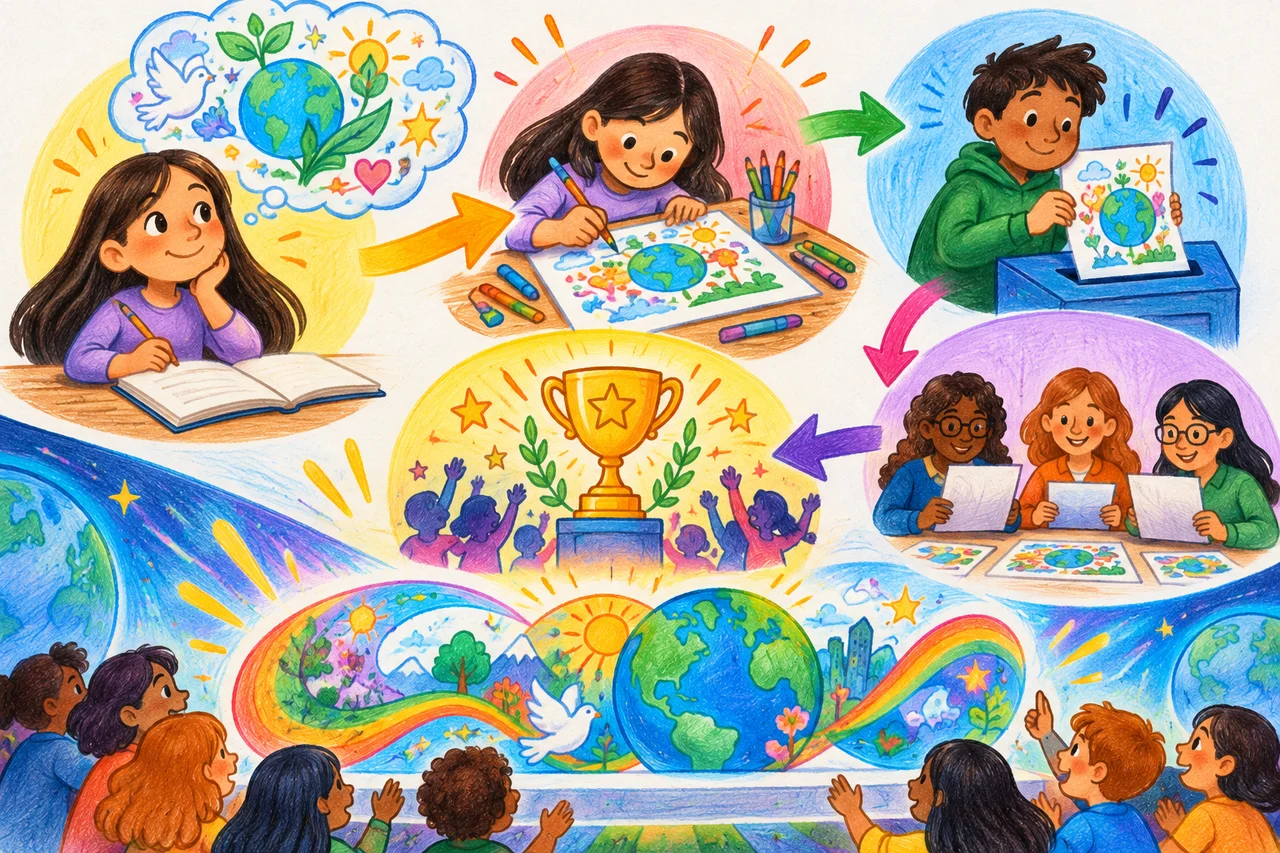
Doodle for Google is an annual art contest that gives K-12 students in the United States an opportunity to redesign the Google logo around a specific theme. Students create original artwork using the letters in “Google,” explain how their design relates to the theme, and submit their work for judging. Selected students can receive scholarships, technology awards for their schools, and the opportunity to have their artwork displayed on Google.com.
The contest is different from the regular Google Doodles created by Google’s professional artists and collaborators. Doodle for Google specifically focuses on student creativity, giving young artists a highly visible platform for sharing their ideas.
Here is how the contest works, what judges look for, who can participate, and what students should know before creating an entry.
What Is Doodle for Google?
Doodle for Google is Google’s student art competition. The U.S. contest is open to eligible students from kindergarten through 12th grade, with participants creating an original interpretation of an annual prompt.
The finished artwork must incorporate the letters G-o-o-g-l-e, but students have considerable creative freedom in how they transform those letters. A design might use traditional drawing and painting, digital illustration, collage, clay, found objects, or another visual medium.
According to Google, Doodle for Google has been held annually in the United States since 2008. The broader history of the competition goes back further, with Google identifying a 2005 UK Doodle competition as the beginning of Doodle for Google.
The contest connects to the much larger tradition of Google Doodles, the temporary versions of the Google logo that appear on the search homepage to recognize holidays, people, cultural events, scientific achievements, places, and other subjects.
How Doodle for Google Differs From a Regular Google Doodle
The names can be confusing because “Google Doodle” and “Doodle for Google” refer to related but different things.
| Feature | Google Doodle | Doodle for Google |
|---|---|---|
| What it is | A special version of Google’s homepage logo | A student art contest |
| Typical creators | Google’s Doodle team and guest artists | Eligible K-12 students |
| Main purpose | Celebrate people, events, culture, holidays, and other subjects | Encourage student creativity around an annual theme |
| Format | Can include illustrations, animations, games, videos, and interactive experiences | Student artwork submitted according to contest requirements |
| Competition involved | No | Yes |
| Can appear on Google.com? | Yes | Winning and selected contest artwork may be displayed on Google.com |
Google says its Doodle team includes artists known as “Doodlers,” along with designers, engineers, program managers, marketers, cultural consultants, and other collaborators. The company has produced more than 5,000 Doodles since the concept began.
Doodle for Google gives students a chance to participate in that creative tradition rather than simply viewing it.
Who Can Enter Doodle for Google?
Eligibility depends on the rules for the particular contest year, so students and parents should always check the current official rules before preparing an entry.
For the 2025-26 U.S. competition, Google stated that eligible entrants had to be K-12 students enrolled in a U.S.-based school or homeschool program, or an eligible school in Puerto Rico, U.S. territories and freely associated states, or the District of Columbia. Children of U.S. military personnel abroad could also participate under the year’s rules.
Google also required participating students to be U.S. citizens or permanent U.S. legal residents at the time of entry.
A parent, teacher, nonprofit organization, or after-school program may be able to submit an entry on a student’s behalf. When required, a parent or guardian must provide the appropriate permission or signature.
Group artwork is not accepted. Each entry must represent the original work of an individual student.
Because eligibility requirements can change between contest cycles, students should use the current official Doodle for Google rules rather than relying on requirements from a previous year.
How to Create a Doodle for Google Entry
A strong entry begins with the annual prompt rather than with decoration. Students should first decide what the theme means to them and then determine how that idea can become a visual story.
A practical process looks like this:
- Read the current theme carefully. Identify what the prompt is asking and brainstorm personal ideas that genuinely relate to it.
- Choose one clear concept. A focused idea is usually easier to communicate than several unrelated ideas squeezed into one image.
- Plan how G-o-o-g-l-e will appear. The letters should become part of the artwork rather than feeling like an afterthought.
- Sketch several possibilities. Experiment with composition, symbols, colors, characters, and letter shapes before producing the final artwork.
- Create the final Doodle. Follow the current contest’s rules for acceptable materials and formats.
- Write the accompanying description. Explain the idea behind the artwork and how it responds to the theme.
- Review the entry requirements. Confirm that the artwork, description, entry form, permissions, and submission format meet the current rules.
- Submit before the deadline. Use the submission method specified for that contest year.
Students should not assume that technically complex artwork automatically has an advantage. Google’s judging criteria also place substantial emphasis on originality and communication of the theme.
What Materials Can Students Use?
Doodle for Google allows considerable artistic flexibility.
For the 2025-26 contest, Google said students could use visual art materials such as pencils, crayons, paint, markers, chalk, charcoal, pastels, and oil pastels. Students could also work with materials such as clay, building blocks, paper, plants, rocks, and other found objects.
Digital artwork was permitted as well.
Three-dimensional creations could be entered by taking a clear photograph so the work could be reviewed in a two-dimensional format.
This flexibility means students can choose a medium that suits their idea and artistic abilities rather than trying to imitate the polished digital style of professional Google Doodles.
Can You Use AI for Doodle for Google?
Students need to be particularly careful about AI-generated artwork.
For the 2025-26 contest, Google’s official FAQ stated that using AI tools to create any part of the Doodle would disqualify the entry. Google allowed AI only for limited, teacher-guided brainstorming activities under its stated conditions. It could not be used to create the actual design.
The central requirement is that the submitted Doodle must be the student’s original work.
This distinction matters because using an AI image generator to produce a background, character, logo element, or other part of the final artwork could make an otherwise strong submission ineligible.
Students should check the rules for the current competition because technology-related policies can change.
How Are Doodle for Google Entries Judged?
Google evaluates entries using three main criteria: artistic merit, creativity, and theme communication.
| Judging area | What judges consider |
|---|---|
| Artistic merit | Skill and expressive qualities appropriate to the student’s age |
| Creativity | Imagination, originality, interpretation of the theme, and use of the Google letters |
| Theme communication | How effectively the artwork and written description communicate the contest theme |
These criteria reveal an important point: Doodle for Google is not simply a drawing-skills competition.
A technically polished image that barely relates to the prompt may not communicate as effectively as artwork built around a thoughtful, original concept. Likewise, an imaginative concept becomes stronger when the visual design and written description clearly support each other.
Students should therefore treat the description as part of the communication process rather than something to complete at the last minute.
What Makes a Strong Doodle for Google Entry?
There is no formula that guarantees selection, but the official judging criteria provide a useful framework for reviewing an entry.
Start with the theme. Someone seeing the artwork and reading its description should be able to understand why the student chose that particular idea.
Next, examine originality. Rather than beginning with “What would a Google Doodle normally look like?”, students can ask, “What can I say about this theme that comes specifically from my interests, family, community, imagination, or perspective?”
The Google letters should also feel integrated into the design. They can become objects, characters, scenery, patterns, or other visual components as long as the required letters remain incorporated into the Doodle.
Finally, the written explanation should clarify the meaning behind the artwork. It does not need to compensate for an unclear concept, but it can reveal details and connections that a viewer might otherwise miss.
What Can Doodle for Google Winners Receive?
Prizes vary by contest year and finalist level, so older articles can contain award amounts that are no longer accurate.
For example, Google announced that the 2025-26 U.S. national winner, Kameirah, received a $55,000 college scholarship and a $50,000 technology package for her school. Her winning Doodle was displayed on Google.com in June 2026.
The other finalists received recognition and scholarship awards as part of the competition.
Students researching a future contest should check that year’s official prize information rather than treating previous scholarship amounts as permanent.
The 2025-26 Doodle for Google Winner
The 2025-26 U.S. national winner was Kameirah, a 12th-grade student from Washington.
The year’s prompt was “My superpower is…”
Kameirah responded with an artwork titled “Hair Power: The Crown That Grows From Us.” Her concept focused on hair and its connection with family history, culture, identity, care, and resilience.
Google announced the winning Doodle after the finalist stage, which included public voting and final judging. The winning artwork appeared on Google.com on June 4, 2026.
The example illustrates how a contest theme can be interpreted through something deeply specific to the artist rather than through a literal superhero concept.
How Public Voting Fits Into the Contest
Doodle for Google involves multiple stages rather than choosing a national winner immediately from all submitted artwork.
Google’s judges evaluate eligible entries according to the contest criteria. Selected artwork progresses through the competition, and the public may then be invited to vote for finalists during the voting stage.
For the 2025-26 competition, Google presented five finalists from different grade groups before announcing the national winner.
Public voting does not eliminate the formal judging process. Google’s contest information states that judging and final deliberations remain part of selecting the winner.
Common Mistakes to Avoid When Preparing an Entry
A visually impressive Doodle can still run into problems if it does not follow the competition rules. Before submitting, students should watch for a few avoidable mistakes:
- Creating artwork that does not clearly address the annual theme.
- Forgetting to incorporate the letters in “Google.”
- Copying another artist’s concept or submitting work that is not original.
- Using AI-generated material when the current rules prohibit it.
- Treating the written description as unrelated to the artwork.
- Submitting group artwork when individual work is required.
- Using an unsupported file or submission format.
- Leaving required entry-form information incomplete.
- Working from an old contest’s deadline, eligibility rules, or prize amounts.
A final rules check can be as important as the artistic review. Requirements can change from one competition to another.
A Simple Planning Framework for Students
Students who are unsure where to begin can separate the creative process into four questions.
What does the theme mean to me?
Write down personal memories, interests, people, places, goals, challenges, or ideas connected with the prompt.
What single idea communicates that meaning best?
Choose a concept that can be understood visually rather than trying to include every brainstormed idea.
How can the Google letters become part of that idea?
Experiment with turning letters into objects or integrating them into the setting.
What does the viewer need to know that the picture cannot fully explain?
Use the written description to communicate that additional meaning.
This approach keeps the artwork, theme, Google logo, and written explanation connected from the beginning.
The History Behind Google Doodles
Google Doodles existed before the student competition.
Google traces the first Doodle to 1998, when founders Larry Page and Sergey Brin altered the company logo as a playful way of indicating that they were away at the Burning Man festival.
Doodles later became a much larger creative program. Google introduced its first international Doodle in 2000 for Bastille Day in France, while animation became part of Doodle storytelling with a Halloween Doodle later that year.
Today, hundreds of Doodles can launch around the world in a year, and different countries may see different artwork based on locally relevant events and subjects.
Many Doodles appear on the homepage for only 24 to 48 hours, but Google maintains an online archive where people can explore past designs.
Can You Submit an Idea for a Regular Google Doodle?
Yes, although proposing a regular Google Doodle is different from entering Doodle for Google.
Google accepts suggestions from members of the public for subjects that its Doodle team might consider. The company says it receives a large number of proposals, so submitting an idea does not mean it will become a Doodle.
Regular Doodle subjects are selected through Google’s internal planning and research process. The company says its team considers thousands of ideas and works with cultural consultants, local experts, guest artists, family members, and subject specialists where appropriate.
Doodle for Google, by comparison, follows a formal student competition process with eligibility requirements, an annual theme, judging criteria, and prizes.
Frequently Asked Questions About Doodle for Google
Is Doodle for Google free to enter?
Doodle for Google is presented as a student art contest rather than a paid competition. Families should use Google’s official contest website and current rules when entering instead of third-party websites claiming to handle submissions.
Does a Doodle have to be drawn by hand?
Not necessarily. Google has permitted multiple visual art media, including digital art. Three-dimensional artwork may also be photographed for submission when allowed by the current rules. Always verify the accepted formats for the specific contest year.
Does the artwork have to contain the word Google?
Yes. Google’s contest guidance requires students to incorporate the letters G-o-o-g-l-e into their Doodle, although students have creative freedom in how they design and transform those letters.
Can parents or teachers submit an entry?
Google has allowed parents, teachers, nonprofits, and after-school programs to submit entries on behalf of eligible students, subject to its consent and entry-form requirements. The artwork itself must be the individual student’s original creation.
Can two students create one Doodle together?
No. Google’s contest FAQ states that group entries are not accepted. Each Doodle must be created individually by the student entering the competition.
Where can I see old Doodle for Google winners?
Past contest artwork and regular Google Doodles can be explored through Google’s official Doodle website and searchable Doodle archive. The archive also lets visitors explore Doodles by date, topic, format, style, and other characteristics.
Conclusion
Doodle for Google gives K-12 students a chance to turn an annual theme into original artwork built around the familiar Google logo. Strong entries combine artistic expression with originality, clear communication, and thoughtful use of the letters in “Google.”
The most useful starting point is not trying to predict what judges will like. Students should understand the current prompt, develop a personal interpretation, connect the artwork and written description, and then verify every submission requirement before entering.
Eligibility rules, deadlines, technology policies, and prizes can change between competitions, so the current official Doodle for Google website should be the final reference before submitting an entry.
For anyone interested in the broader history and archive, Google Doodles provides past Doodles, interactive creations, and information about how Google’s Doodle team develops them.
For more helpful guides please visit RoyalSprinter.
